
Process Capacity Sheet
Personalize This
Get insights for your role
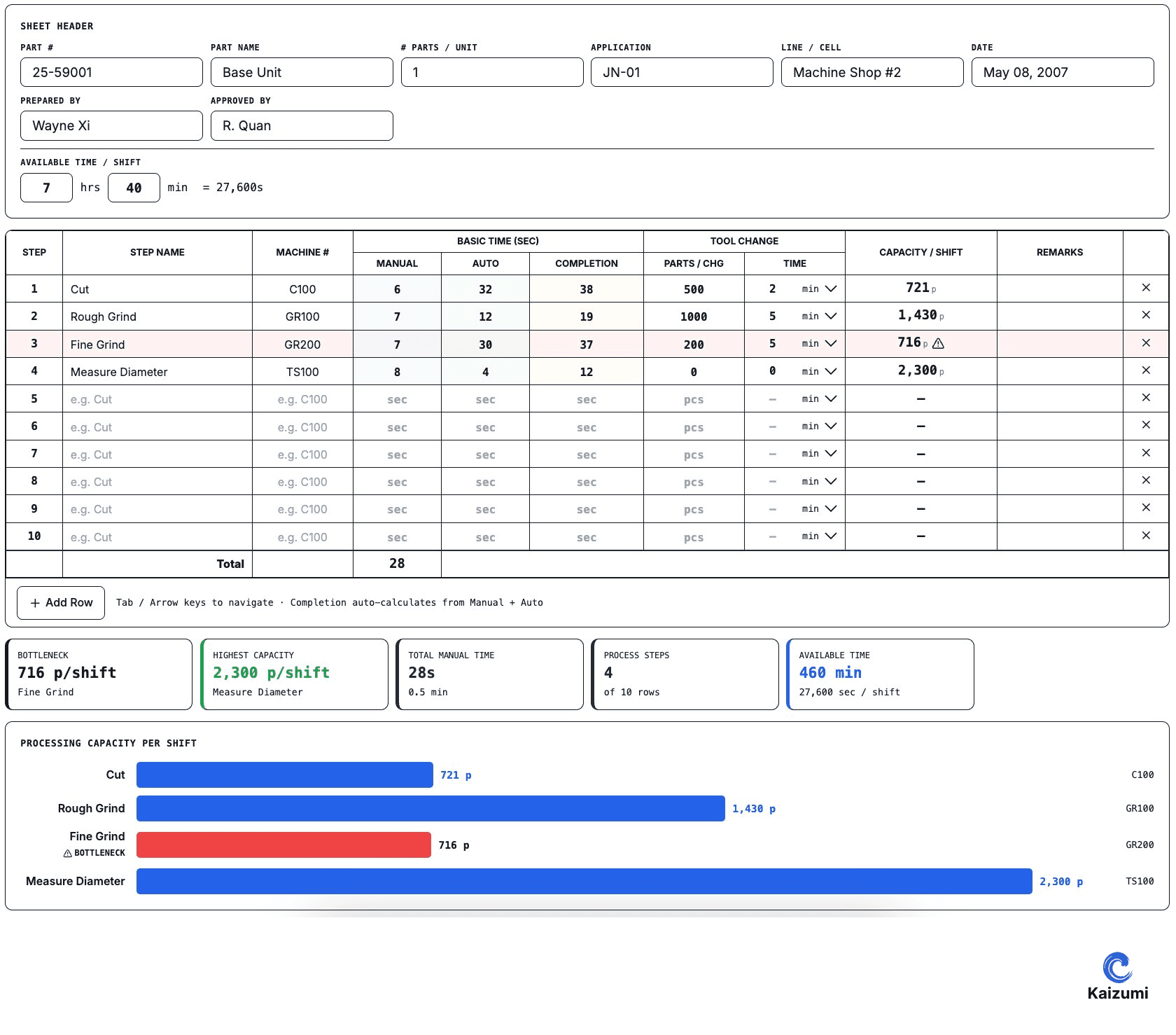
A Process Capacity Sheet (PCS) calculates the capacity of each machine in a sequence to identify bottlenecks and support line balancing.
Definition
The Process Capacity Sheet (PCS) is one of the three core standardized work documents in the Toyota Production System, often called Form 1. It calculates how many units each machine or process can produce in a given period by combining manual work time, automatic machine cycle time, and the time lost to tool changes. By comparing each machine's capacity to takt time and to the capacity of adjacent processes, the PCS exposes the bottleneck in a production line and quantifies how much capacity slack exists upstream and downstream. It is the analytical foundation that precedes the Standardized Work Combination Table and the Standardized Work Chart.
Examples
A machine shop used a PCS to document capacity across a six-step machining line. The sheet revealed that the CNC lathe could produce 420 parts per shift while the downstream grinder was capped at 310 parts per shift. With takt time requiring 380 parts, the grinder was the bottleneck. The team applied SMED to the grinder's changeover, raising its capacity to 410 parts and pulling the line above takt.
Key Points
- Combines manual time, auto time, and tool change time into capacity per shift or per hour
- Capacity-to-takt comparison identifies which process is the bottleneck
- Must be completed before building standardized work — it sets the capacity envelope
- Tool change time is frequently overlooked but often the largest hidden capacity loss
Common Misconceptions
PCS is just a spreadsheet of machine speeds. The PCS combines multiple time categories — manual, auto, and tool-change — to produce a realistic capacity figure rather than a theoretical one. A machine that cycles in 12 seconds but changes tools every 30 minutes has very different capacity than the raw cycle time suggests.
PCS is only useful in fully automated environments. The PCS applies to any process with repeating cycles and periodic interruptions. Manual assembly, service processes, and administrative work all benefit from the same capacity-versus-takt logic.
Try It
Build your own Process Capacity Sheet right here. Calculate machine capacity per shift, identify bottleneck processes, and document tool change impacts. (Also available as a standalone tool.)
See Also
- Standard Work — The umbrella concept the PCS supports
- Takt Time — What capacity is measured against
- Bottleneck Analysis — What the PCS reveals
- Time Observation Sheet — The observation method that feeds the PCS