
Trade-Off Curves
Personalize This
Get insights for your role
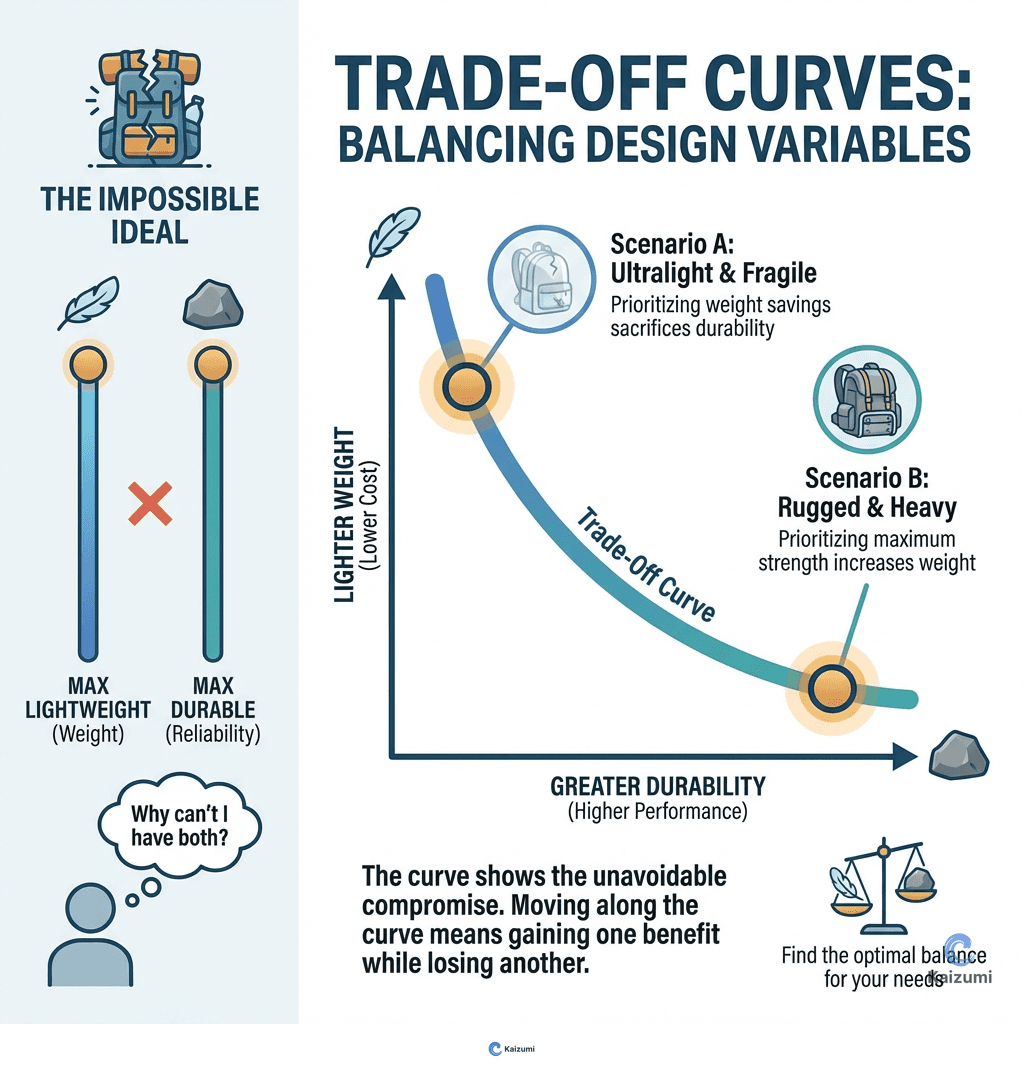
Trade-off curves document the relationships between design parameters, showing how improving one attribute affects others.
Definition
Trade-off curves are graphical representations of the relationships between design parameters, showing how improving one attribute affects others. For example, a trade-off curve might show how battery weight affects vehicle range, or how wall thickness affects both part strength and material cost. These curves capture engineering knowledge in reusable form, enabling set-based concurrent engineering by showing which design spaces are feasible and where the optimal balance lies. Trade-off curves prevent reinventing knowledge on each project and enable faster, better-informed decisions.
Examples
Toyota maintains trade-off curves showing the relationship between engine weight and fuel economy across different engine families. When developing a new vehicle, the chief engineer can immediately see what weight reduction is needed to achieve a fuel economy target, without starting analysis from scratch.
Key Points
- Capture engineering knowledge in reusable, visual form
- Enable set-based decisions by showing feasible design space
- Prevent repeating analysis for known relationships
- Must be maintained and updated as technology advances
Common Misconceptions
Trade-off curves are just engineering data. They're strategic assets that enable faster development. Organizations that capture and maintain trade-off knowledge outpace those that rediscover it each project.
Once created, trade-off curves are permanent. Technology changes shift the curves. Material advances, manufacturing improvements, and design innovations require updating trade-off knowledge.
See Also
- A3 Problem Solving - Tool for capturing trade-off analysis