
Work Element
Personalize This
Get insights for your role
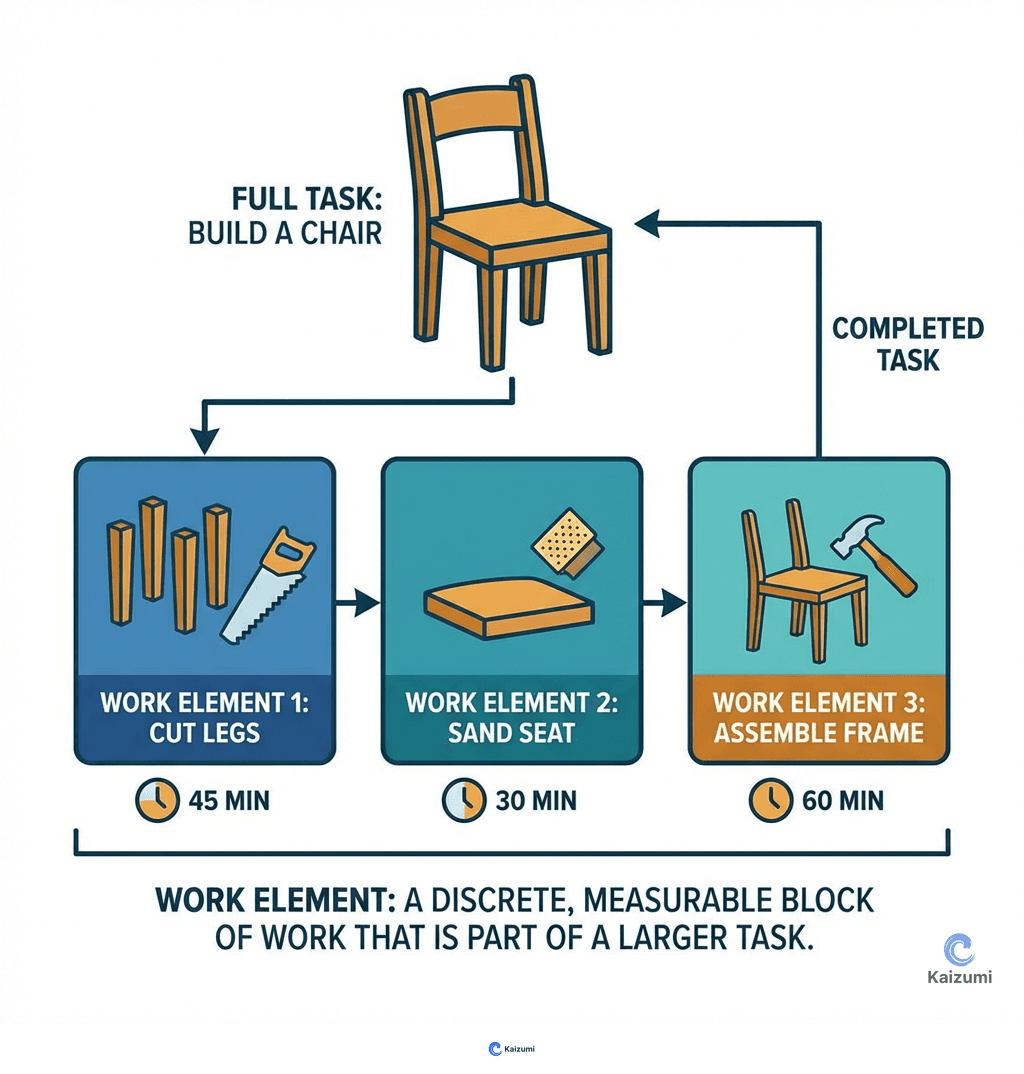
A work element is the smallest logical unit of work that can be timed, transferred, or reassigned in a process.
Definition
A work element is the smallest increment of work that can be independently timed and potentially reassigned to a different operator or station. Work elements are the building blocks of standard work—each element has a defined start point, end point, and repeatable sequence of motions. When balancing a production line, work is redistributed at the element level: elements are moved between stations until each station's total work content approaches takt time. Breaking work into elements makes inefficiencies visible and enables precise line balancing.
Examples
An assembly operation is broken into work elements: (1) pick up housing - 3 sec, (2) insert circuit board - 5 sec, (3) secure with 4 screws - 12 sec, (4) attach cover - 4 sec, (5) place in tote - 2 sec. Total: 26 seconds. When takt time changed, element 3 was split between two stations to rebalance the line.
Key Points
- Elements must have clear start and end points that can be observed
- Element times should be repeatable within reasonable variation
- Elements are the unit of analysis for line balancing and kaizen
- Breaking work too finely creates measurement overhead; too coarsely hides waste
Common Misconceptions
Smaller elements are always better. Elements that are too small (under 2-3 seconds) are hard to time accurately and create excessive documentation. The right granularity balances analysis precision with practical usability.
Work elements are fixed. Elements can and should be combined, split, or eliminated during kaizen. The current element breakdown reflects the current best method, not a permanent structure.