
ABC Production Analysis
Personalize This
Get insights for your role
ABC Production Analysis categorizes products by volume and frequency to determine the appropriate production strategy for each category.
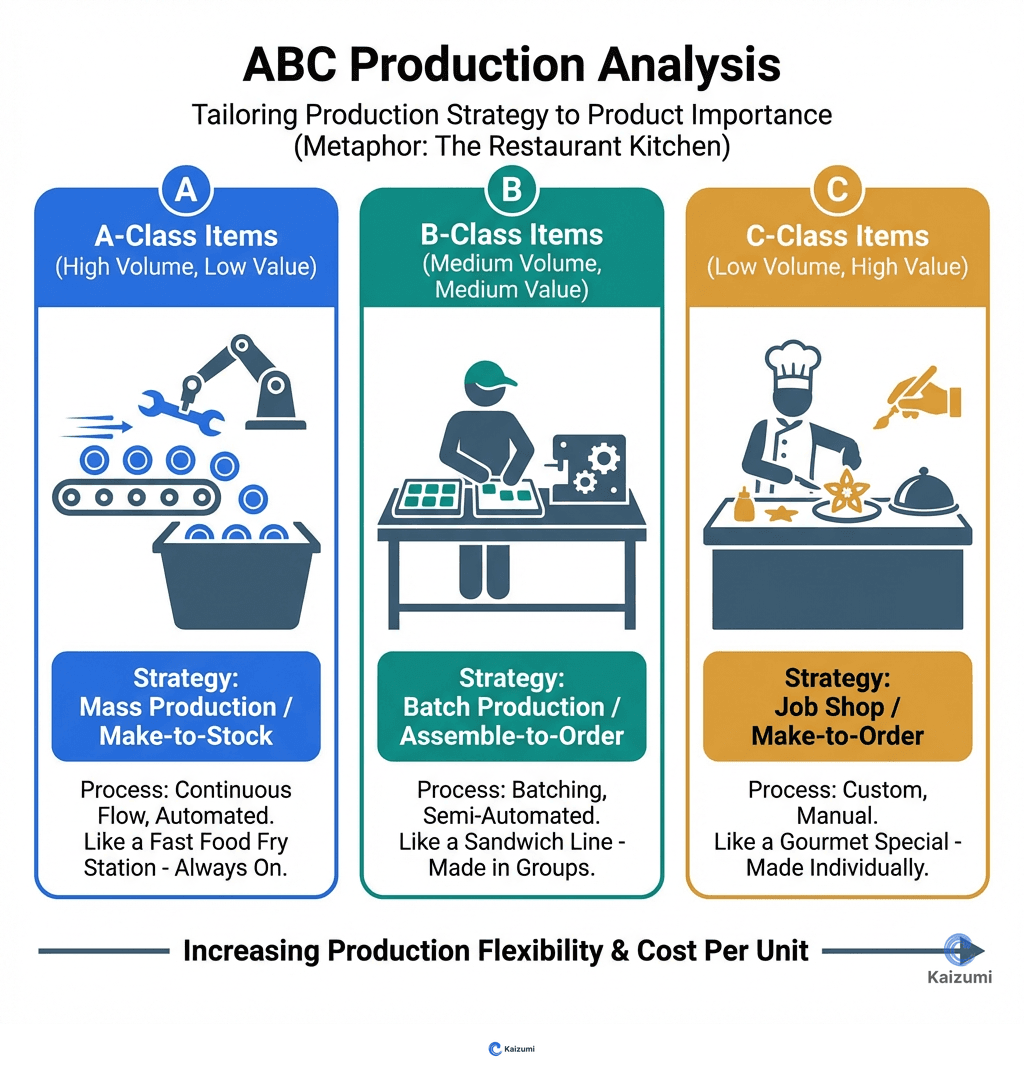
Definition
ABC Production Analysis categorizes products based on production volume and order frequency to determine the most appropriate flow strategy for each category. "A" items are high-volume, high-frequency products suited for continuous flow or make-to-stock. "B" items have moderate volume and frequency, appropriate for small-batch production or make-to-order with short lead times. "C" items are low-volume, infrequent products best handled as make-to-order with longer lead times. This analysis prevents the mistake of applying one production strategy to all products, which either creates excess inventory for slow movers or poor service for fast movers.
Examples
An electronics manufacturer analyzed 500 SKUs. The top 50 (A items) represented 80% of volume and ran daily. The next 150 (B items) represented 15% of volume and ran weekly. The remaining 300 (C items) represented 5% of volume and ran only to order. This insight led to dedicated A-item cells, flexible B-item areas, and a job-shop approach for C items.
Key Points
- Typically follows an 80/20 pattern: ~20% of products represent ~80% of volume
- Each category requires different inventory, scheduling, and flow strategies
- Products may shift categories as demand changes—review periodically
- Prevents over-investment in flexibility for A items or excess inventory for C items
Common Misconceptions
ABC analysis is only about inventory value. While traditional ABC analysis in inventory management focuses on dollar value, ABC production analysis focuses on volume and frequency to determine production strategy—different metrics for different purposes.
C items don't matter. C items often include new products, custom orders, or specialty items that serve strategic customers. They require attention to lead time and flexibility, not just cost minimization.