
Product Family
Personalize This
Get insights for your role
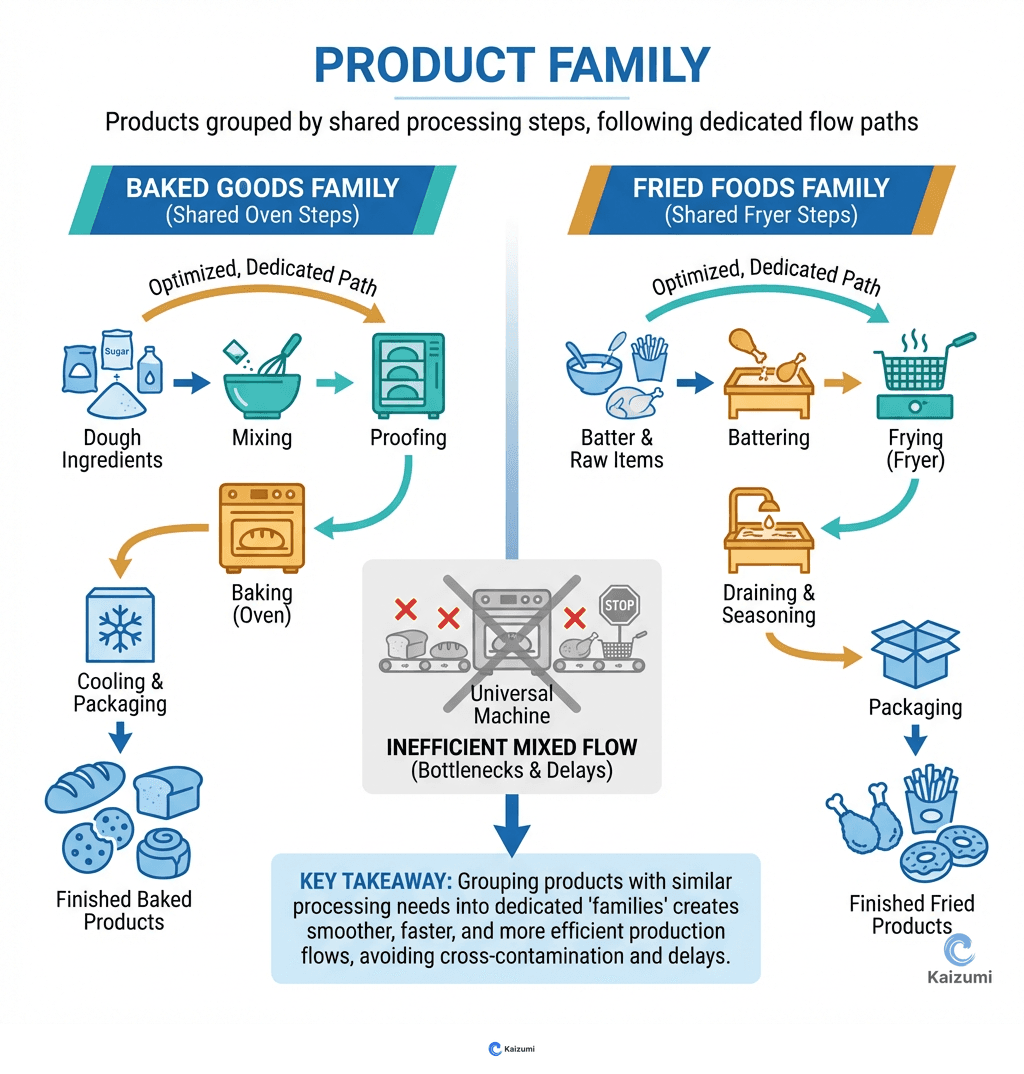
A product family is a group of products that share similar processing steps and equipment, enabling flow cell design and value stream focus.
Definition
A product family is a group of products that pass through similar processing steps and common equipment, making them suitable for a dedicated flow cell or value stream. Identifying product families is a crucial early step in lean transformation: products grouped into families can share a cell, a scheduling system, and a value-stream focus. The grouping criterion is process similarity (do they use the same operations in roughly the same sequence?), not customer segments or marketing categories. A product family matrix helps visualize which products share which processes.
Examples
A fastener manufacturer analyzed 200 products. Three product families emerged based on process similarity: (1) cold-headed bolts, (2) machined screws, (3) formed brackets. Each family could have a dedicated cell with its unique equipment sequence, even though all three served the same automotive customers.
Key Points
- Grouping based on process similarity, not market categories
- Enables dedicated cells, focused scheduling, and value-stream management
- Products in a family should share 60-80% of processing steps
- Product family analysis precedes cell design and value-stream mapping
Common Misconceptions
Product families are defined by customers. A customer might buy products from multiple families. Families are defined by process similarity, not customer relationship.
All products must fit into families. Some products are "orphans" that don't fit cleanly into any family. These may require separate handling or assignment to the closest family.
Try It
A value stream map covers one product family, never a whole operation. Once you have grouped items by process similarity, map the family you chose. The builder below lays out process steps, the inventory sitting between them, and the information flow that schedules each one, then sums lead time against processing time. If the grouping is right, every item in the family fits the same map. (Also available as a standalone tool.)
Frequently asked questions
```kz-qa q: How does a lean product family differ from a commercial product line? a: A commercial product line groups items by customer segments, branding, or marketing categories. In contrast, a lean product family groups products strictly by process similarity and shared equipment. Products sold to different markets belong to the same family if they pass through similar operations in roughly the same sequence. q: How much process overlap do products need to share a product family? a: Products in a product family should share 60-80% of their processing steps. They must follow common equipment paths in a similar order to work effectively within a shared cell or scheduling system. Items with lower overlap cannot efficiently share the same value-stream flow. q: What is a product family matrix? a: A product family matrix is a visual analysis tool that lists products against production processes and equipment. By displaying which products pass through which operations, it reveals natural clusters that share manufacturing steps. This matrix analysis is performed prior to cellular manufacturing design and value-stream mapping. q: What should be done with products that do not fit into a family? a: Not every product fits cleanly into a group; items that fall outside clear clusters are treated as orphans. These products can either be routed to separate handling processes or assigned to the closest existing family. Forcing mismatched items into a primary family disrupts flow cells and scheduling. q: Why can a value stream map cover only one product family? a: A value stream map tracks the specific sequence of processing steps, equipment, inventory, and scheduling for a single continuous flow. Because different product families take distinct operational paths, combining them onto one map produces conflicting information flows and inaccurate lead times. Every item covered on a map must share the same processing steps. ```
See Also
- Product Family Matrix - Tool for identifying families
- Cellular Manufacturing - Where product families are built