
Buffer Stock
Personalize This
Get insights for your role
Buffer stock is inventory held to protect against variability in production or demand, distinct from safety stock for supply variation.
Definition
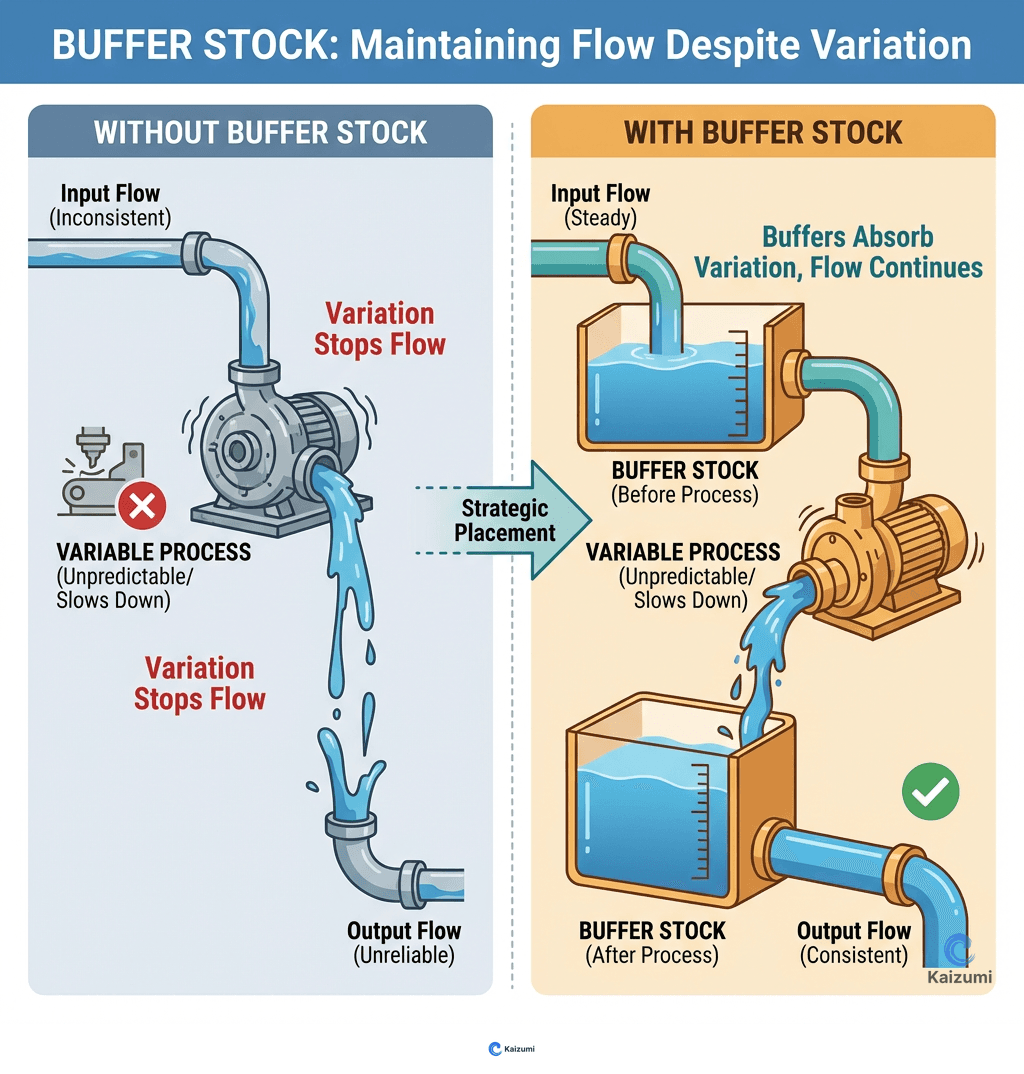
Buffer stock is inventory strategically placed to absorb variability in production processes or customer demand, enabling downstream operations to continue despite upstream disruptions. Unlike safety stock (which protects against supply variability), buffer stock protects against process variability—equipment breakdowns, quality issues, or demand fluctuations. In Theory of Constraints, buffer stock before constraints protects against starvation; in lean systems, buffer stock exists in supermarkets to absorb demand variation. Buffer stock is a necessary compromise when variability cannot yet be eliminated.
Examples
A machining center has 85% uptime due to periodic breakdowns. Buffer stock equivalent to 3 hours of production is maintained downstream, allowing assembly to continue during typical repair times. As machine reliability improves, buffer stock is reduced proportionally.
Key Points
- Sized based on variability magnitude and acceptable stock-out risk
- Should be systematically reduced as variability is eliminated
- Location matters—buffer should protect the point of highest impact
- Different from safety stock, which protects against supply variability
Common Misconceptions
Buffer stock is waste. Ideally yes, but it's necessary waste when variability exists. The goal is to reduce the need for buffer by improving stability, not to eliminate buffer while variability remains.
Bigger buffer is safer. Excess buffer hides problems and consumes resources. Buffer should be sized to variability—enough to protect, not more.
Try It
Buffer stock should be a number you set on purpose, not one that accumulates. In the calculator below, the safety factor is that deliberate number. Enter daily demand, replenishment lead time, and container quantity, then change the safety factor and watch max WIP and days of supply move with it. Seeing what each extra percent costs in inventory is what turns buffer reduction into a real target. (Also available as a standalone tool.)
Frequently asked questions
```kz-qa q: Where should buffer stock be placed within an operation? a: Buffer stock should be placed strategically downstream of unreliable operations or directly before constraints to prevent downstream starvation. In lean production systems, it is maintained in supermarkets to absorb sudden shifts in customer demand. Siting the inventory at the point of highest impact ensures downstream assembly continues without disruption during typical equipment repair times. q: How does buffer stock differ from safety stock? a: Buffer stock protects downstream operations from process variability, such as machine breakdowns, internal quality defects, or fluctuations in customer demand. Safety stock, by contrast, is specifically held to protect against external supply variability from vendors or transit delays. While both prevent work stoppages, buffer stock isolates operations from disruptions inside the production flow. q: What factors determine the size of a buffer stock? a: Buffer stock sizing depends on daily demand, replenishment lead time, container quantity, and an intentional safety factor. It is also calculated based on the magnitude of process variability—such as typical equipment repair durations—balanced against acceptable stock-out risk. As machine uptime and process stability improve, the buffer stock should be systematically reduced. q: Why is buffer stock considered a necessary compromise rather than pure waste? a: Buffer stock is non-value-adding inventory, but it serves as a critical defense against costlier shutdowns when process variability cannot yet be eliminated. Attempting to eliminate buffer stock while machine unreliability and demand swings persist causes frequent production starvation. The proper operational goal is to stabilize processes first, which naturally removes the need for the buffer. q: What is the operational risk of holding an oversized buffer stock? a: Holding excessive buffer stock consumes resources and hides underlying process and equipment defects instead of solving them. Extra inventory creates an illusion of safety while obscuring the true frequency of machine breakdowns and quality issues. Buffers must be sized strictly to cover known variability, never expanded into unmanaged stockpiles. ```
See Also
- Safety Stock - Protection against supply variation
- Supermarket - Controlled inventory point