
Elevate
Personalize This
Get insights for your role
Elevate is the fourth of TOC's Five Focusing Steps—investing to increase constraint capacity after exploitation is maximized.
Definition
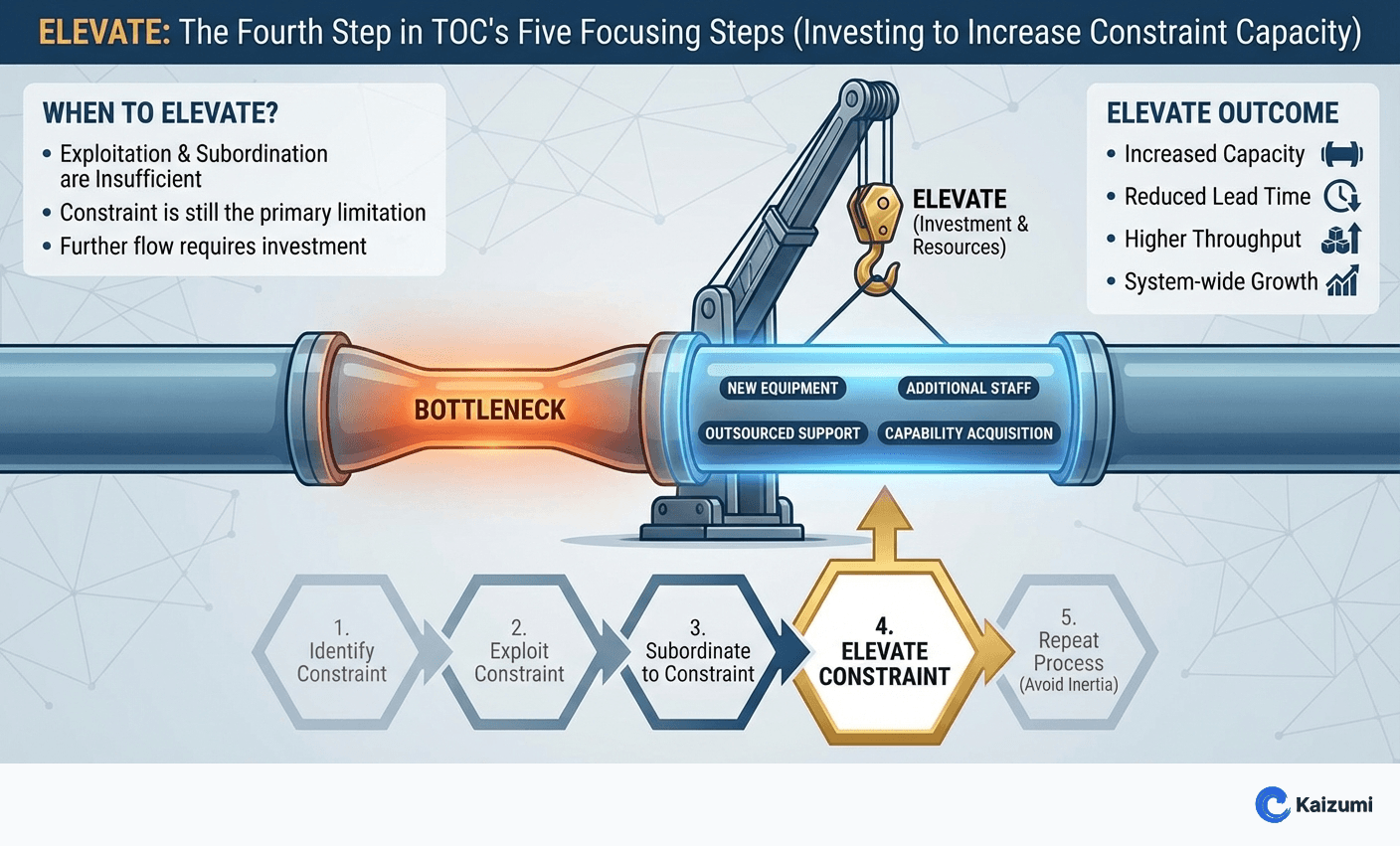
Elevate is the fourth step in TOC's Five Focusing Steps—investing to increase constraint capacity when exploitation and subordination are insufficient. Elevation involves spending money or resources: purchasing equipment, hiring staff, outsourcing constraint operations, or acquiring capability. The key insight is that elevation should only occur after exploitation (maximizing existing capacity) and subordination (aligning the system) are complete. Otherwise, investment is wasted on capacity that could have been freed through better management.
Examples
After exploiting the constraint (25% more output) and subordinating the system (stable buffers, aligned metrics), the team hit the limit of existing capacity. Elevation: purchased a second machine, doubling constraint capacity. But only after confirming no more free capacity was available.
Key Points
- Fourth of Five Focusing Steps—comes after Exploit and Subordinate
- Involves real investment: equipment, people, facilities, outsourcing
- Only appropriate after exploitation maximizes existing capacity
- Investment in non-constraint capacity is usually wasted
Common Misconceptions
Elevate is the primary solution for constraints. Elevation should be the last resort. Most organizations jump to buying more capacity without first exploiting existing resources. Exploitation often yields 20-50% more capacity at negligible cost.
Elevation permanently solves the constraint. Elevation may move the constraint elsewhere. Step 5 of the Five Focusing Steps warns: if the constraint moves, return to Step 1. Elevation is not the end—it's part of ongoing improvement.