
Value Stream
Personalize This
Get insights for your role
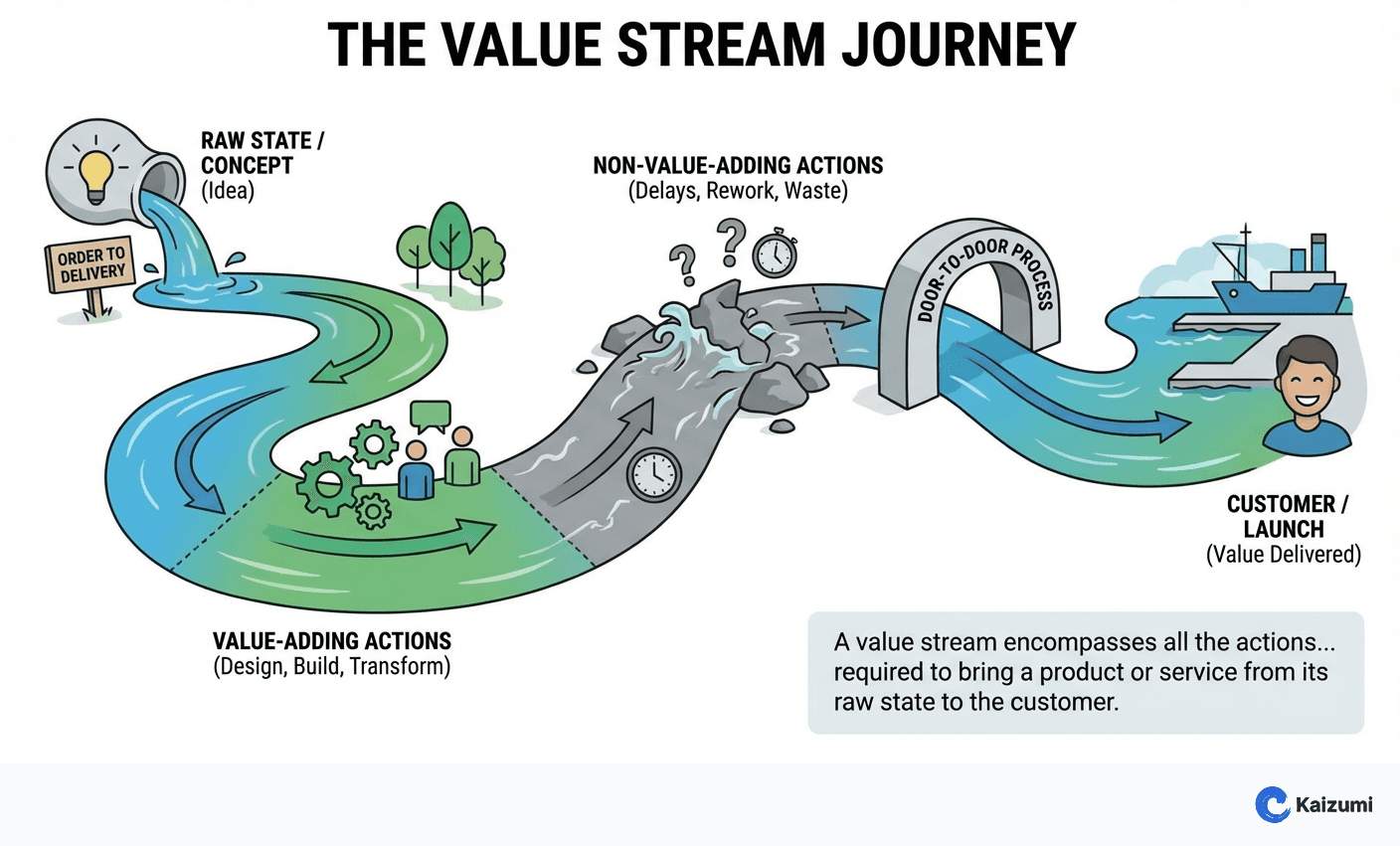
A value stream is the complete sequence of activities required to transform raw materials or information into a product or service delivered to the customer.
Definition
A value stream encompasses all the actions—both value-adding and non-value-adding—currently required to bring a product or service from its raw state to the customer. This includes the entire process from order to delivery (door-to-door) and often extends from concept to launch (for product development) or from raw material to end consumer (for supply chains). Viewing work as value streams rather than isolated departmental functions reveals the true end-to-end performance and exposes waste that's invisible when viewing individual steps.
Examples
The value stream for a hydraulic pump begins with steel bar stock and ends with a tested pump shipping to the customer. It includes machining, heat treatment, assembly, testing, and packaging—plus all the waiting, inspection, and transportation between steps. Mapping this value stream revealed that actual processing time was 45 minutes in a 6-week lead time.
Key Points
- Value streams cut across traditional organizational boundaries and departments
- End-to-end view reveals waste hidden in the gaps between departments
- Understanding the current state value stream is prerequisite to improvement
- Organizations often have multiple value streams for different product/service families
Common Misconceptions
Value streams are just process maps. Process maps show steps and flows; value stream maps include time (lead time, cycle time), inventory, information flow, and performance metrics. The analytical framework differs from simple process documentation.
Each department has its own value stream. Value streams are defined by customer outcomes, not organizational boundaries. A value stream flows through multiple departments, and understanding this cross-functional view is precisely the point.
Try It
Map your own value stream right here. Lay out material and information flow, expose the gap between lead time and processing time, and compare against industry examples. (Also available as a standalone tool.)
See Also
- Value Stream Mapping - Tool for analyzing value streams