
Multimachine Handling
Personalize This
Get insights for your role
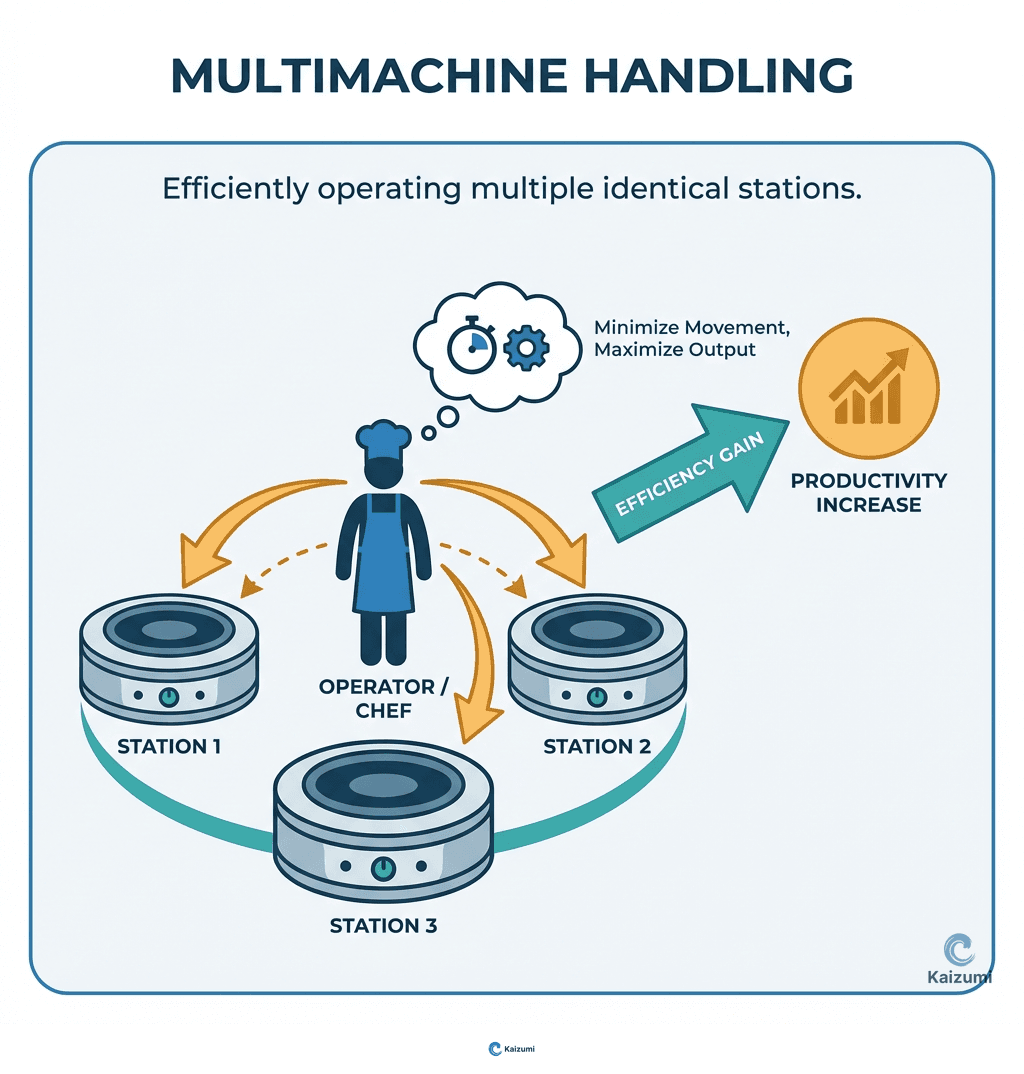
Multimachine handling is when one operator runs multiple machines of the same type, maximizing labor utilization during machine cycle times.
Definition
Multimachine handling is when one operator manages multiple machines of the same type, performing load/unload operations while machines run their automatic cycles. During the time Machine A is cycling, the operator loads/unloads Machine B, then Machine C, returning to Machine A when its cycle completes. This utilizes operator time that would otherwise be spent watching a machine cycle. Multimachine handling is distinct from multiprocess handling, where an operator runs different types of machines in sequence to produce a complete product.
Examples
An injection molding operator runs four machines producing the same part. Each machine has a 45-second cycle; the operator needs 10 seconds per machine for unload, inspect, and load. Walking time between machines is 5 seconds. The operator's circuit of 60 seconds matches the machines' cycles, achieving 4x the output of one-machine-per-operator with the same labor.
Key Points
- Requires machine cycle time longer than operator's load/unload time
- Layout must minimize walking distance between machines
- All machines must produce the same or similar products
- Creates standard work that can be documented and improved
Common Misconceptions
More machines per operator is always better. There's an optimum based on cycle times, walking distance, and variation. Too many machines means operators can't keep up and machines sit idle waiting.
Multimachine handling is the same as multiprocess handling. Multimachine = same machine type, typically same product. Multiprocess = different machine types in sequence, producing a complete product. Different concepts with different applications.