
Multiprocess Handling
Personalize This
Get insights for your role
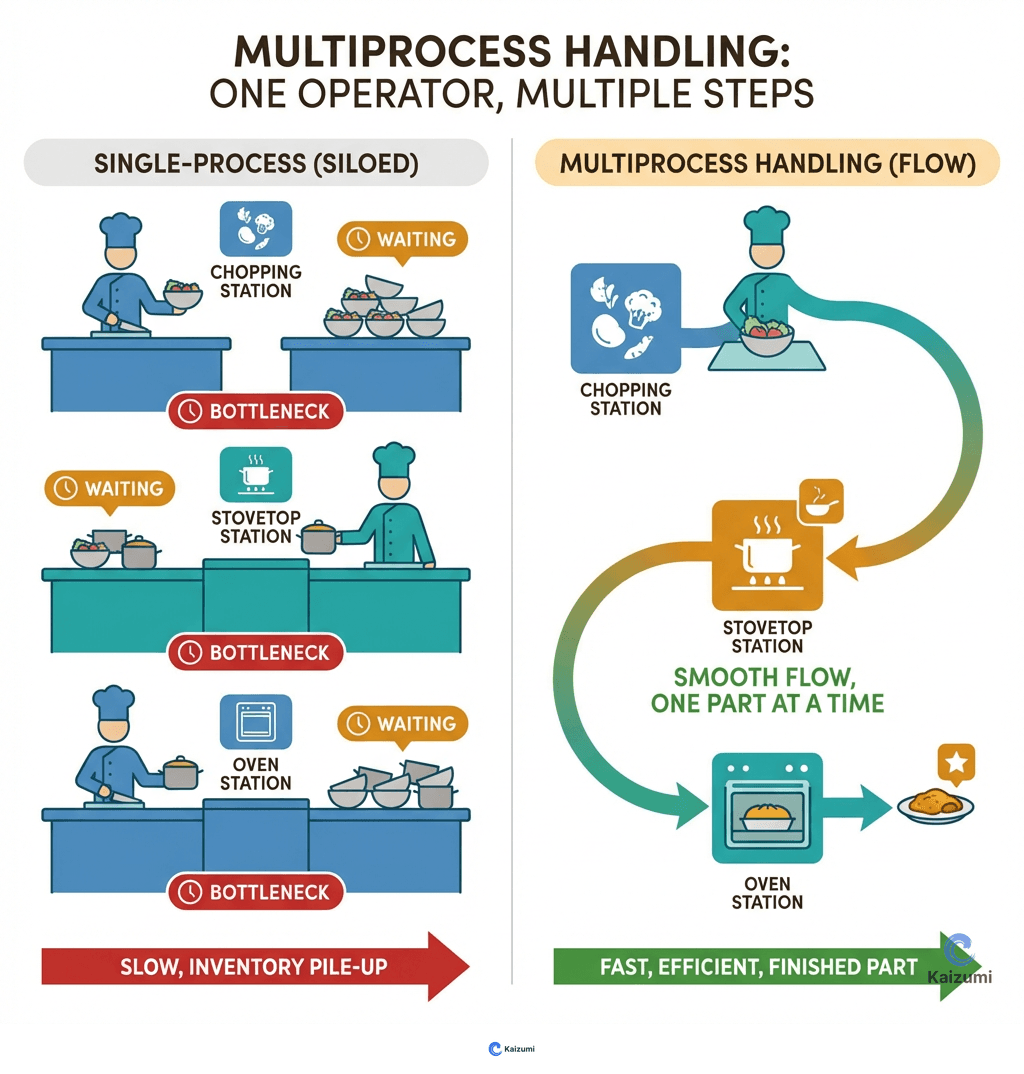
Multiprocess handling is when one operator runs different types of machines in sequence to complete a product through multiple operations.
Definition
Multiprocess handling is when one operator runs multiple different types of machines in sequence, taking a product through several operations to completion. Unlike multimachine handling (running multiple machines of the same type), multiprocess handling follows the product through its routing: load the lathe, move to the mill, then to the drill, creating a complete part. This is the foundation of cellular manufacturing—one operator can produce a complete product by walking through a U-shaped cell of different machines, maintaining one-piece flow throughout.
Examples
In a machining cell, one operator produces complete shafts by moving through five machines: saw (cut blank), lathe (turn OD), mill (cut keyway), drill (add holes), grinder (finish surfaces). The operator carries each piece through all operations, producing one complete shaft every takt time. Previously, five specialists in separate departments each ran one machine type.
Key Points
- Creates one-piece flow by following the product through its operations
- Requires cross-trained operators skilled in multiple machine types
- Cell layout must support logical flow and minimal walking
- Enables faster feedback on quality—defects discovered immediately downstream
Common Misconceptions
Specialists are always more efficient than generalists. Specialization creates waiting, handoffs, and disconnection from the final product. Multiprocess handling often achieves better total productivity with fewer people.
Multiprocess handling requires slow machines. It requires machines whose cycle times work together with operator walking and handling time. Fast or slow machines can work if the overall balance is achievable.