
Point-of-Use Storage
Personalize This
Get insights for your role
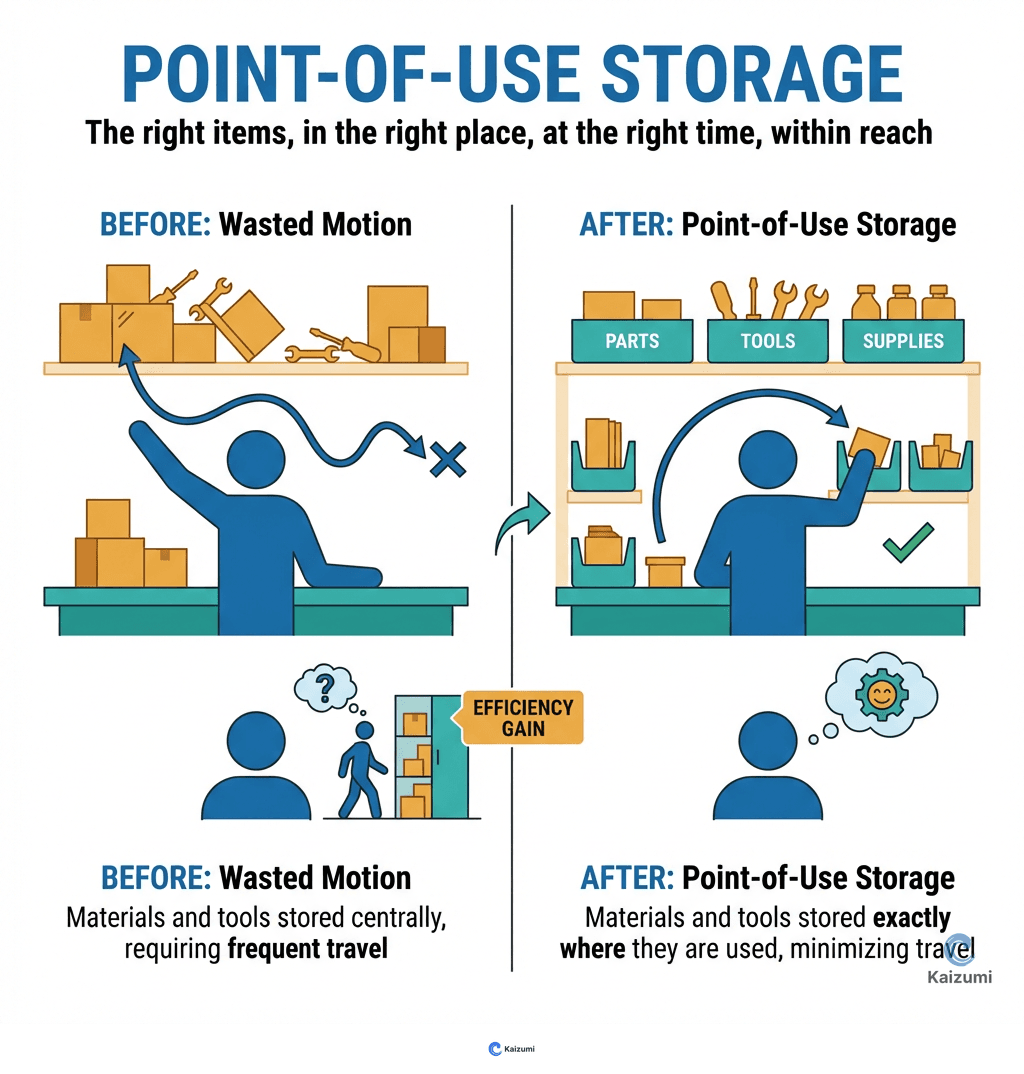
Point-of-use storage positions materials at the exact location where they will be used, eliminating retrieval time and motion waste.
Definition
Point-of-use storage (POUS) places materials exactly where they are used—at the workstation, within arm's reach of the operator, in the sequence they're needed. Rather than storing materials in a central warehouse or stockroom and retrieving them for each use, POUS brings inventory to the consumption point. This eliminates travel time, searching, and waiting for material delivery. Point-of-use storage requires small container sizes, frequent replenishment, and organized workstation layout—but dramatically reduces operator motion and enables faster flow.
Examples
An assembly station converted from retrieving parts from a stockroom 100 feet away to point-of-use storage with parts within 3 feet of the work position. Each part has a dedicated location, sized containers, and visual min/max indicators. Operator retrieval time dropped from 2 minutes to 5 seconds per assembly.
Key Points
- Eliminates motion waste of traveling to retrieve materials
- Requires small containers and frequent replenishment
- Part locations must be standardized and visually managed
- Replenishment responsibility typically shifts to material handlers (water spiders)
Common Misconceptions
Point-of-use creates excess inventory. Done correctly, POUS reduces total inventory because it uses small containers with frequent replenishment, not large buffers at each station.
Point-of-use works for all materials. Large, bulky, or rarely-used items may not fit at the workstation. The principle is to get as close to point of use as practical for each item.