
Water Spider
水すまし·mizusumashi·"water strider, whirligig beetle"
Personalize This
Get insights for your role
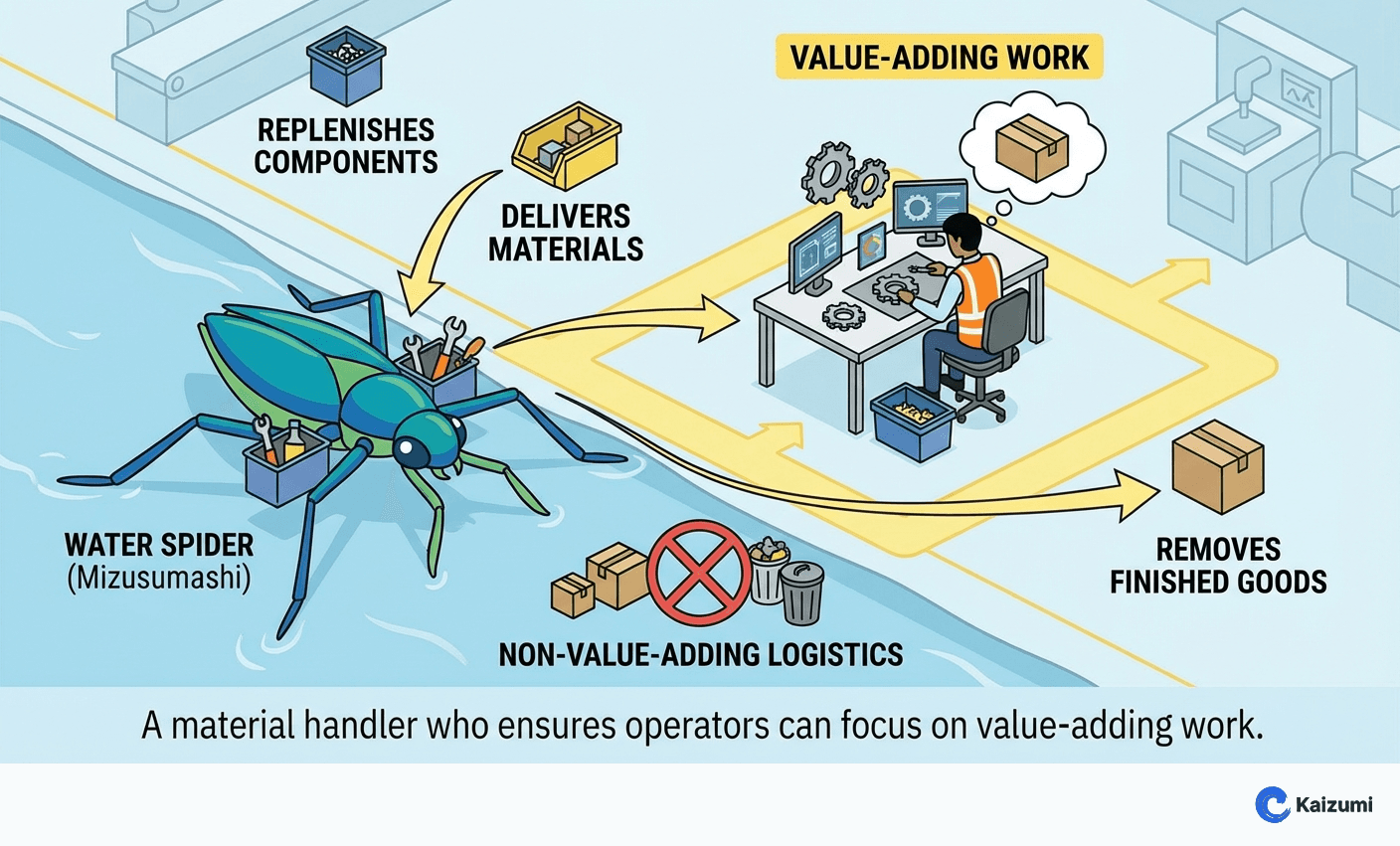
A water spider is a material handler who replenishes production areas, enabling operators to focus on value-adding work.
Definition
A water spider (mizusumashi in Japanese, named for an insect that skims across water surfaces) is a material handler who replenishes production areas, delivers components, removes finished goods, and handles non-value-adding logistics so that operators can focus on value-adding work. Rather than operators leaving their stations to get parts, the water spider brings materials on regular routes. The role requires understanding of kanban systems, production pace, and the ability to anticipate needs before shortages occur.
Examples
A water spider serves a cell of six operators. Following a five-minute route, she delivers components, removes finished goods, replenishes consumables, and collects kanban cards. Operators never leave their stations for materials; they focus entirely on assembly.
Key Points
- Water spiders separate material handling from value-adding work
- The role requires understanding of flow, kanban, and production needs
- Regular routes and timing enable reliable, predictable replenishment
- Water spiders often identify problems early by seeing the whole process
Common Misconceptions
Water spiders are just material handlers. Good water spiders understand the entire system—they anticipate needs, identify flow problems, and enable smooth production. The role requires more skill than simple material movement.
The water spider role is inefficient overhead. By freeing operators from material handling, water spiders often improve overall system efficiency. Operator time on value-adding work increases more than the water spider's time costs.