
Product Family Matrix
Personalize This
Get insights for your role
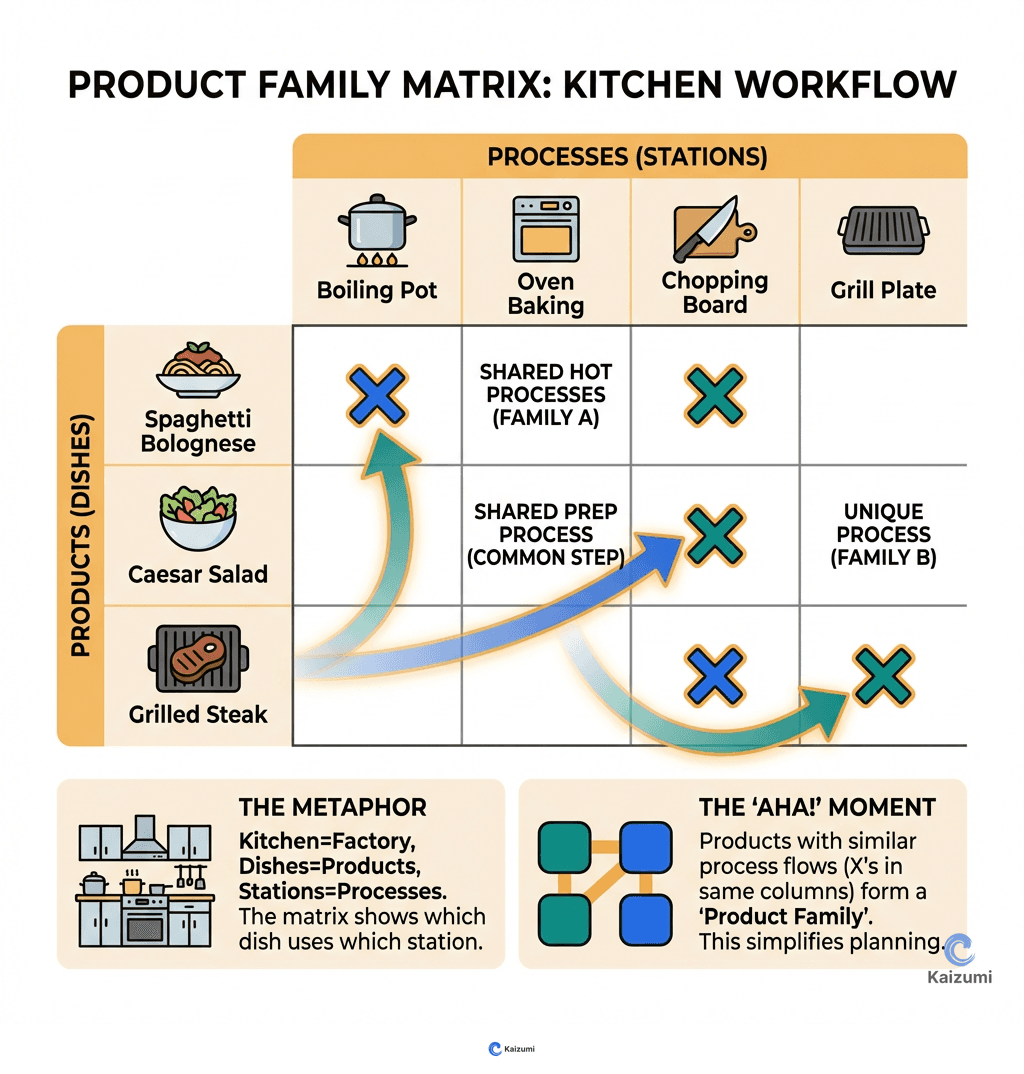
A product family matrix is a tool that maps products against processing steps to identify product families with similar routings.
Definition
A product family matrix is a visual tool that maps products (rows) against processing steps or equipment (columns), marking which products pass through which processes. Products with similar patterns—the same or overlapping columns marked—belong to the same product family. Creating this matrix is often the first step in value-stream analysis or cell design: before you can improve flow for a product family, you must identify which products constitute a family. The matrix makes grouping decisions visual and data-based rather than based on assumptions.
Examples
A machine shop listed 50 products down the rows and 12 machines across the columns. Marking each product's routing revealed three clear clusters: products using mostly lathes and mills, products using grinders and CNC, and products using stamping equipment. Three product families emerged from the pattern.
Key Points
- Products on rows, processes/equipment on columns
- Similar patterns indicate potential product families
- Sorting and clustering reveals families that may not be obvious
- Foundation for cell design and value-stream organization
Common Misconceptions
The matrix gives a definitive answer. The matrix shows patterns; judgment is still needed. Products with 70% overlap might be one family or two depending on the 30% difference.
Create the matrix once and you're done. Products change, equipment changes, volumes change. The matrix should be updated periodically to ensure product families still make sense.
Try It
The matrix ends by naming a family. Mapping that family is what you do next. Take the tightest cluster from your matrix and lay its routing out below as process steps, with real cycle times and the inventory that sits between them. The timeline at the bottom separates waiting from processing. Draw a second cluster and compare: if the two maps look nothing alike, the split was correct.
See Also
- Product Family - What the matrix identifies
- Cellular Manufacturing - How families are organized