
Takt Board
Personalize This
Get insights for your role
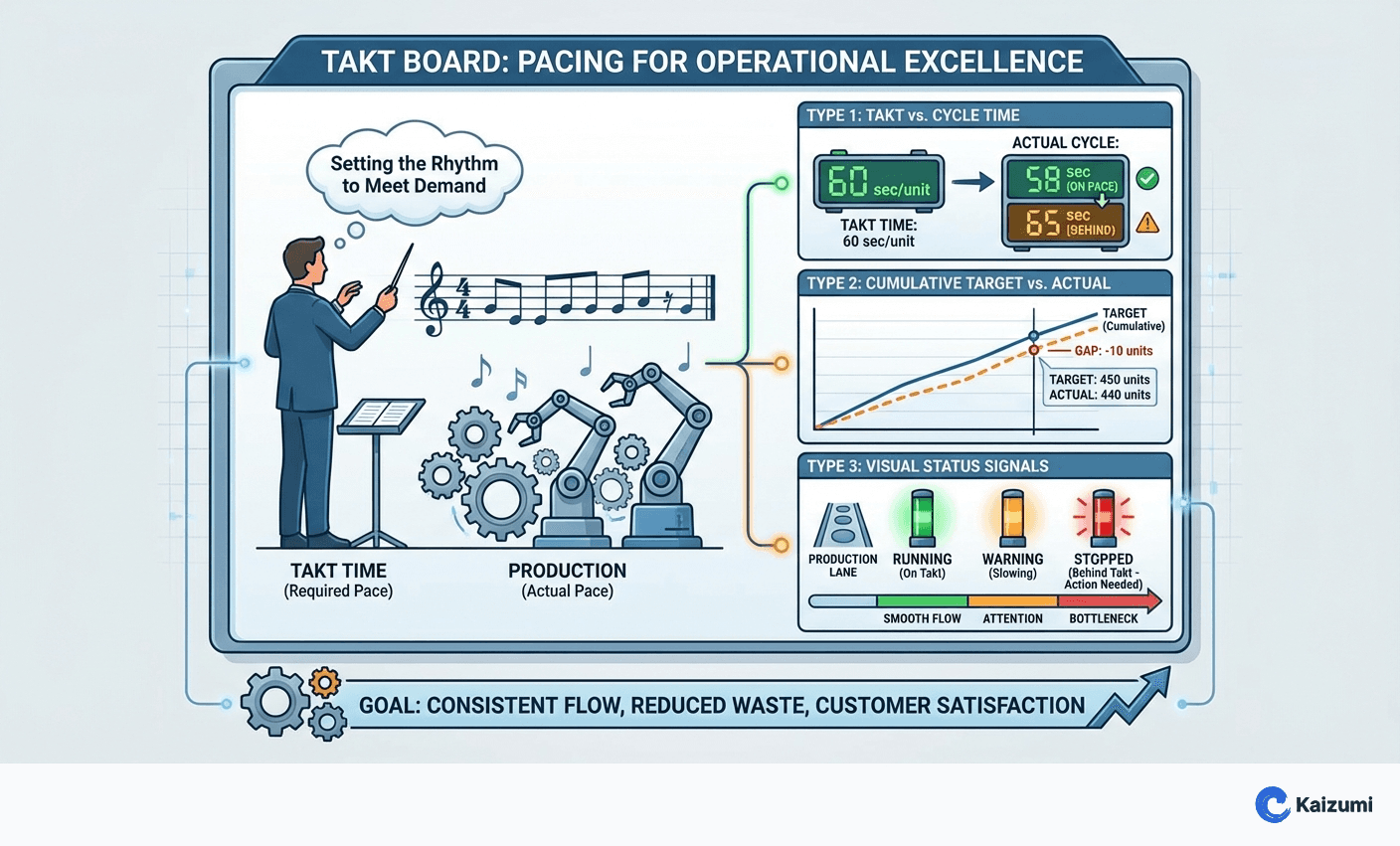
A takt board displays takt time and actual cycle time, showing whether production is keeping pace with customer demand.
Definition
A takt board displays takt time (the pace required to meet customer demand) and shows whether actual production is keeping pace. Displays vary: some show takt time and actual cycle time; others show cumulative target versus actual; some include visual signals (lights or colors) indicating status. The takt board makes the connection between work pace and customer demand visible. When production falls behind takt, it's immediately apparent, triggering response to recover or escalation if recovery isn't possible.
Examples
A takt board at an assembly line shows: Takt time 60 seconds, current cycle 58 seconds (green). When the cycle exceeds takt time, the display turns yellow; sustained overage turns red and triggers andon for support.
Key Points
- Takt boards connect work pace directly to customer demand
- Visual status (colors, lights) makes performance immediately obvious
- Triggers response when pace falls behind required rate
- Supports proactive management rather than reactive discovery
Common Misconceptions
Takt boards create pressure to rush. The purpose is visibility, not pressure. When behind takt, the question is "what support is needed?" not "work faster." Sustained gaps indicate systemic issues to solve.
Takt boards only work for assembly lines. Any operation with measurable output and time can use takt concepts. Service, healthcare, and administrative processes benefit from pace visibility.