
Target Cost
Personalize This
Get insights for your role
Target cost is a price-driven costing approach where the allowable product cost is determined by market price minus required profit margin.
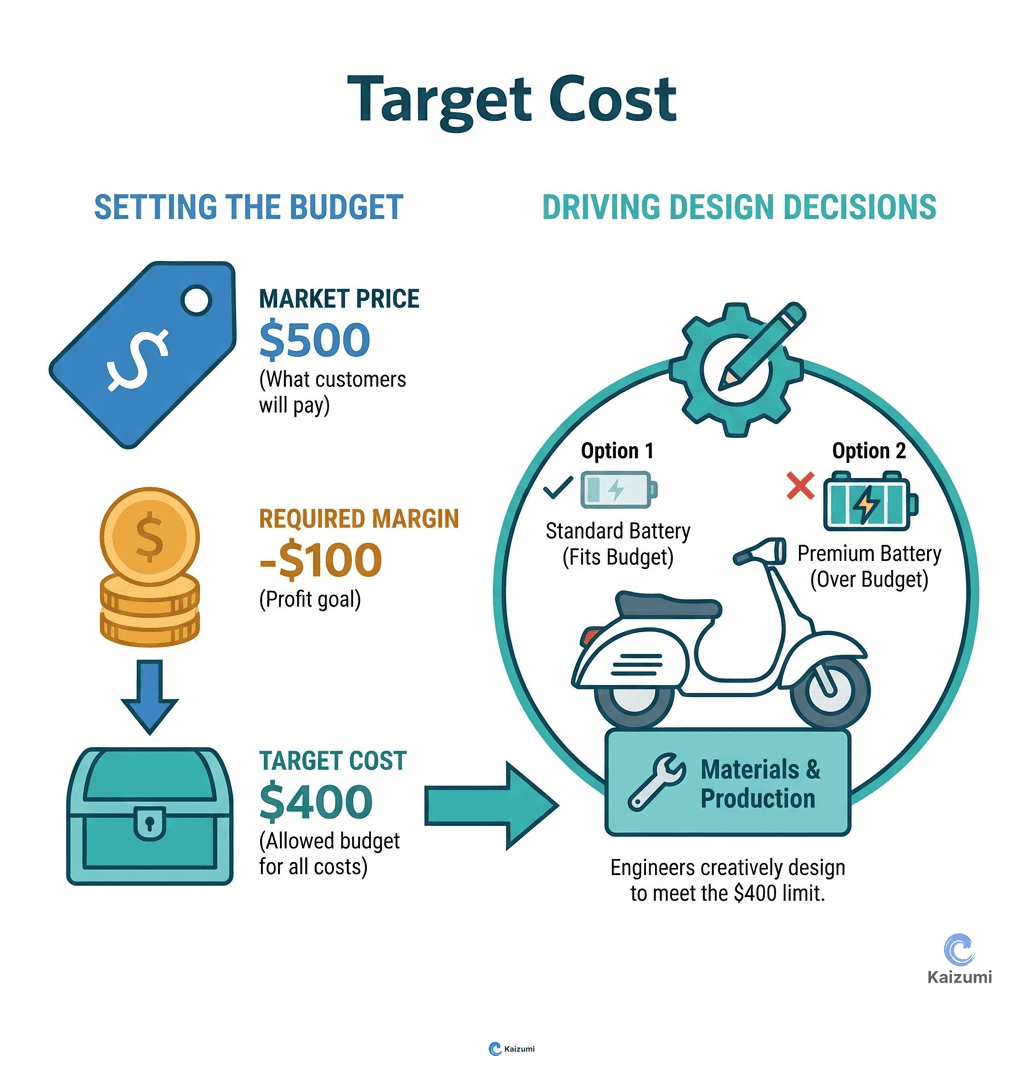
Definition
Target cost is a price-driven approach to product development costing where the allowable product cost is calculated from market price minus required profit margin, rather than the traditional approach of adding margin to calculated cost. If the market will pay $100 and the company needs 20% margin, the target cost is $80. The product must be designed and manufactured for $80 or less—costs above target mean redesigning the product, not raising the price or accepting lower margin. Target costing drives cost discipline into product development from the start, before designs are locked in.
Examples
Key Points
- Market price determines target, not internal cost buildup
- Drives cost discipline into early product development
- Forces creative problem-solving when initial designs exceed targets
- Prevents the "cost-plus" mentality that accepts whatever costs emerge
Common Misconceptions
Target cost means cutting quality. Target costing drives value engineering—finding ways to deliver function at lower cost. Cutting quality to meet targets defeats the purpose.
Targets can be set without market understanding. Target cost requires deep understanding of what customers will pay. Arbitrary targets disconnected from market reality lead to either unrealistic projects or uncompetitive prices.