
What strategy deployment is
Strategy deployment, or hoshin kanri (方針管理), is a way to run a plant’s few most important changes. Leadership picks three to five breakthrough objectives for the next three to five years. Each level of the plant turns its share into its own targets through catchball (キャッチボール), a back-and-forth in which the level below says what it can do and what it needs. Every month the owners review progress and fix what is off track.
It sits on top of daily management. Daily boards keep today’s work at standard. Strategy deployment changes the standard. When a breakthrough target is reached, the new level moves to the daily boards and the plan makes room for the next objective.
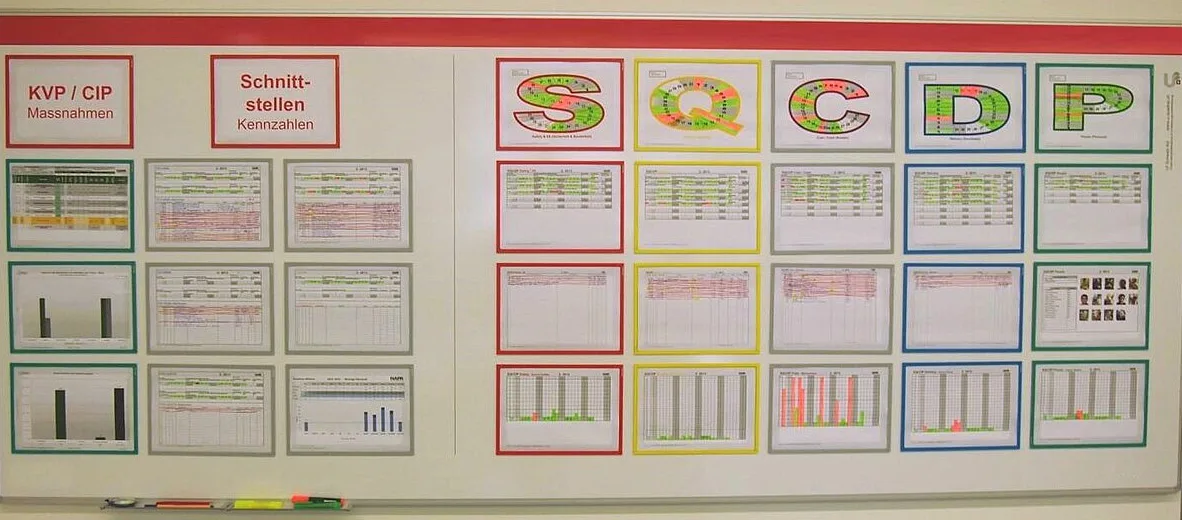
Most plant plans fail the same way
Most plants already have goals. The trouble is what happens to them after the planning meeting.
- The plan holds 20 or 30 goals, so none of them gets real effort.
- Targets come down the organization chart and nobody below is asked whether they can be met.
- Each goal has a number but no plan for how to reach it.
- Goals that cross departments have no single owner.
- Progress is checked once a year, when it is too late to change course.
Strategy deployment answers each of these. It keeps the list short, asks the people who will do the work, names one owner per target and checks every month.
How to run your first cycle
- 1Set three to five breakthrough objectives
About three months before the year starts, the leadership team picks the few changes the plant needs in the next three to five years and cannot reach through daily improvement. Each one gets a number, a date and one owner.
- 2Pick this year’s target for each
Each objective gets one target for the coming year. Keep the list short. Write down what you will stop doing to make room for it.
- 3Run catchball down and up
Each leader takes a target to the level below and asks how they would reach it. The team replies with what it found, what it can commit to and what it needs. Departments agree what they need from each other. Expect two or three rounds over six to eight weeks. The plan is done when each owner says they can deliver it.
- 4Set improvement priorities with owners and metrics
Each department turns its share into a few priorities. Every priority gets one owner, one metric, a baseline, a year-end target and a target for each month. Put each level’s plan on one page.
- 5Review every month on a bowling chart
A bowling chart has one row per metric and one column per month, with the target and the actual in each cell. Owners spend the meeting on misses. A miss gets a reason. Two misses in a row get an A3 with a countermeasure. Change the method, not the target.
- 6Reflect at the end of the year
In the last two months, each owner writes what was reached, what was missed and why, and what went wrong in the planning itself. Reached targets move to daily management. Missed ones carry over or are dropped by decision. This reflection (反省, hansei) is the first input to next year’s plan.
A worked example: one plant’s first year
The plant below is made up. It has 300 people who machine and assemble hydraulic valves. Its numbers are typical of a first year.
Leadership set three objectives for 2027 to 2029, each with one owner and one target for 2027.
After catchball, the departments agreed on five priorities for the year. Each has one owner and one metric. The last column shows which objectives it serves.
● strong link, ○ some link. The letters match the objectives above. An X-matrix shows the same links on one sheet.
Follow objective B down the plant. On-time delivery depends on small batches, and small batches depend on short changeovers. So the machining department carries a changeover target, and the cell 2 team carries its own share of it.
The changeover target did not start at 30 minutes. It came out of catchball.
- DownPlant to machining: we need 92% on time. Can cell 2 changeovers drop to 20 minutes, so you can run smaller batches?
- UpMachining to plant: 20 minutes needs a quick-clamp fixture we can’t fund this year. We can reach 30 with standard work and tools staged before the stop. We need two kaizen weeks from maintenance.
- AcrossMachining to planning: shorter changeovers only help if the schedule stays frozen five days out.
- DownMachining to the cell 2 team: help us get from 90 to 30 minutes.
- UpCell 2 team to machining: half the time goes to finding tools and waiting for the first-piece check. A tool cart gets us to 45 by June. Getting to 30 needs an inspector at the cell within 10 minutes.
- Agreed30 minutes by December and 45 by June. Quality commits to first-piece checks within 10 minutes. Planning freezes five days. The fixture goes into next year’s budget request.
Each month the plant reviews its bowling chart. Here are the first six months for four of its metrics.
Delivery missed in February and March, so the operations manager wrote an A3. It traced the misses to a casting supplier shipping late. Purchasing added that supplier to its monthly reviews, and by April delivery was back on target.
Customer defects missed in April and May. The quality manager’s A3 traced most of the escapes to a valve model launched in March without error-proofing for its seal. A fixture that will not close without the seal in place brought June back under target.
OEE missed three months running. The engineering manager’s A3 found that the weekly two-hour maintenance window was skipped whenever the cells fell behind. The plant manager protected the window, and June beat the target.
Common mistakes
- Too many objectives
If everything is a priority, the monthly review becomes a reading of 40 numbers. Keep three to five at the top and one to three per team.
- Cascading without catchball
Targets handed down get met on paper or not at all. The reply from below is where the real limits show up.
- Metrics without owners
A metric shared by three departments belongs to none of them. Name one person and list who supports them.
- Reviews that only report
If a missed month gets a comment and no countermeasure, the meeting is a status update. Ask for the A3.
- Treating it as OKRs or a budget
A budget sets what you spend. OKRs are usually set team by team each quarter and graded at the end. Strategy deployment picks a few objectives for the whole plant, agrees how to reach them and corrects course every month.
- Using it to run daily work
Keeping the line at standard belongs on the daily boards. Strategy deployment is for the few changes daily management cannot make.
Free tools for the work
Write each priority’s plan and every countermeasure on the free A3 tool, coach owners through their next steps with the kata storyboard, and put the monthly review on your calendar with leader standard work.