
Demand Amplification
Personalize This
Get insights for your role
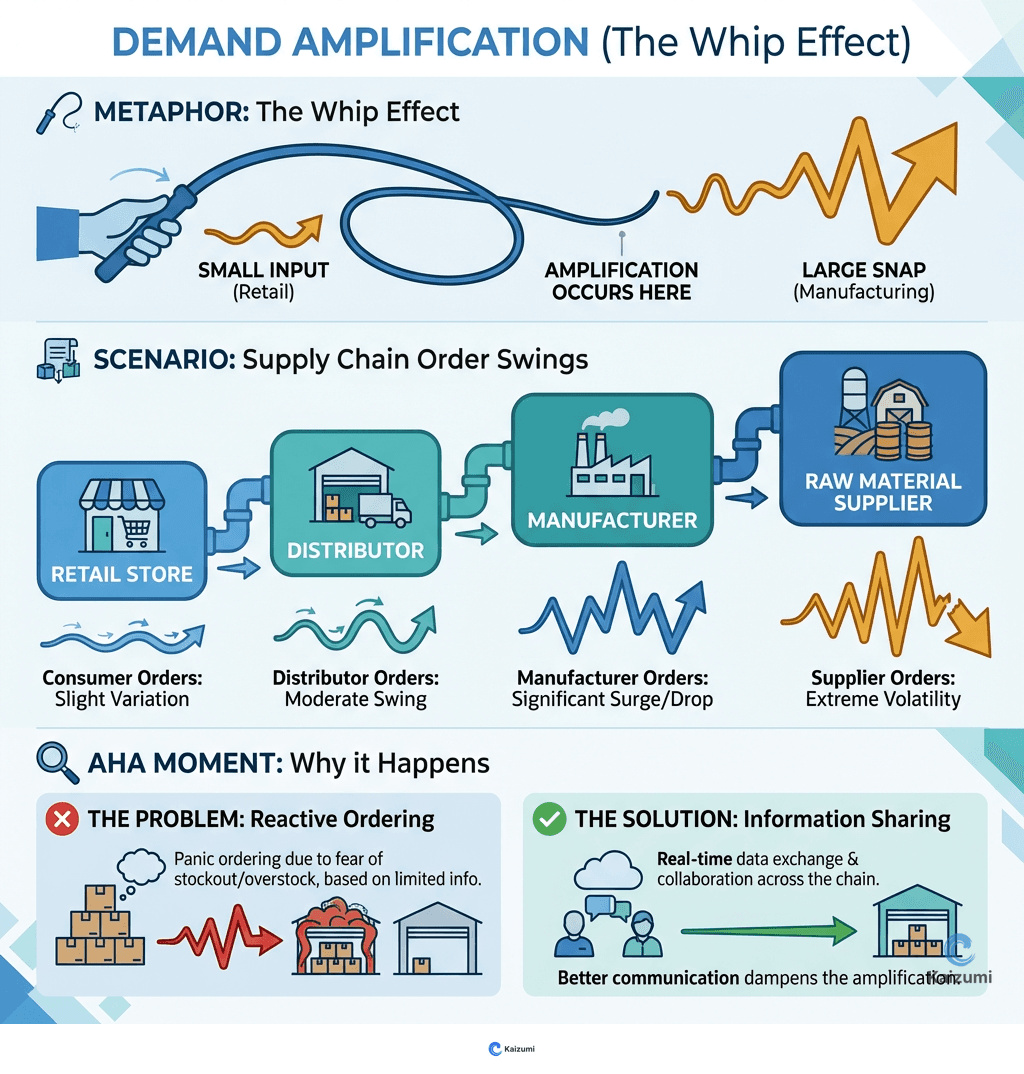
Demand amplification (bullwhip effect) is the increasing variability of orders as they move upstream through a supply chain.
Definition
Demand amplification (also called the bullwhip effect) is the phenomenon where small variations in customer demand create increasingly larger variations as orders propagate upstream through the supply chain. A retailer sees 10% demand variation; they order with 20% variation; the distributor orders from the manufacturer with 40% variation; the manufacturer orders materials with 80% variation. Each level adds safety margin, batches orders, and reacts to perceived patterns—amplifying the signal. The result is massive inefficiency: upstream suppliers swing between overtime and idle time while holding excessive inventory.
Examples
An automotive OEM's daily build variation of ±5% becomes ±30% at Tier 1 suppliers and ±60% at Tier 2 suppliers. Each tier adds buffer and batches orders. Raw material suppliers see order patterns unrelated to actual vehicle sales.
Key Points
- Amplification increases with each supply chain level
- Caused by batching, forecasting errors, ordering policies, and safety stock decisions
- Reduces dramatically with shorter lead times and smaller batches
- Pull systems and information sharing help dampen amplification
Common Misconceptions
Demand amplification is caused by customers. Customer demand is typically relatively stable. Amplification is created by ordering policies, batching, and forecasting errors at each supply chain level.
Better forecasting solves the problem. Forecasting accuracy helps, but the structural causes (batching, lead times, safety stock policies) persist even with perfect forecasts. System design matters more than forecast accuracy.