
Inventory Turns
Personalize This
Get insights for your role
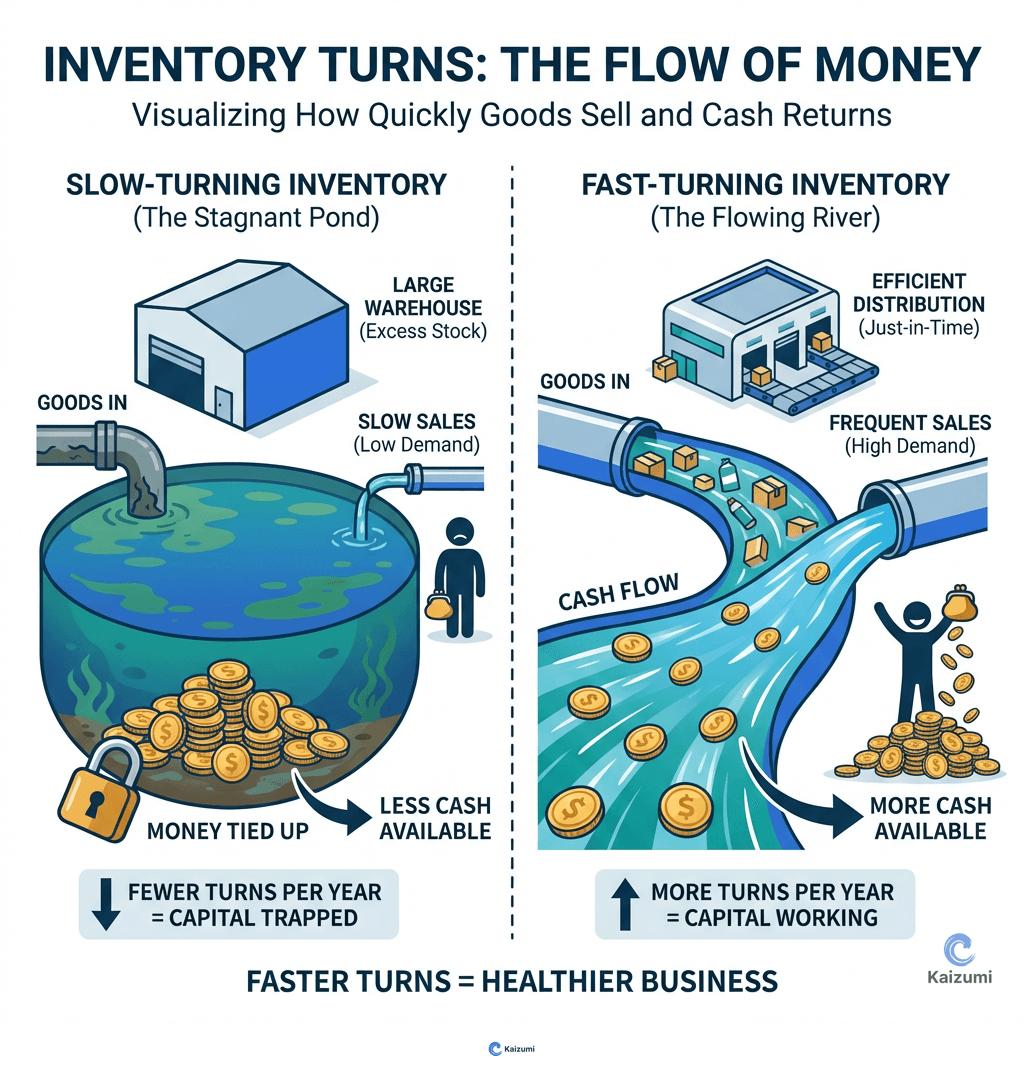
Inventory turns measure how many times inventory is sold and replaced in a period, indicating the velocity of material flow.
Definition
Inventory turns (or turnover) measure how many times inventory is sold or used during a period, typically a year. The calculation is: Annual Cost of Goods Sold ÷ Average Inventory Value. Higher turns indicate faster-flowing material and less capital tied up in inventory. If a company has $10M in COGS and $2M average inventory, turns are 5—meaning inventory is replaced five times per year, or sits for about 10 weeks on average. Lean organizations pursue higher turns by reducing batch sizes, shortening lead times, and improving flow.
Examples
A traditional manufacturer had 4 inventory turns—averaging 3 months of inventory on hand. After implementing flow cells and pull systems, turns improved to 12—one month of inventory. This freed $8M in working capital while improving delivery performance.
Key Points
- Higher turns = less capital tied up in inventory
- Turns can be calculated for total inventory or by category
- Days of inventory = 365 ÷ turns (5 turns = 73 days supply)
- Improving turns requires improving the underlying system, not just cutting inventory
Common Misconceptions
Just reduce inventory to improve turns. Cutting inventory without improving the system creates stockouts and expediting. True improvement requires reducing lead time and variation so less inventory is needed.
Higher turns are always better. There's a balance. Extremely high turns may indicate inadequate safety stock for variability. The right level depends on demand patterns, lead times, and service requirements.
See Also
- Cycle Time vs Takt Time vs Lead Time - Lead time is the driver of inventory requirements