
Labor Linearity
Personalize This
Get insights for your role
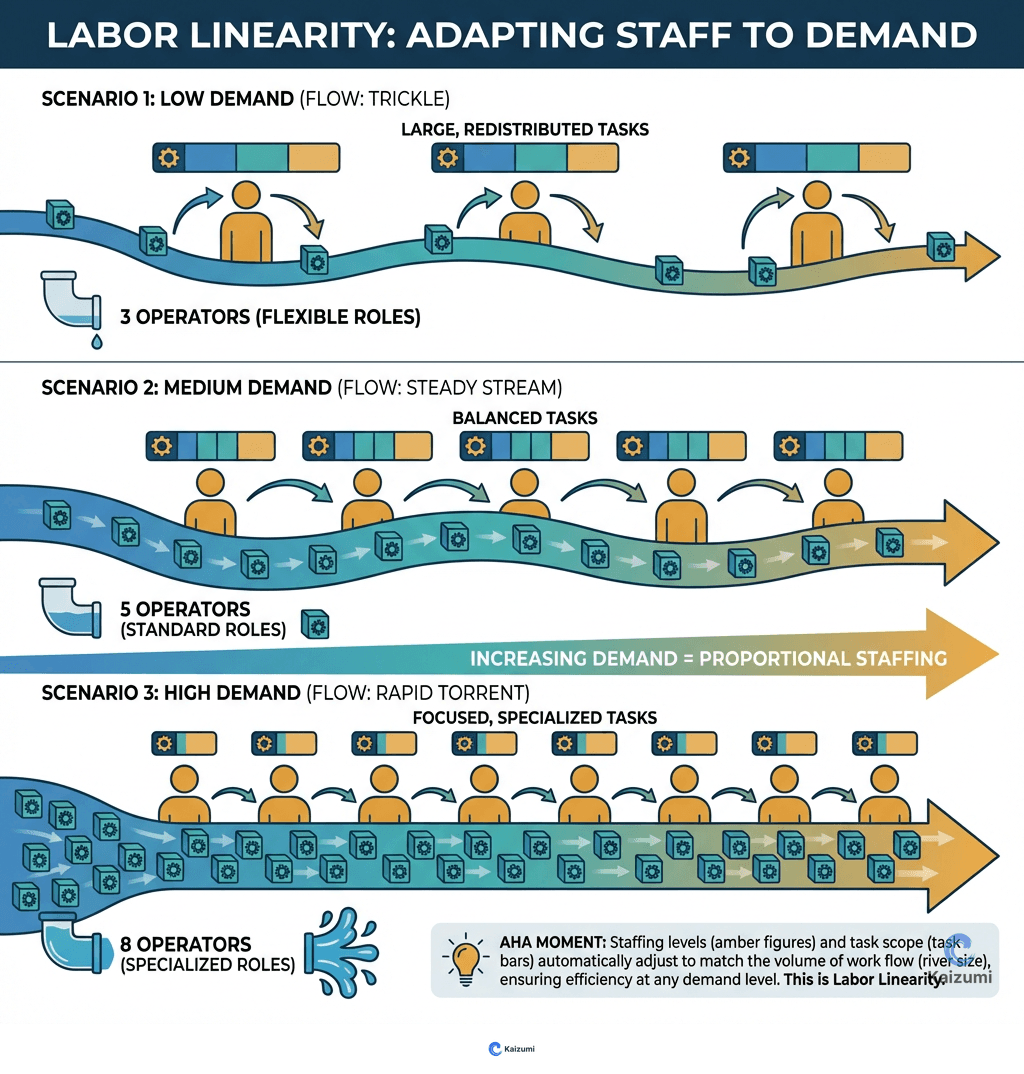
Labor linearity is the ability to adjust labor proportionally to production volume, adding or removing workers as demand changes.
Definition
Labor linearity is the ability to scale labor up or down in direct proportion to production volume. When demand increases 20%, labor increases 20%. When demand drops 30%, labor can be reduced 30% without inefficiency. This requires cross-trained workers, processes designed for flexible staffing, and work that can be redistributed among different numbers of operators. Without labor linearity, organizations either carry excess labor during low demand or cannot respond to high demand, leading to overtime, quality problems, or missed customer requirements.
Examples
A cell produces 400 units daily with 4 operators at normal demand. When demand drops to 300 units, 3 operators can run the cell by redistributing work elements—each operator picks up additional tasks from the removed position. When demand spikes to 500, a fifth operator joins and work is redistributed to maintain flow. Labor flexes with volume.
Key Points
- Requires extensive cross-training so workers can perform multiple jobs
- Cell and line design must accommodate different numbers of operators
- Work elements must be redistributable without creating bottlenecks
- Management systems must enable rapid redeployment of people
Common Misconceptions
Labor linearity means eliminating people. It means matching labor to demand. Sometimes that's fewer people; sometimes more. The goal is appropriate staffing, not minimum staffing.
Any operation can achieve labor linearity. Some processes have fixed labor requirements regardless of volume (watchman, minimum crew for equipment). Labor linearity applies to the variable portion of labor.