
LAMDA Cycle
Personalize This
Get insights for your role
LAMDA (Look, Ask, Model, Discuss, Act) is a learning cycle used in lean product development for rapid knowledge building.
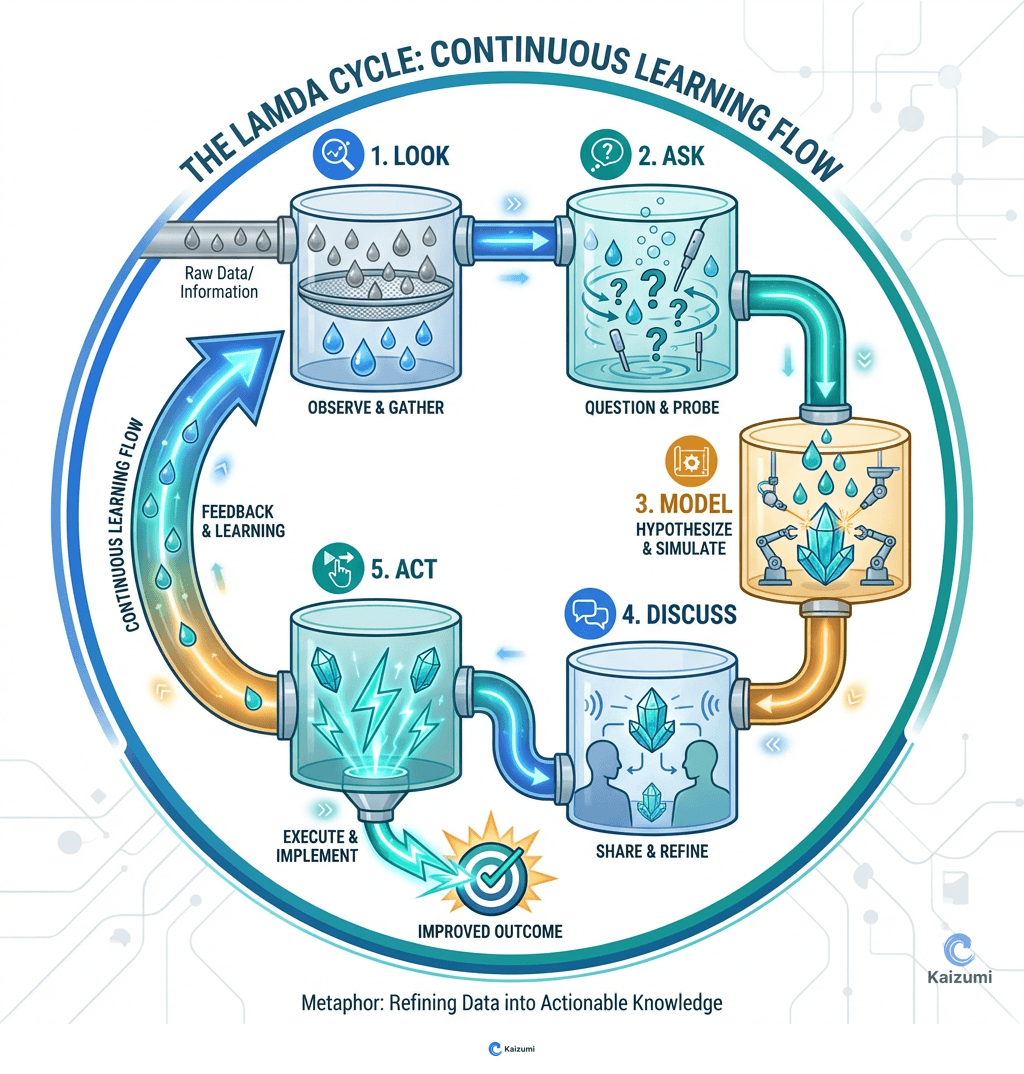
Definition
LAMDA (Look, Ask, Model, Discuss, Act) is a learning cycle used in lean product development to build knowledge rapidly through iterative experimentation. Look: go and see the actual situation (genchi genbutsu). Ask: question what you observe and form hypotheses. Model: create representations (prototypes, simulations, analyses) to test hypotheses. Discuss: share findings with others and incorporate their perspectives. Act: decide and take action based on learning. LAMDA is similar to PDCA but emphasizes direct observation and dialogue, particularly valuable in product development where knowledge gaps are significant.
Examples
Investigating a quality problem: Look—went to the gemba to observe defects occurring. Ask—developed questions about root cause. Model—created process maps and ran designed experiments. Discuss—reviewed with operators and engineers. Act—implemented countermeasures based on validated learning.
Key Points
- Emphasizes direct observation (Look) as the starting point
- Multiple LAMDA cycles build knowledge iteratively
- Discussion brings diverse perspectives into learning
- Related to PDCA but with different emphasis on observation and dialogue
Common Misconceptions
LAMDA is just PDCA with different letters. While similar in spirit, LAMDA's explicit emphasis on observation (Look) and dialogue (Discuss) addresses gaps in how PDCA is often practiced.
Model means computer simulation. Model can be any representation that tests your hypothesis: physical prototype, simulation, calculation, or even a thought experiment. The right model depends on the question.