
Pacemaker Process
Personalize This
Get insights for your role
The pacemaker process is the single point in a value stream that receives the production schedule and sets the pace for all upstream processes.
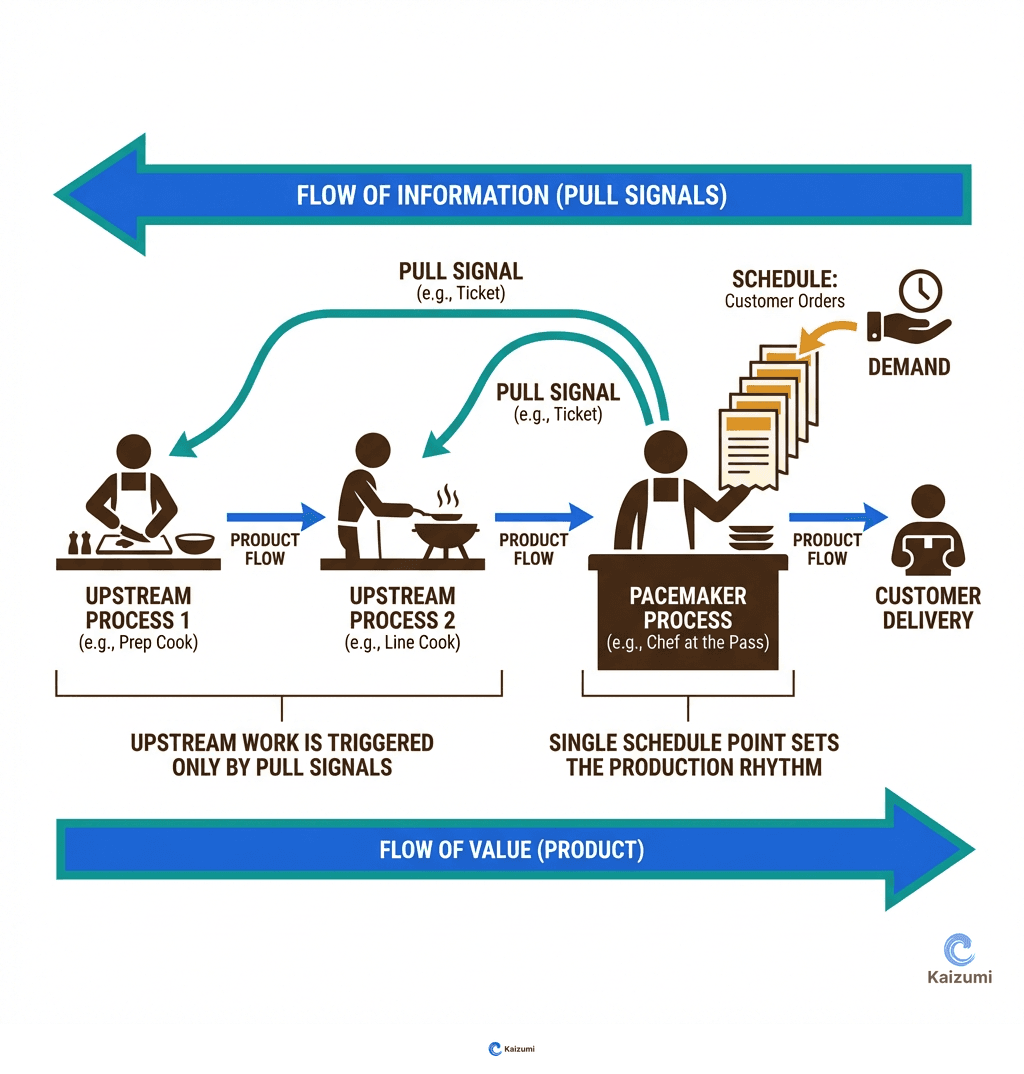
Definition
The pacemaker process is the single point in a value stream that receives the customer schedule and sets the production rhythm for the entire stream. Downstream from the pacemaker, products flow continuously to the customer. Upstream from the pacemaker, pull signals trigger replenishment. By scheduling only one point rather than every process, complexity is reduced and the entire stream moves in coordination. The pacemaker is typically the most downstream process that still has continuous flow to the customer—often final assembly or the shipping preparation area.
Examples
In an automotive assembly plant, the pacemaker is final assembly. The daily schedule tells final assembly how many of each model to build in what sequence. Final assembly pulls components from subassembly through kanban, and subassembly pulls from fabrication. Only final assembly receives a schedule; everything else responds to pull signals.
Key Points
- Only one process should receive the schedule—the pacemaker
- Downstream from pacemaker: continuous flow to customer
- Upstream from pacemaker: pull-based replenishment
- Simplifies scheduling by controlling one point instead of many
Common Misconceptions
Every process needs its own schedule. Scheduling every process creates complexity, conflicts, and disconnection. Scheduling only the pacemaker and using pull for everything else simplifies control.
The pacemaker should be the constraint. Not necessarily. The pacemaker is selected based on position in the value stream (most downstream with flow to customer), not capacity. Constraints elsewhere must be managed but don't change pacemaker location.