
PFEP (Plan For Every Part)
Personalize This
Get insights for your role
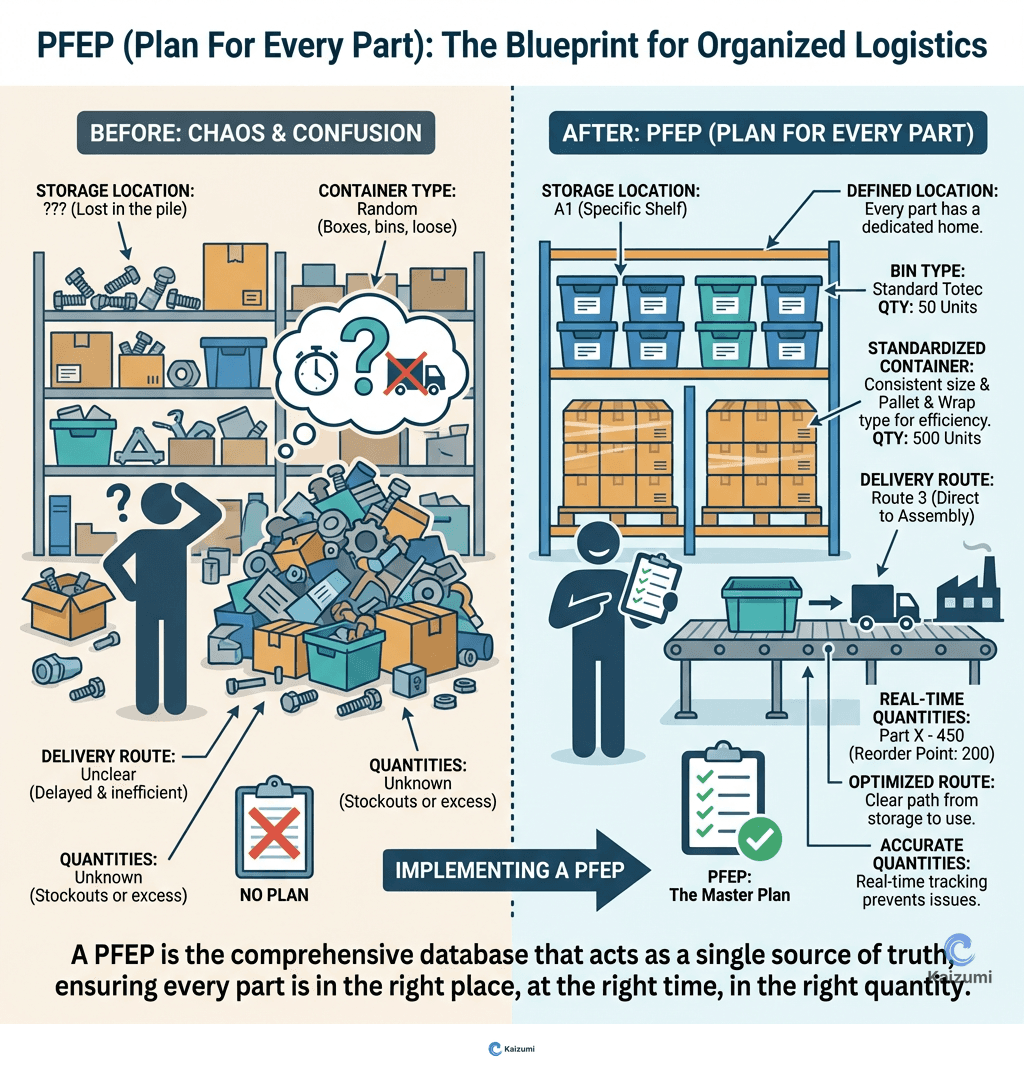
PFEP is a database documenting material flow specifications for every part number: storage locations, quantities, delivery methods, and container types.
Definition
PFEP (Plan For Every Part) is a comprehensive database that documents the material flow plan for every part number in a facility. For each part, PFEP specifies: where it's stored, how many are kept at each location, what container it uses, how it's delivered, what the min/max levels are, who supplies it, and its usage rate. PFEP transforms material flow from tribal knowledge into documented standards, enabling systematic improvement, consistent training, and proper material handling. Without PFEP, each material handler invents their own system.
Examples
An automotive plant's PFEP database contains 15,000 entries—one for each part number. Entry for Part 12345: stored in Aisle 3, Rack B, Bin 4; container is blue tote holding 24 pieces; delivered by Route 3 tugger every 30 minutes; min 24, max 72; supplier is XYZ Corp. Material handlers follow PFEP standards; improvements are documented back into PFEP.
Key Points
- One record for every part number—complete coverage, no exceptions
- Living document—updated when conditions change
- Foundation for pull systems, milk runs, and material flow kaizen
- Enables anyone to manage material flow, not just tribal knowledge holders
Common Misconceptions
PFEP is just an inventory list. PFEP goes far beyond quantities to document the complete flow plan: how, where, when, and by whom material moves.
Once created, PFEP is done. PFEP requires continuous maintenance as products change, volumes shift, and improvements are implemented. Outdated PFEP causes as many problems as no PFEP.
See Also
- Supermarket - Storage locations documented in PFEP
- Milk Run - Delivery routes documented in PFEP