
Production Control
Personalize This
Get insights for your role
Production control is the function responsible for scheduling, sequencing, and coordinating production to meet customer requirements.
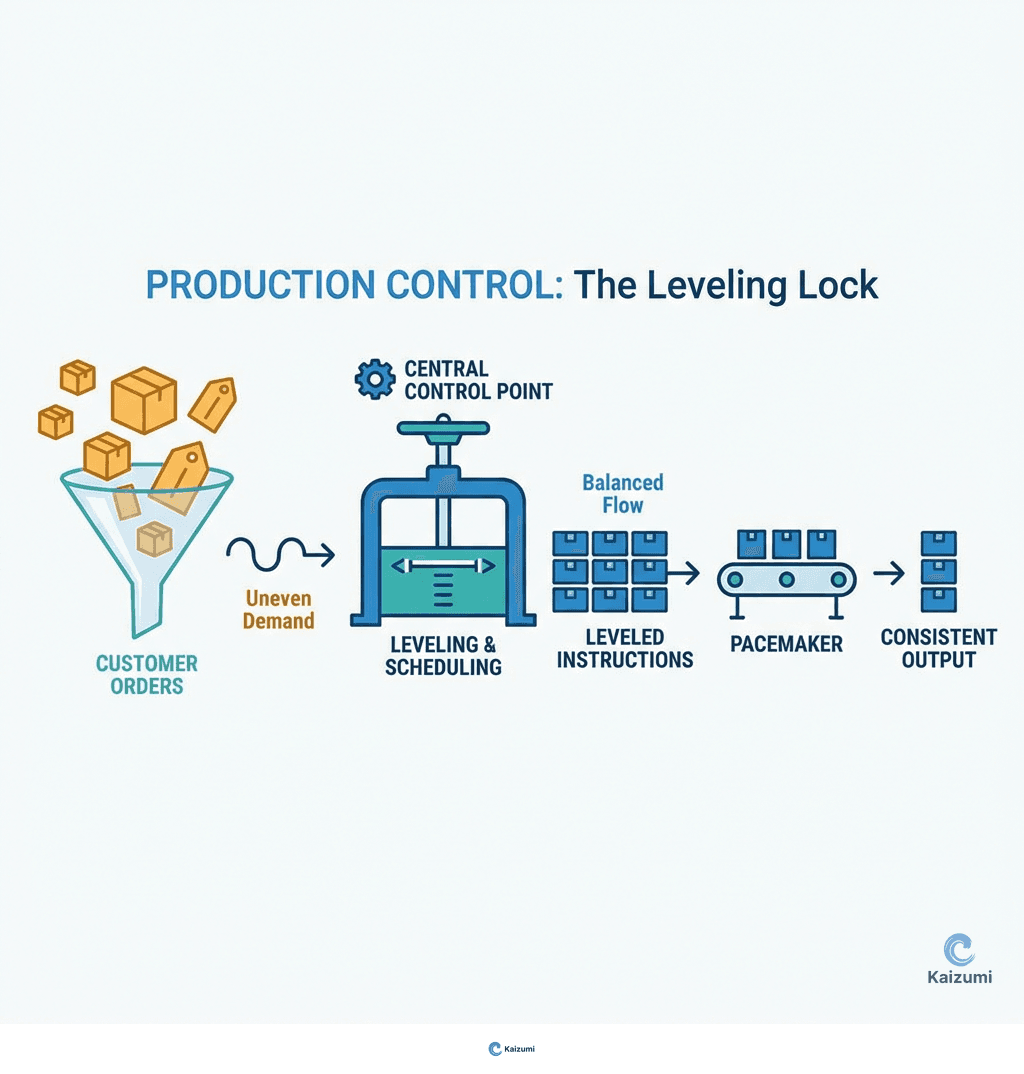
Definition
Production control is the organizational function responsible for translating customer demand into production schedules, sequencing work orders, and coordinating material flow throughout the value stream. In lean systems, production control focuses on leveling demand (heijunka), scheduling only the pacemaker process, and letting pull signals coordinate upstream processes. This contrasts with traditional production control that tries to schedule every operation, creating complexity and disconnected systems. Effective production control balances customer service, inventory investment, and production efficiency.
Examples
Production control receives weekly forecasts and daily orders from customers. They level demand into a daily heijunka pattern, create sequenced production instructions for final assembly (the pacemaker), and monitor kanban loops for upstream processes. Rather than scheduling every work center, they control one point and let pull handle the rest.
Key Points
- Focus on pacemaker scheduling rather than attempting to schedule everything
- Level demand to reduce variation and improve flow
- Use pull systems for upstream coordination rather than detailed schedules
- Balance customer service with production efficiency and inventory
Common Misconceptions
More detailed schedules mean better control. Over-scheduling creates rigidity and cascading rescheduling when anything changes. Lean production control schedules strategically at the pacemaker and trusts pull for the rest.
Production control is just scheduling. It includes demand analysis, capacity planning, inventory policy, supplier coordination, and continuous improvement of the planning system itself.