
Right-Sized Tools
Personalize This
Get insights for your role
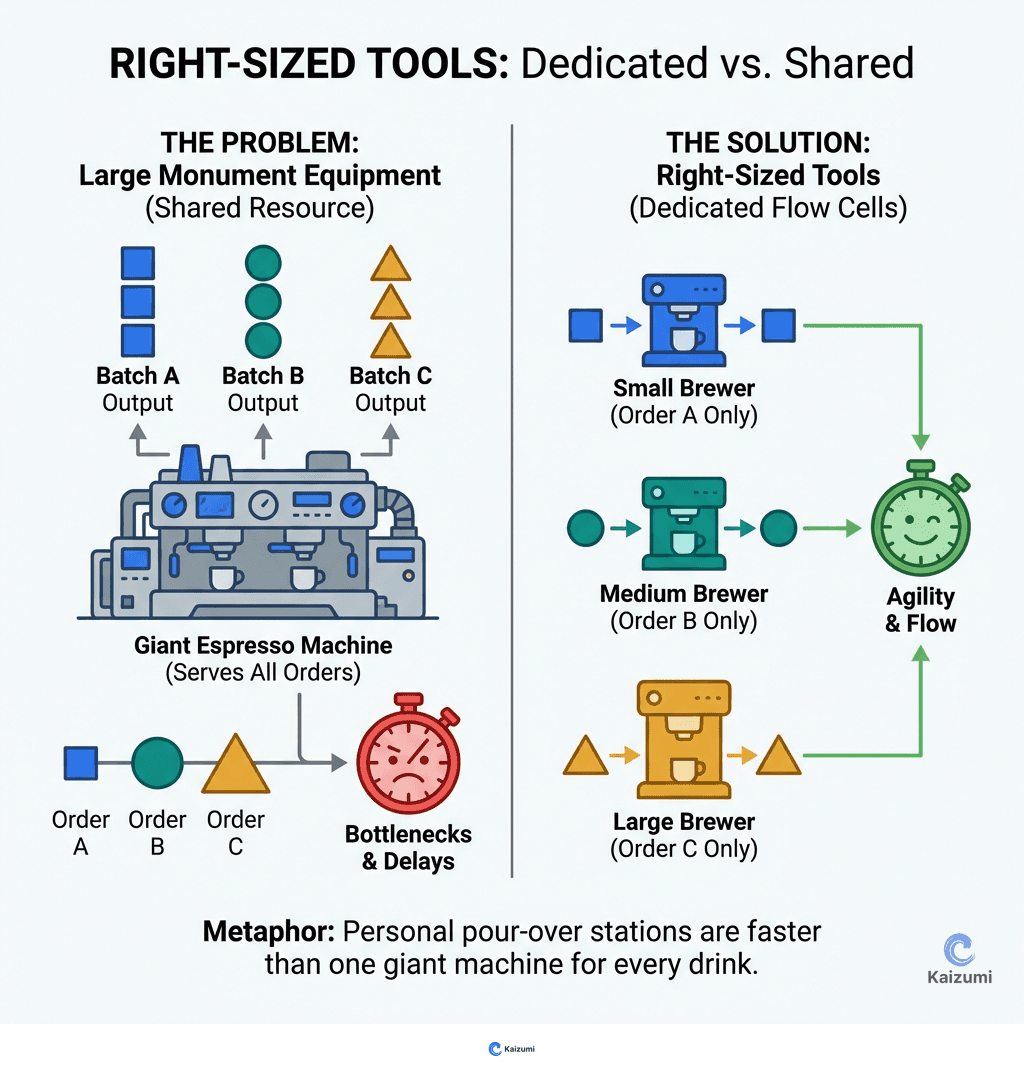
Right-sized tools are equipment scaled to fit the process need, enabling flow and flexibility rather than forcing batching for utilization.
Definition
Right-sized tools are equipment deliberately scaled to fit the actual process need rather than maximized for theoretical efficiency. A right-sized machine matches production requirements: sized for reasonable batch sizes, capable of quick changeover, moveable for layout flexibility, and affordable enough to dedicate to a product family. This contrasts with monuments—large, expensive equipment that forces batching, creates scheduling conflicts, and prevents flow. Right-sizing often means choosing smaller, simpler equipment that enables flow over larger equipment that maximizes unit-level efficiency.
Examples
A company traditionally used a massive press serving all product lines—a monument requiring batches, scheduling, and material handling. Right-sizing meant purchasing smaller presses dedicated to each product family. Unit cost per press stroke increased, but total cost (including inventory, handling, and quality) decreased.
Key Points
- Size equipment to process requirements, not to maximize capacity or minimize unit cost
- Right-sized equipment enables dedicated assignment to product families
- Small and simple often beats large and complex for total cost
- Consider total cost (inventory, handling, quality) not just processing cost
Common Misconceptions
Bigger equipment is more efficient. Unit processing cost may be lower, but total system cost including inventory, handling, scheduling, and quality is often higher with oversized equipment.
Right-sizing means under-capacity. Right-sized equipment meets actual demand with appropriate buffer. It's sized to need, not undersized for cost saving.