
Standardized Work Combination Table
Personalize This
Get insights for your role
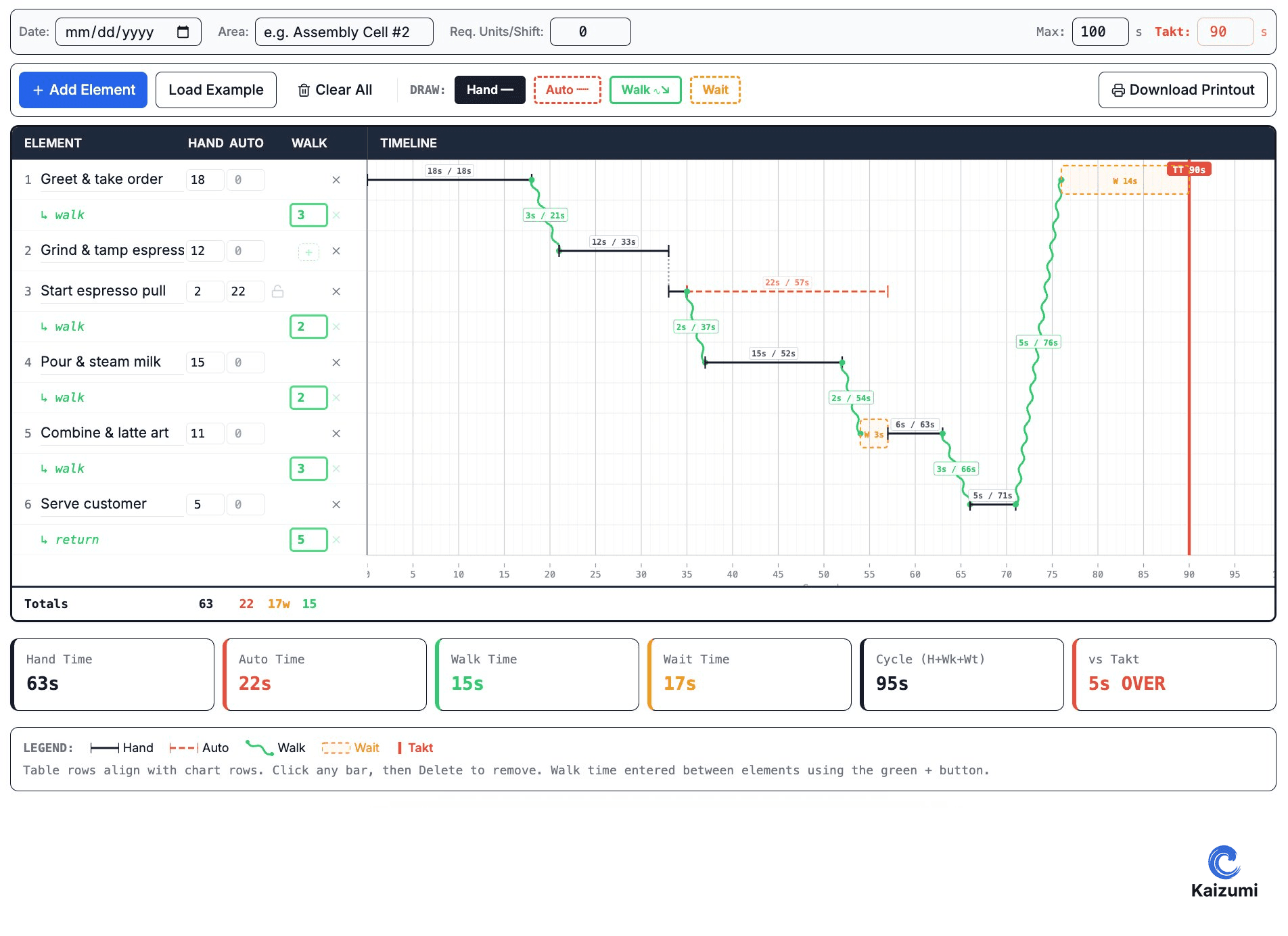
A Standardized Work Combination Table (SWCT) plots manual, automatic, walking, and waiting time for each work element against takt time to balance a work cycle.
Definition
The Standardized Work Combination Table (SWCT) is Form 2 of the three core standardized work documents in the Toyota Production System. It is a time-scaled chart that shows, for a single operator's cycle, when each work element is happening and how it fits against takt time. Each element is drawn as a horizontal bar broken into segments: manual time (operator-controlled), automatic time (machine-controlled, operator free), walking time (movement between stations), and waiting time (idle for the machine). A vertical line marks takt. The SWCT makes it immediately visible whether a cycle fits within takt, where an operator is blocked on a machine, and how much waiting could be eliminated by resequencing.
Examples
A line built an SWCT for a single-operator two-machine cell. The chart showed 28 seconds of manual work across the two machines, 45 seconds of auto time on Machine A, and 12 seconds of walking, adding up to a 67-second cycle against a 62-second takt. The SWCT revealed that the operator was waiting 14 seconds on Machine A's auto cycle — resequencing to start Machine A before loading Machine B reclaimed enough time to fit the cycle under takt.
Key Points
- Plots manual, auto, walking, and waiting time against takt on a time-scaled axis
- Reveals when the operator is blocked on a machine versus when the machine is blocked on the operator
- Supports line balancing by making idle time visible
- Pairs with the Standardized Work Chart, which shows the same cycle from a layout perspective
Common Misconceptions
The SWCT is the same as a Gantt chart. A Gantt chart is project-scale and schedule-based; the SWCT is cycle-scale and operator-based. The SWCT repeats every takt, and every second of waiting is an improvement opportunity.
The SWCT is only useful for one-operator cells. The SWCT is most powerful at the single-operator or single-station level, but the same chart form is used to coordinate multiple operators by stacking their SWCTs and looking for handoff mismatches.
Try It
Build your own right here. Draw timelines, plot manual, auto, walking, and waiting time against takt, and export a print-ready document. (Also available as a standalone tool.)
See Also
- Standard Work — The umbrella concept
- Takt Time — The reference line on every SWCT
- Standardized Work Chart — The spatial companion to the SWCT
- Process Capacity Sheet — The capacity analysis that precedes the SWCT
- Line Balancing — What the SWCT supports