
Standardized Work Chart
Personalize This
Get insights for your role
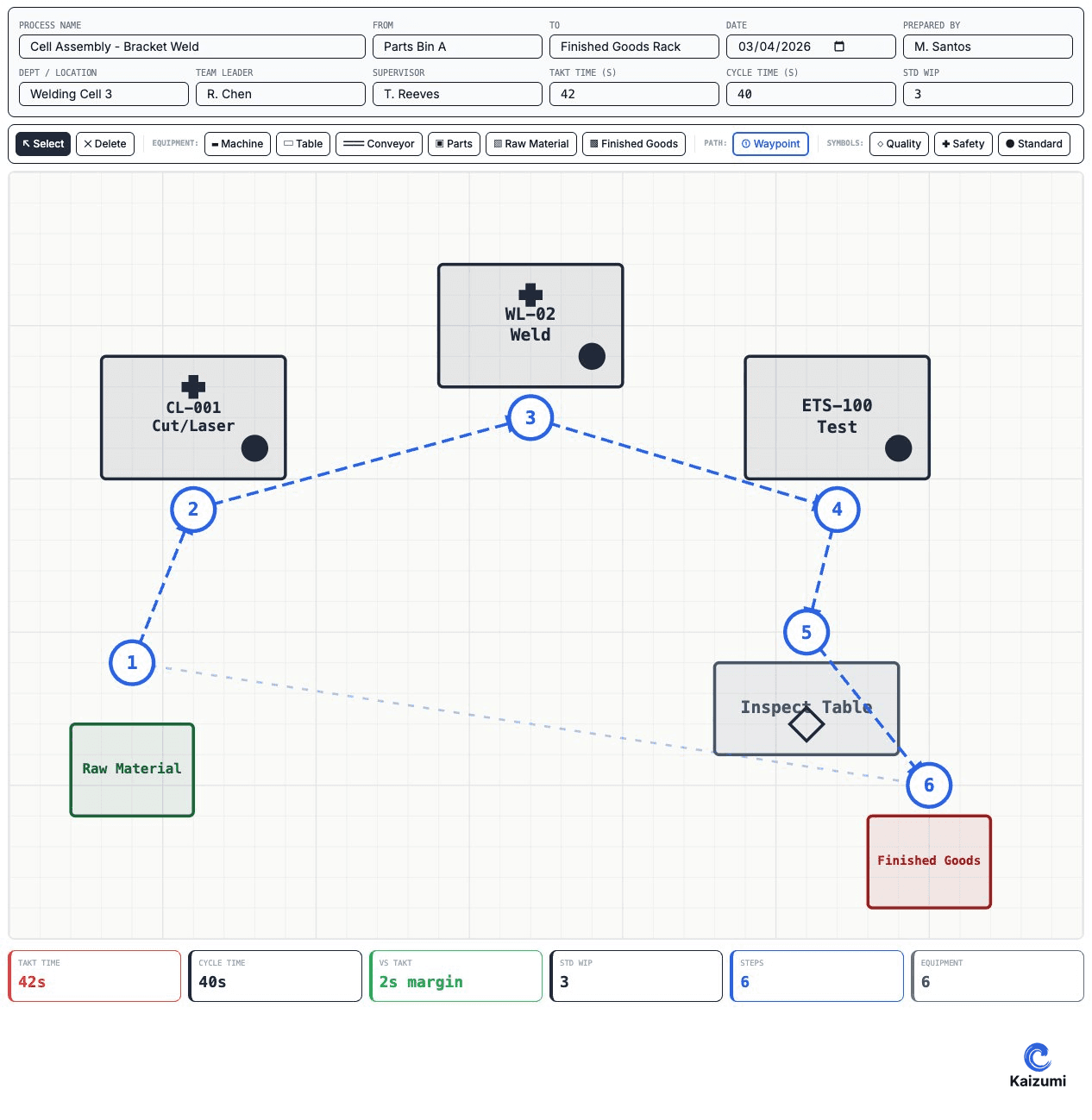
A Standardized Work Chart (SWC) is a top-down diagram of a work area showing the operator walking path, work sequence, quality checks, and safety points for a standardized cycle.
Definition
The Standardized Work Chart (SWC) is Form 3 of the three core standardized work documents in the Toyota Production System. It is a spatial, top-down diagram of a work cell or station that shows the operator's walking path, the sequence of operations, the location of each machine or work point, and the positions where quality checks and safety-critical steps occur. Alongside the diagram, the SWC records the takt time, cycle time, and standard work-in-process for the cycle. Where the Standardized Work Combination Table shows the work in time, the SWC shows it in space — and together they define how a cycle should be performed.
Examples
A machining cell posted an SWC at the entrance showing the operator's figure-eight walking path across three machines, each loading step numbered in sequence. Red dots marked two in-process quality checks, a yellow triangle flagged the overhead crane interaction as a safety-critical step. New operators could learn the cycle from the chart in minutes.
Key Points
- Shows work in space, complementing the SWCT which shows work in time
- Makes the operator's walking path explicit, exposing unnecessary motion
- Flags quality checks and safety-critical steps visually at their physical location
- Posted at the line so operators and leaders share the same standard
Common Misconceptions
The SWC is a facility floor plan. A floor plan shows what is where; an SWC shows what is done in what order, where. The operator path and step sequence are the point, not the geometry.
The SWC is only for manufacturing cells. The spatial-standard-work logic applies anywhere a person moves between resources to complete a repeating task — operating rooms, kitchens, labs, warehouses, offices.
Try It
Build your own right here. Map the work area, trace the operator walking path, mark quality and safety points, and export a print-ready chart. (Also available as a standalone tool.)
See Also
- Standard Work — The umbrella concept
- Standardized Work Combination Table — The temporal companion to the SWC
- Takt Time — Recorded on the SWC alongside cycle time
- Visual Management — Why the SWC is posted at the line