
Value-Stream Manager
Personalize This
Get insights for your role
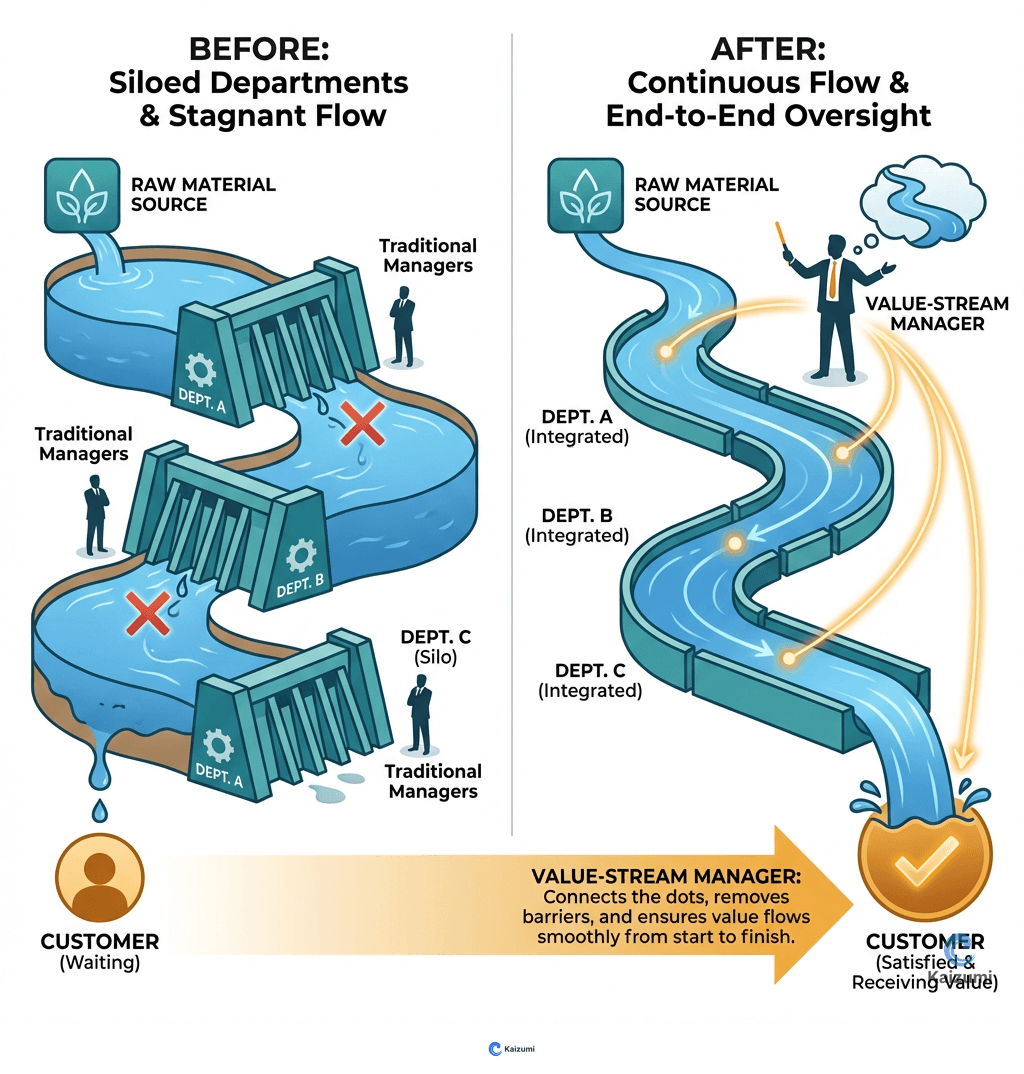
A value-stream manager has end-to-end accountability for a product family's flow, cutting across functional departments to optimize the whole.
Definition
A value-stream manager (VSM) is a leader accountable for the end-to-end performance of a product family's value stream—from raw material to customer delivery, crossing all functional boundaries. Unlike functional managers who optimize their departments, value-stream managers optimize flow across the entire system. They own lead time, inventory, quality, and delivery performance for their value stream. Value-stream managers have authority to make trade-offs between functions when local optimization would hurt overall flow. This role addresses the common problem of functional silos optimizing locally while the customer-facing value stream suffers.
Examples
A plant organized into three value streams, each with a value-stream manager. The VSM for Product Family A owns everything from receiving raw materials through shipping finished goods. When production wanted to batch for efficiency but shipping needed smaller lots, the VSM made the call based on total cost and customer impact.
Key Points
- End-to-end accountability across functional boundaries
- Optimizes total flow, not functional efficiency
- Authority to make trade-offs between competing departmental interests
- Requires matrix management skills and organizational support
Common Misconceptions
Value-stream managers replace functional managers. Both roles often coexist. Functional managers develop technical expertise and people; value-stream managers optimize flow across functions. It's matrix management.
The title alone creates the role. Without authority to make cross-functional decisions and accountability for end-to-end metrics, it's just a title. The organizational structure must support the role.