
Toyota’s bet
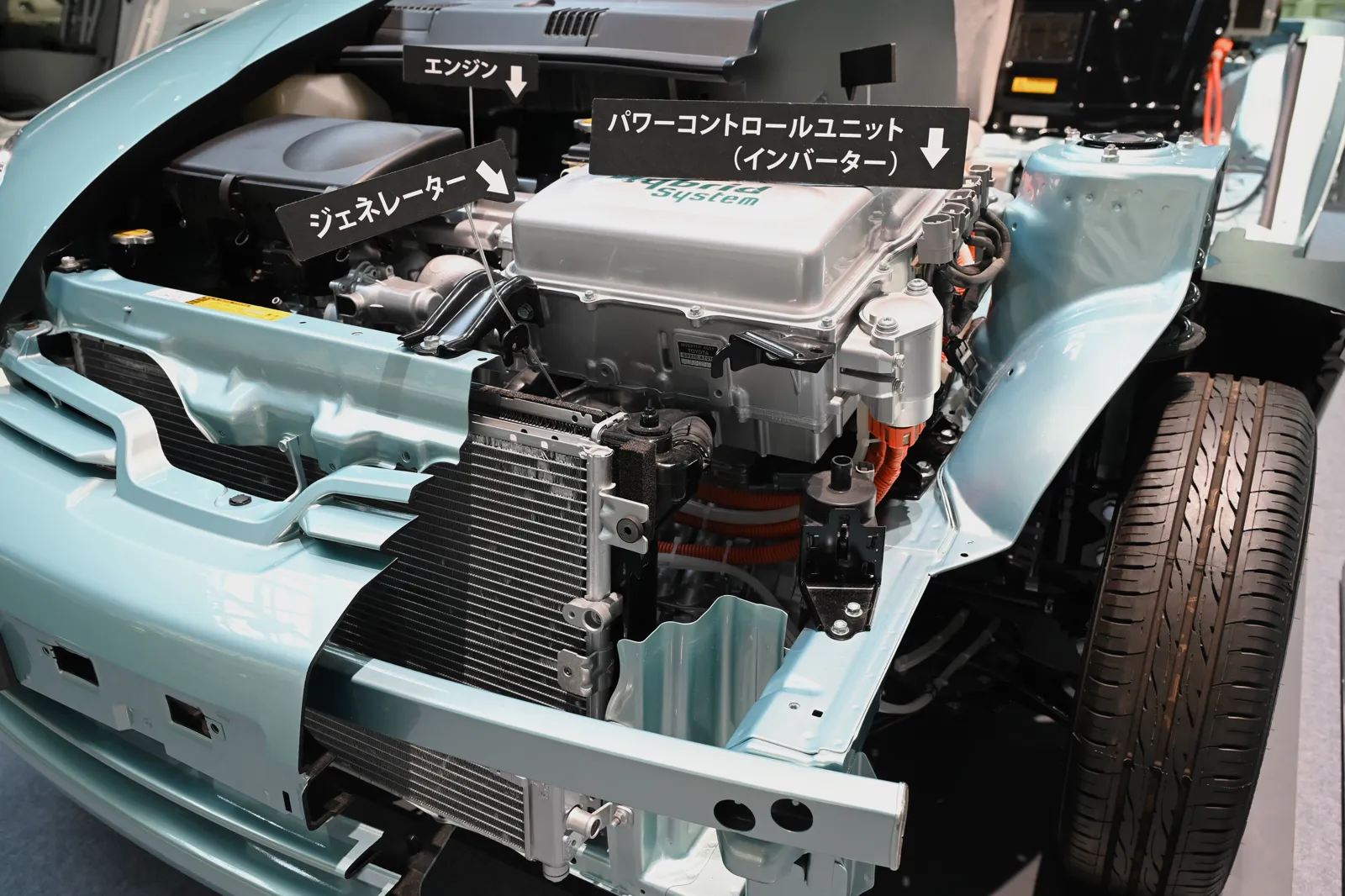
Toyota put the first Prius on sale in Japan on December 10, 1997. It reached North America and Europe in 2000. The Toyota Hybrid System pairs a gasoline engine with an electric motor, a generator and a small battery. A planetary gear set splits the engine’s power between the wheels and the generator, so the engine can run in its most efficient range. It shuts off at stops, and braking energy goes back into the battery.
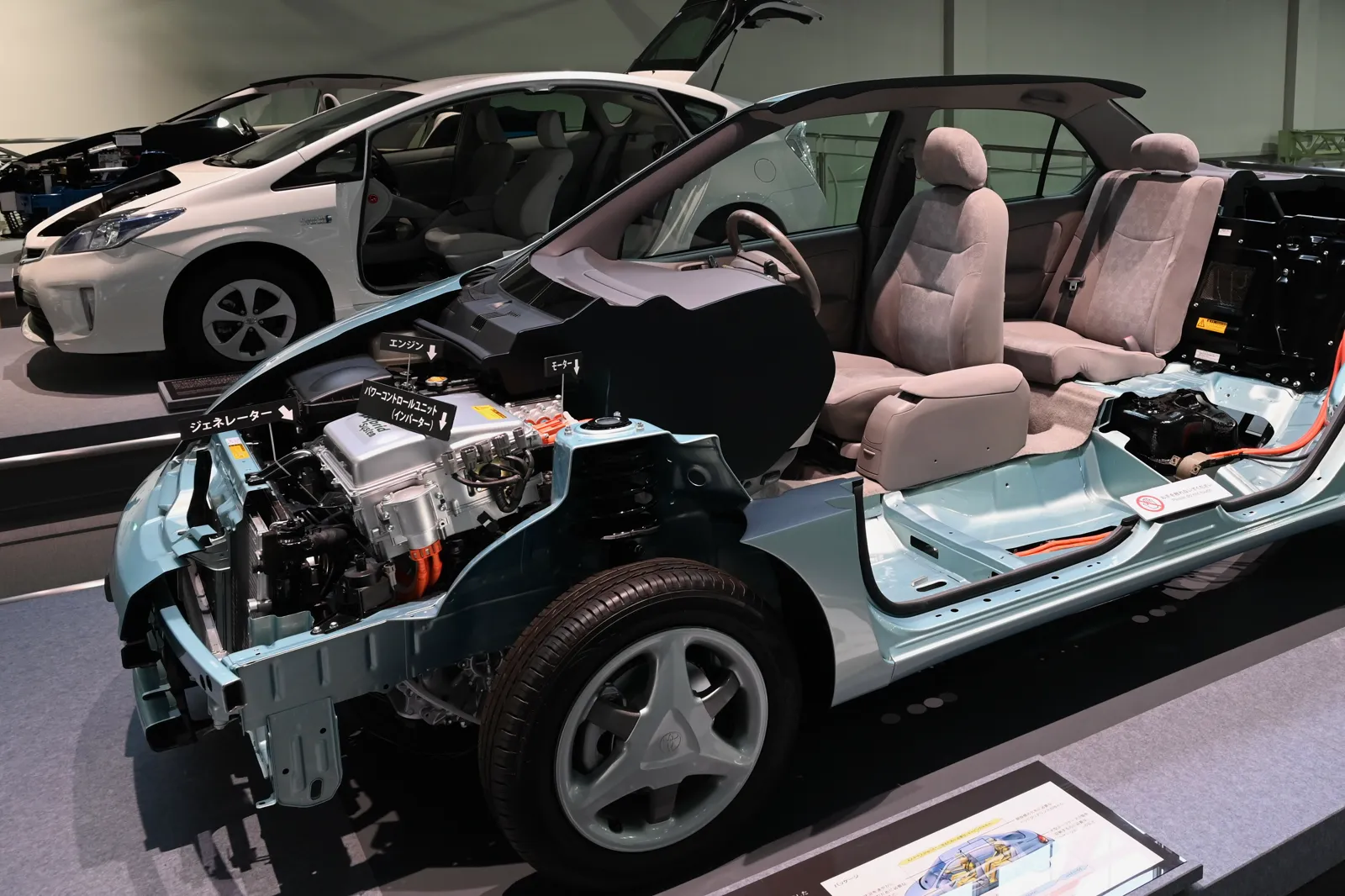
The bet paid off in sales. Hybrids made up 15% of Toyota and Lexus sales worldwide in 2016 and 42% in 2025, when Toyota sold 4.43 million of them. In the first eight months of 2026 the share reached 46.5%. Battery EVs were 1.9% of Toyota’s 2025 sales.
Source: Toyota sales workbooks, December 2025 and August 2026.
In the US, electrified models (hybrids, plug-ins, EVs and fuel-cell cars) made up 29% of Toyota’s sales in 2023 and 57% in the third quarter of 2026. Every 2026 RAV4 listed on fueleconomy.gov is a hybrid. Toyota says it has sold 36.8 million electrified vehicles through March 2026.
Toyota’s leaders have argued for this path for years. In January 2024 Akio Toyoda, the chairman, predicted EVs would top out at about 30% of the market. In June 2026 he told the car site Carwow that he felt alone as the rest of the industry shifted to EVs.
The 1:6:90 claim
In April 2023 Toyota sent its US dealers a one-page sheet, which Jalopnik published in May. It said the raw materials in one long-range EV could instead make 6 plug-in hybrids or 90 hybrids. It said the 90 hybrids would cut carbon by “37 times as much as a single battery electric vehicle” over their lives. The sheet gave no battery sizes and no method.
The idea comes from Gill Pratt, Toyota’s chief scientist. At the World Economic Forum in Davos in January 2023 he described 100 gasoline cars and 100 kWh of battery. The battery could go into one EV, six plug-in hybrids or 90 hybrids, which works out to about 17 kWh per plug-in and 1.1 kWh per hybrid.
His own figures give 30 times, not 37. In his example the 100 gasoline cars average 250 g CO2/km. One EV lowers the fleet average to 248.5 g/km, a cut of 1.5. Ninety hybrids at 200 g/km each lower it to 205 g/km, a cut of 45. Pratt gave those figures; the last step, 45 divided by 1.5, is ours. Toyota has not published how it got 37.
The claim rests on one condition, and Pratt said so at Davos: battery material has to be the limit on how many cleaner cars get built.
Per car, the EV wins
Lifecycle studies count the emissions from making the car and its battery, producing the fuel or electricity, and driving. The independent studies agree on the order: gasoline cars emit the most, then hybrids, then plug-in hybrids, then EVs.
Source: ICCT, July 2025. ICCT averages the EU grid over the car’s 20-year life as more power comes from renewables, which lowers the EV and plug-in figures.
In the same study, the hybrid emits 20% less than the gasoline car: 188 against 235 g/km. The IEA’s 2026 outlook puts an EV about 50% below a hybrid worldwide. A 2022 US study by University of Michigan and Ford researchers found that an EV sedan catches up with a hybrid sedan after 2.2 to 2.4 years of driving.
Our calculator, built on official ratings for the RAV4 family and the bZ, gives the same order. Over 150,000 miles on today’s US grid, the gasoline RAV4 emits 61.9 tonnes of CO2 equivalent, the hybrid 48.0, the plug-in 42.8 and the bZ EV 26.6. The EV is 44% below the hybrid and pulls ahead after about 24,000 miles.
Per battery, the hybrid wins
The 1:6:90 rule answers a different question: what to do with a fixed amount of battery. Asked that way, hybrids win by a wide margin. Each hybrid saves less than an EV, but a hybrid needs a tiny battery, so the same material covers many more cars.
With Toyota’s battery sizes, on the US grid at 150,000 miles, our calculator gives the 90 hybrids about 37 times the CO2 savings of one EV. Each hybrid saves 14.0 tonnes against a gasoline RAV4, so 90 save 1,256 tonnes. One 100 kWh EV saves 33.6 tonnes. That is the same multiple as Toyota’s sheet, though Toyota has not published its method and Pratt’s own Davos figures give 30. With the batteries in today’s cars, a 74.7 kWh bZ and a RAV4 Hybrid at about 1.6 kWh (a published spec, not a Toyota figure), one EV battery covers 46 hybrids, and they save about 18 times as much as the EV. On cleaner grids the multiple falls, because each EV saves more.
So the arithmetic holds. The question is whether batteries are actually the limit.
Run the numbers
Change the miles, the grid and where the battery is made. Switch to Per EV battery to test the 1:6:90 rule with today’s cars or with Toyota’s sizes.
The EV emits 44% less than the hybrid over 150,000 miles. It pulls ahead after about 24,000 miles.
Kaizumi model. Fuel and energy use from fueleconomy.gov. Vehicle and battery manufacturing from ICCT (2025) and Argonne GREET. Gasoline 10.57 kg CO2e per gallon, full life cycle. Grids are Ember 2025 life-cycle figures (US states from Ember's state series) and stay fixed for the car's life, so EV and plug-in results are higher than in studies that assume a cleaner future grid. EPA energy ratings already include charging losses; the model adds 4.2% for transmission. The EPA label assumes the plug-in drives 69% of its miles on electricity, based on its 42-mile range and a full charge every day. Studies of real owners find about 40% for plug-ins with this range, so the calculator starts there. Toyota's 1:6:90 sizes are 100, 16.7 and 1.1 kWh, implied by Gill Pratt's 2023 Davos talk. The RAV4 Hybrid's 1.6 kWh comes from a published spec; Toyota does not list it.
On every grid in the calculator, the EV ends up below the hybrid at 150,000 miles. With these inputs, the two cars’ lifetime totals only match on a grid that emits about 920 grams of CO2 per kWh. West Virginia, the dirtiest grid listed, is at 745.
Are batteries the limit?
When Pratt spoke in 2023, lithium prices had just risen eightfold in two years. The shortage he warned about has not come. The IEA says lithium prices fell more than 80% after 2023. BloombergNEF’s average battery pack price fell from $151 per kWh in 2022 to $108 in 2025.
Sources: BloombergNEF (capacity, December 2024; pack prices, 2025); IEA Global EV Outlook 2026 (LFP share).
At the end of 2024 BloombergNEF counted 3.1 TWh a year of battery cell factories, more than 2.5 times that year’s demand. In 2025, lithium iron phosphate (LFP) batteries, which use no cobalt or nickel, made up more than 55% of EV batteries, according to the IEA.
The long run is less settled. The IEA says lithium prices more than doubled from 2025 into early 2026, and it expects lithium supply to fall short of demand through 2035 on today’s mine pipeline. Toyota’s near-term shortage did not happen. Whether one comes in the 2030s is still an open question.
Plug-in hybrids depend on the plug
A plug-in hybrid is only as clean as its owner’s charging habits. The European Commission found that plug-in hybrids registered in 2021 emitted 3.5 times their official CO2 on the road. An ICCT study of about 920,000 European plug-ins, published in September 2026, found the gap had grown to 4.6 times for 2023 cars. That is why the calculator starts at 40% electric miles, not the 69% on the EPA label.
China’s plug-in hybrids carry big batteries: more than 25 kWh on average in 2025, against less than 60 kWh for EVs, according to the IEA. That is closer to one EV for every 2.4 plug-ins than one for every six. BYD, the largest maker of both, sold 2.29 million plug-ins in 2025, down 8%, and 2.26 million EVs, up 28%.
Where hybrids come out ahead
A few studies find cases where a hybrid beats an EV. A 2024 study in Scientific Reports used the emissions of the power plants that ramp up when cars charge. It found that small EVs beat a Prius in most of the US, but not in rural counties of the Midwest and South. It also found that a Tesla Model S emits more over its life than a Prius almost everywhere outside the Northeast and Florida.
The IEA’s 2024 outlook found EVs, plug-ins and hybrids within 10% of each other in India. Its 2026 edition shows a larger EV lead there. In every study we read, the hybrid’s wins come from the same two things: a coal-heavy grid or a very large battery.
The market moved toward Toyota
In the US, hybrids took a growing share of new vehicle sales while EVs slipped. The federal EV tax credit ended for cars bought after September 30, 2025. EV share hit 10.5% in the third quarter of 2025 as buyers rushed in, then fell to 5.8% in the fourth, according to Cox Automotive.
Source: Argonne National Laboratory, monthly Wards sales data. Kaizumi arithmetic: hybrid sales divided by all light-vehicle sales for each period.
Other carmakers changed course. Ford took a $19.5 billion charge in December 2025 and promised hybrids across its lineup. GM booked $7.6 billion of EV charges in the second half of 2025. Stellantis took about €22.2 billion of charges in February 2026. Honda posted its first annual operating loss after EV write-downs and dropped its long-term EV targets.
Other markets went their own ways. In the EU from January to September 2026, EVs were 22.7% of new cars and hybrids 36.3%, a figure that includes mild hybrids. In Japan, hybrids were 61% of registered new cars. In China, EVs and plug-ins together were 53.6% of vehicle sales. Each market counts hybrids differently, so the shares are not directly comparable.
Selling engines to rivals
At an investor briefing in Brussels in October 2026, Toyota set a goal of about ¥250 billion a year from selling engines and hybrid systems to other carmakers by 2032, Automotive News reported. That is about $1.7 billion, against about $560 million in engine orders this fiscal year. Toyota has not named the buyers.
The engines are the 1.5- and 2.0-liter four-cylinders Toyota showed with Mazda and Subaru on May 28, 2024. Toyota says its new 1.5-liter turbo is 20% smaller than the 2.5-liter engine it replaces. Partners already use Toyota hybrid hardware: Mazda’s 2025 CX-50 Hybrid uses Toyota’s system, and Subaru’s Forester hybrid uses Toyota’s motors.
What the bet has cost
Toyota’s EV plans have slipped. In December 2021 Akio Toyoda announced 30 EV models and 3.5 million EV sales a year by 2030. Toyota now forecasts 598,000 EVs for the year to March 2027, though its June 2026 sustainability data book still lists 3.5 million by 2030. In 2026 it cancelled the production version of the Lexus LF-ZC, a flagship EV.
Environmental groups rank Toyota low. Greenpeace East Asia put it last among the top 10 carmakers in 2021 and 2022. In May 2024 InfluenceMap called Toyota the lowest-scoring of 15 carmakers on climate-policy lobbying. Toyota says it supports the Paris Agreement and has emissions targets certified by the Science Based Targets initiative.
Toyota’s own figure for the CO2 its hybrids have saved is dated. It says its electrified cars had cut 160 million tonnes by February 2022, compared with similar gasoline cars. That figure counts fuel burned, not battery manufacturing, and Toyota has not updated it.
Profits are falling for other reasons. Operating income peaked at ¥5.35 trillion in the year to March 2024 and fell to ¥3.77 trillion two years later. Toyota put the cost of US tariffs in that year at ¥1.38 trillion. Rivals are adding hybrids too: Toyota’s share of US hybrid registrations fell to 44% in the second quarter of 2026, down more than four points in a year.
What this means for operations people
The 1:6:90 rule is a bottleneck argument. When one input is scarce, you put it where it does the most good. That is sound practice on a factory floor, and it is how Toyota made the case for hybrids. The decision is only right while the bottleneck is real.
Since 2023, battery capacity has run well ahead of demand, and per car the EV cuts far more CO2. Toyota’s hybrids still cut about a fifth of a gasoline car’s lifetime emissions, sell in record numbers and make money, but the climate case for choosing them over EVs depends on batteries running short again.