Lean, made visible · Field notes

The phone company’s car.

In 2021 a smartphone maker with no factory, no license and no automotive team bet $10 billion it could build cars. Five years later: 600,000 vehicles, a 76-second takt, the fastest route to auto profitability ever recorded — and a bill that includes a fatal crash and a one-third recall. The Xiaomi speedrun, honestly told.

Scope: Xiaomi EV, 2021–2026Sources: English · 中文, cited throughoutReading time: ~8 min, scrolling
Scroll to begin
Act I · The bet

A phone CEO stakes “all of my reputation.”

March 30, 2021. Lei Jun — founder of the world’s #3 phone maker, with no license, no factory and no automotive team — commits $10 billion over ten years and calls it “the last major entrepreneurial project of my life. I am willing to stake all of my reputation.” The industry mostly laughed: consumer-electronics companies don’t survive contact with crash regulations, stamping plants and five-year development cycles. This guide is about what happened instead — and what it cost.

Announcement and quote per Xiaomi’s March 2021 event; delivery rituals per 网易/新华 coverage.
Act I · The bet

Apple placed the same bet. Look at the dates.

Apple’s Project Titan started in 2014 and consumed roughly the same $10 billion — a decade, thousands of engineers, no product. It was cancelled on February 27, 2024. The SU7 went on sale thirty days later and took 88,898 paid orders in 24 hours. Same bet, same budget, opposite outcome. The difference wasn’t taste or money — it was a company willing to ship a car the way it ships a phone, into a supply chain and a market that made that possible.

Titan per AppleInsider/Reuters reporting; the contrast analysis per CleanTechnica (2025).
Act II · The speedrun

Five years, compressed into the timeline at right.

Announcement to unveiling: 33 months. The factory itself went up in ~14 months — Xiaomi speedran the plant before it speedran the car. First 135,000 cars in nine months; 600,000 cumulative in 22 months and 16 days after the first delivery — a ramp no EV startup, including Tesla, has matched. This is the 18-month-car thesis (previous guide) executed by a company that had never built a car — which is precisely the point: the speed lives in the system, not the badge.

Timeline per CnEVPost/CarNewsChina/Gasgoo — every date in Sources.
Act II · The speedrun

Then demand broke the takt.

June 2025: the YU7 SUV takes ~289,000 pre-orders in the first hour — more cars in sixty minutes than most legacy brands sell in China in a year — and 240,000 non-refundable orders inside 18 hours. The bill: delivery waits of 38–62 weeks, scalpers hoarding order slots, and buyers waiting a year for a car sold in an hour. A lean reader will name the disease immediately: mura at record scale. Xiaomi’s answer was capacity — double shifts, Phase 2, Phase 3 land — rather than price.

YU7 figures per CarNewsChina (Jun 2025); wait times per CnEVPost/新浪科技.
Act III · The factory

The factory: real, fast — and worth de-mythologizing.

Yizhuang runs six workshops with 700+ robots and claims a car every 76 seconds (a company figure, repeated by state media — about 40 jobs per hour). Now the myth-bust your LinkedIn feed needs: the famous Xiaomi “dark factory” is the Changping phone plant, not the car plant; and the celebrated “100% automation” applies to key processes only — overall automation is ~91%, and the YU7 ramp hired human line workers onto 11-hour double shifts. Impressive factory. Not magic. Not lights-out.

Automation scoping per 第一财经/北京经开区 official material; the phone-plant distinction per Xiaomi’s own Changping materials.
Act III · The factory

The 9,100-ton argument for — and against — gigacasting.

The die-cast shop runs a 9,100-ton press — ~100 tons larger than Tesla’s biggest at the time — casting the rear underbody as one piece: 72 parts → 1, eliminating ~840 welds and about 45% of that section’s man-hours, in Xiaomi’s self-developed heat-treatment-free “Titans Metal” alloy. The lean trade-off belongs in the same sentence: Chinese insurers price SU7 premiums like a ¥500k gas car partly because a one-piece casting is expensive to repair. Fewer welds in the plant; bigger bills at the body shop. Waste moved, not eliminated — know where it went.

Casting specs are company claims (Dec 2023 tech launch); insurance pricing per Chinese trade coverage.
Act III · The factory

The capacity math is the quiet masterpiece.

2025 output: 411,082 cars from a 300,000-car nameplate plant — about 137% of rated capacity, with Phase 1 alone running near 186% on double shifts. Phase 2 was completed in June 2025; Phase 3 land is bought; a Wuhan plant follows. Note the direction: this is capacity chasing demand — the exact inverse of the overcapacity disease everywhere else in China’s EV market, and the reason the YU7 queue is measured in weeks instead of cancelled orders.

Output and phases per CnEVPost/ChinaEVHome; double-shift reporting from May 2024 onward.
Act IV · The playbook

The playbook is consumer electronics, bolted to a car plant.

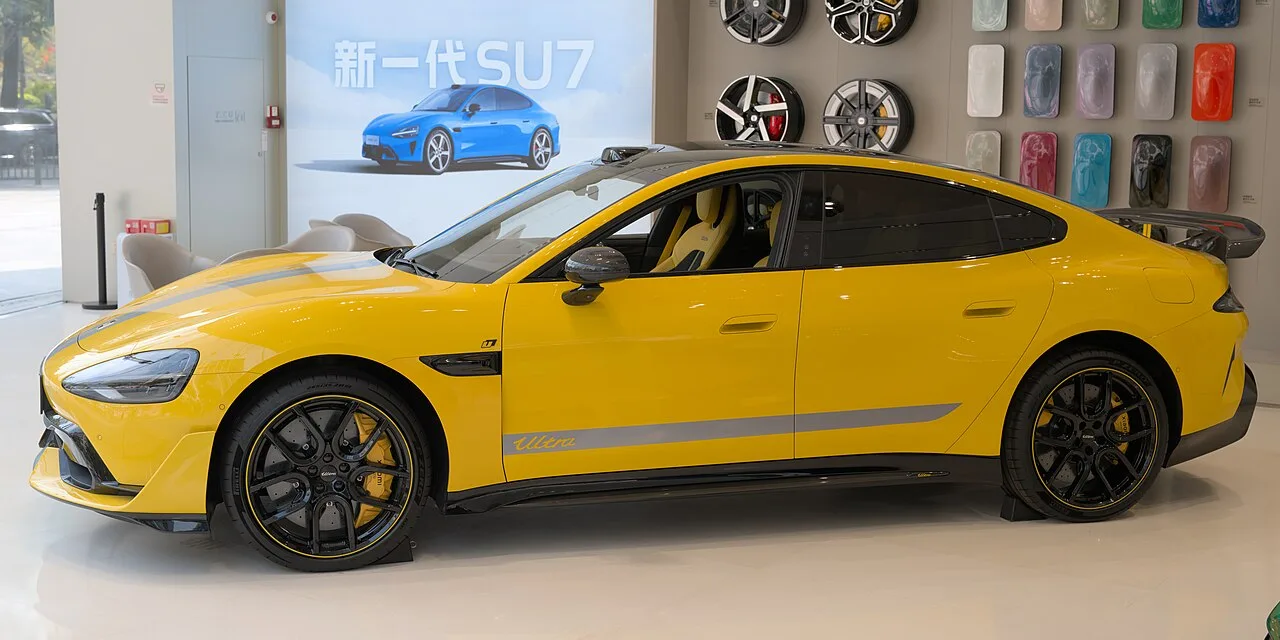
Four moves, all imported from phones: price like a keynote (the SU7 launched ~¥30k under the Model 3, announced on stage against Tesla’s number); the founder is the channel (Lei Jun personally opened doors for the first 100 owners); ecosystem lock-in (人车家全生态 — HyperOS across phone, car and 600M+ devices; the car is the biggest peripheral Xiaomi ever shipped); and iterate in public (the 1,548-hp SU7 Ultra exists to set Nürburgring records and make the brand, not the margin).

Ecosystem strategy per Counterpoint; fan-machine reporting per Rest of World.
Act IV · The playbook

Scoreboard vs Tesla — both columns.

The trophy: in 2025 the SU7 outsold the Model 3 in China, 258,164 to 200,361 — the first car to dethrone it in premium electric sedans since 2019. The honest column: through April 2026 the YU7 had lost 8 of 10 monthly rounds to the Model Y (八败两胜, as Chinese trade tallies put it) despite the lower price, and Xiaomi cut the base price ¥20,000 in May 2026. Locking 240,000 orders is not the same as winning the segment — demand fireworks and durable share are different metrics.

CPCA full-year data via 盖世汽车/SCMP; YU7 head-to-head per 新浪科技 (May 2026).
Act V · The bill

Now the page nobody keynotes.

March 29, 2025: an SU7 on NOA assisted driving hit a highway barrier at ~97 km/h; three students died. The crash triggered China’s industry-wide crackdown on 智驾 ("smart driving") marketing — and, after investigation, a recall of 116,887 SU7s: roughly a third of every SU7 ever sold. Launch-fast-and-OTA is a real method with a real bill, and in cars the bill is sometimes paid by people who never read the keynote.

Crash and log disclosure per CarNewsChina (Apr 2025); recall per SAMR filing via CnEVPost (Sep 2025).
Act V · The bill

The smaller scandals carry the same lesson.

The ¥42,000 carbon-fiber “aero” hood on the SU7 Ultra turned out to be largely cosmetic — bloggers proved the ducts led nowhere; ~400 buyers demanded refunds and courts split, ordering partial refunds while rejecting fraud claims. October 2025: a fatal post-crash fire in Chengdu where flush electronic door handles failed after power loss, feeding a national debate and a draft standard. Lei Jun called 2025 “the hardest period since Xiaomi was founded.” It was also the year the car division turned profitable. An honest guide holds both.

Hood saga per 36氪 + CarNewsChina court coverage; Chengdu fire per 百度百科 incident record and Reuters.
Act VI · The ledger

The fastest route to auto profitability ever recorded.

2024: losing ~¥45,000 per car — the tuition year. Q3 2025: first operating profit, ~¥6,434 per car, roughly 21 months after first delivery. Full-year 2025: ¥106.1B revenue at a 24.3% gross margin. For scale: Tesla took ~17 years to a profitable year; NIO took 11. And the honest footnote: Q1 2026 swung back to a ¥3.1B loss on the SU7 generation change — “profitable” is a trajectory here, not a settled state.

Segment results per Xiaomi quarterlies via CnEVPost; NIO comparison per CarNewsChina (Mar 2026).
Act VI · The ledger

What a lean practitioner should take home.

Xiaomi didn’t out-invent the auto industry — it imported a different clock: consumer-electronics cadence (annual iteration, ecosystem pull, launch-day demand) bolted onto real manufacturing (76-second takt, gigacasting, ruthless capacity math). And the bill — a fatal crash, a one-third recall, year-long queues — is printed on the same page as the trophy. Study the clock. Audit the bill. Go see.

Companions: The 18-Month Car · Parts Per Billion · China’s car industry goes global.
The bet, in the founder’s wordsMar 30, 2021 · Xiaomi launch event
Aqua-blue electric sedan in front of a modern EV factory at duskAI illustration
An SU7-class sedan at the factory gate — the $10B bet, rendered.
这是我人生中最后一次重大的创业项目,我愿意押上我人生全部的声誉
"This is the last major entrepreneurial project of my life. I am willing to stake all of my reputation."Lei Jun (雷军), March 30, 2021 — announcing a $10B, 10-year commitment to build cars

Xiaomi was the world’s #3 phone maker with zero automotive experience. It had no license, no factory, no chassis team.

~$10B
Apple’s Project Titan spend, 2014–2024 — shipped nothing
30 days
between Titan’s cancellation and the SU7 going on sale
88,898
paid SU7 orders in the first 24 hours

Apple started Project Titan in 2014 with the same order of money — roughly $10B spent over a decade, thousands of engineers — and cancelled it on February 27, 2024, having shipped nothing.

The SU7 went on sale 30 days later, on March 28, 2024. Same bet, same budget, opposite outcome — the difference was a company willing to ship a car the way it ships a phone.
Announcement → 600,000 carsCnEVPost · CarNewsChina · Gasgoo
Mar 2021Announcement. $10B committed; no license, no factory, no car people.
Apr 2022Ground breaks at Yizhuang, Beijing. The plant goes up in ~14 months.
Dec 2023SU7 unveiled — 33 months from a standing start.
Mar 2024On sale. 88,898 paid orders in 24 hours; Apple had cancelled Titan 30 days earlier.
Dec 2024135,000 delivered in the first nine months — the fastest 100k ramp of any EV startup.
Jun 2025YU7 SUV: ~289,000 pre-orders in one hour; 240,000 locked (non-refundable) in 18 hours.
Feb 2026600,000 cumulative cars — 22 months and 16 days after the first delivery.
289k / hr
YU7 pre-orders in the first 60 minutes (Jun 2025)
240k / 18h
non-refundable orders locked
38–62 wks
delivery waits that followed

the bill for that demand: delivery waits stretched to 38–62 weeks, scalpers hoarded orders (one reportedly held ~300 slots), and buyers waited more than a year for a car sold in one hour.

A lean reader will name the disease immediately: this is mura at record scale — a demand spike no takt can absorb, converted into a year of queue. Xiaomi’s answer was capacity (double shifts, Phase 2, Phase 3 land) rather than price.
2024
135,000
2025
411,082
deliveries by calendar year; 2026 target ~550,000
Yizhuang, Beijing — claims flaggedcompany figures via state media · 第一财经
Modern EV assembly line with robot arms and sedan bodiesAI illustration
700+ robots across six workshops: die-casting, stamping, body, paint, battery, final assembly.
76 s
one car every 76 seconds at full clip — a company claim, repeated by state media; ~40 JPH
~91%
overall automation — the "100%" figure covers key processes only
14 mo
to build the plant itself
Myth-bust: Xiaomi’s celebrated "dark factory" is its Changping PHONE plant (~81% automation). The car plant is impressive — and not lights-out. The two get conflated constantly.
Gigacasting press extracting a large aluminum underbody castingAI illustration
9,100-ton HyperCasting press — ~100 tons larger than Tesla’s largest at the time (company claim).
72 → 1
parts in the rear underbody; ~840 welds eliminated
−45%
man-hours on that section (company)
The trade-off is the lean lesson: Chinese insurers price SU7 premiums like a ¥500k gas car (¥6–8k/yr) partly because a one-piece casting is expensive to repair. Fewer welds in the plant; bigger bills at the body shop.
Nameplate
300,000 / yr
2025 actual
411,082 — ~137%

2025 output was 411,082 cars from a 300,000-car nameplate plant — ~137% of rated capacity, via double shifts on Phase 1 (which alone ran to ~186% of its rating).

Phase 2 completed June 2025; Phase 3 land bought for ¥635M; a Wuhan plant (extended-range models, with Dongfeng) targeted for 2026.

Capacity chasing demand rather than demand chasing capacity — the inverse of the overcapacity story everywhere else in China’s EV market.
The consumer-electronics playbookCounterpoint · Rest of World · CPCA
Price like a phone launch
SU7 launched at ¥215,900 — deliberately ~¥30k under the Model 3, announced on stage against Tesla’s price the way phone keynotes target the iPhone.
The founder is the channel
Lei Jun delivered the first 100 cars personally, opening doors for owners; his launch keynotes and Weibo run the funnel. Marketing spend behaves like a fandom, not an ad budget.
Ecosystem lock-in
人车家全生态 — "human, car, home": HyperOS across phone, car and 600M+ IoT devices. The car is the biggest peripheral Xiaomi ever shipped.
Iterate in public
OTA cadence and annual-refresh thinking from consumer electronics; the SU7 Ultra’s Nürburgring records (1,548 hp) exist to make the brand, not the margin.
Xiaomi SU7
258,164
Tesla Model 3
200,361
China deliveries, full-year 2025 (CPCA)

The trophy: In 2025 the SU7 outsold the Model 3 in China: 258,164 vs 200,361 (CPCA) — the first time anything dethroned the Model 3 in premium electric sedans since its 2019 China launch.

The honest column: through April 2026 the YU7 had lost 8 of 10 monthly rounds against the Model Y (八败两胜, per Chinese trade tallies) despite the lower price, and Xiaomi cut the base price ¥20,000 in May 2026. Locking 240k orders is not the same as winning the segment.
The billSAMR filings · court records · incident reports
One crash on assisted driving. Three deaths. A nationwide marketing crackdown — and a recall of 116,887 cars, a third of every SU7 ever sold.March 29, 2025, Tongling → September 2025 recall

March 29, 2025: an SU7 on NOA (assisted driving) hit a highway barrier at ~97 km/h near Tongling; three students died. The crash triggered the industry-wide crackdown on 智驾 ("smart driving") marketing and, after an investigation, a recall of 116,887 SU7s — roughly a third of every SU7 ever sold.

The hood
The ¥42,000 carbon-fiber "aero" hood on the SU7 Ultra turned out to be largely cosmetic — bloggers proved the ducts led nowhere and ~400 buyers demanded refunds. The courts split: rulings have ordered partial refunds (~¥21,000) while rejecting outright-fraud claims.
The door handles
October 2025, Chengdu: a fatal post-crash fire where the flush door handles failed after power loss — feeding a national debate (and draft standard) on electronic door handles.
The founder’s year
Lei Jun called 2025 "小米创办以来最艰难的时期" — the hardest period since Xiaomi was founded. It was also the year the car division turned profitable. Both things are true, and an honest guide holds them together.
The ledger — per-car economicsXiaomi quarterlies via CnEVPost
2024≈ −¥45,000 per carthe learning-curve tuition year
Q3 2025first operating profit≈ +¥6,434 per car — ~18 months after first delivery
FY 2025¥106.1B revenue · 24.3% gross margin~¥900M segment profit on 411k cars
Q1 2026back to a ¥3.1B lossSU7 generation change + subsidy retreat — "profitable" is not a settled state

For scale: Tesla took ~17 years to a profitable year; NIO took 11 and counting. Xiaomi’s ~21 months is the fastest route to auto profitability on record — built on the phone business’s supply chain, cash, and 600M-device funnel, none of which a startup gets for free.

The lean reading: Xiaomi didn’t out-invent the industry — it imported a different clock. Consumer-electronics cadence (annual iteration, ecosystem pull, launch-day demand) bolted onto real manufacturing (76-second takt, gigacasting, double-shift capacity math), with the bill — a fatal crash, a one-third recall, year-long queues — printed on the same page as the trophy.
Now it’s your move

The speed lives in the system, not the badge.

A phone company built the fastest auto ramp in history because the system around it — suppliers, simulation, capacity discipline, launch-day demand — made it possible. The same system printed the bill on the facing page. Study both sides of the ledger.

Good to know

Frequently asked

How fast did Xiaomi go from announcement to selling cars?
Thirty-three months from the March 2021 announcement to the SU7’s unveiling (December 2023), and on sale March 28, 2024 — taking 88,898 paid orders in the first 24 hours. The Yizhuang factory itself was built in about 14 months. Cumulative deliveries reached 600,000 cars 22 months and 16 days after the first delivery — a ramp no EV startup, including Tesla, has matched.
Is the "car every 76 seconds" claim real?
It is a company figure, repeated by Chinese state media, describing the line’s full-speed cadence (~40 jobs per hour) — plausible for a modern assembly line but not independently audited. Two adjacent claims deserve more care: the famous "dark factory" is Xiaomi’s Changping phone plant, not the car plant; and the "100% automation" figure is scoped to key processes only — overall automation is about 91%, and the YU7 ramp added human workers on double shifts.
What is Xiaomi’s gigacasting setup?
A 9,100-ton "HyperCasting" press — about 100 tons larger than Tesla’s largest at the time — casting the rear underbody as a single piece: 72 parts become 1, eliminating ~840 welds, using Xiaomi’s self-developed heat-treatment-free "Titans Metal" alloy (all company claims from its December 2023 technology launch). The trade-off: one-piece castings are costly to repair, which is one reason Chinese insurers price SU7 premiums like a car twice its price.
How did Xiaomi become profitable so fast?
The EV segment recorded its first operating profit in Q3 2025 — roughly 21 months after first delivery — and closed FY2025 with ¥106.1B revenue at a 24.3% gross margin on 411,082 cars. Tesla took ~17 years to a profitable year, NIO 11. The advantages a startup doesn’t get: Xiaomi’s existing supply chain, cash pile, brand, and a 600M-device ecosystem funnel. Honest footnote: Q1 2026 swung back to a ¥3.1B loss during the SU7 generation change.
What happened with the fatal SU7 crash?
On March 29, 2025, an SU7 operating on NOA assisted driving struck a highway barrier near Tongling at ~97 km/h; three university students died. The crash triggered China’s industry-wide crackdown on "smart driving" marketing language, and an investigation led to a September 2025 recall of 116,887 SU7s — roughly a third of every SU7 ever sold — for assisted-driving software fixes.
Did the SU7 really outsell the Tesla Model 3?
Yes — in China, in 2025: 258,164 SU7s vs 200,361 Model 3s (CPCA data), the first time any car dethroned the Model 3 in premium electric sedans since its 2019 China launch. The fuller picture: the YU7 SUV, despite locking 240,000 orders in 18 hours, lost 8 of its first 10 monthly rounds to the Model Y and took a ¥20,000 price cut in May 2026.
What did Apple’s cancelled car project have to do with Xiaomi?
Apple’s Project Titan ran 2014–2024, consumed roughly $10B — the same order of money as Xiaomi’s bet — and was cancelled on February 27, 2024, without shipping anything. The SU7 went on sale 30 days later. The comparison is the guide’s framing device: the same bet produced opposite outcomes, and the difference was manufacturing system and market context, not money or talent.
MS
Matthew Savas

Founder of Kaizumi, an AI-powered Lean training platform. More about Matthew →

Updated July 12, 2026 · Drafted with AI assistance and reviewed by Matthew Savas for accuracy. Every statistic is dated and sourced (data as of 2026-07-12); factory figures (76-second takt, casting stats, automation rates) are labeled as company claims, and the guide corrects the common dark-factory conflation. Illustrations are AI-generated and labeled.

References

Every statistic in this guide traces to one of the sources below · data as of 2026-07-12. Chinese titles are given as published.