
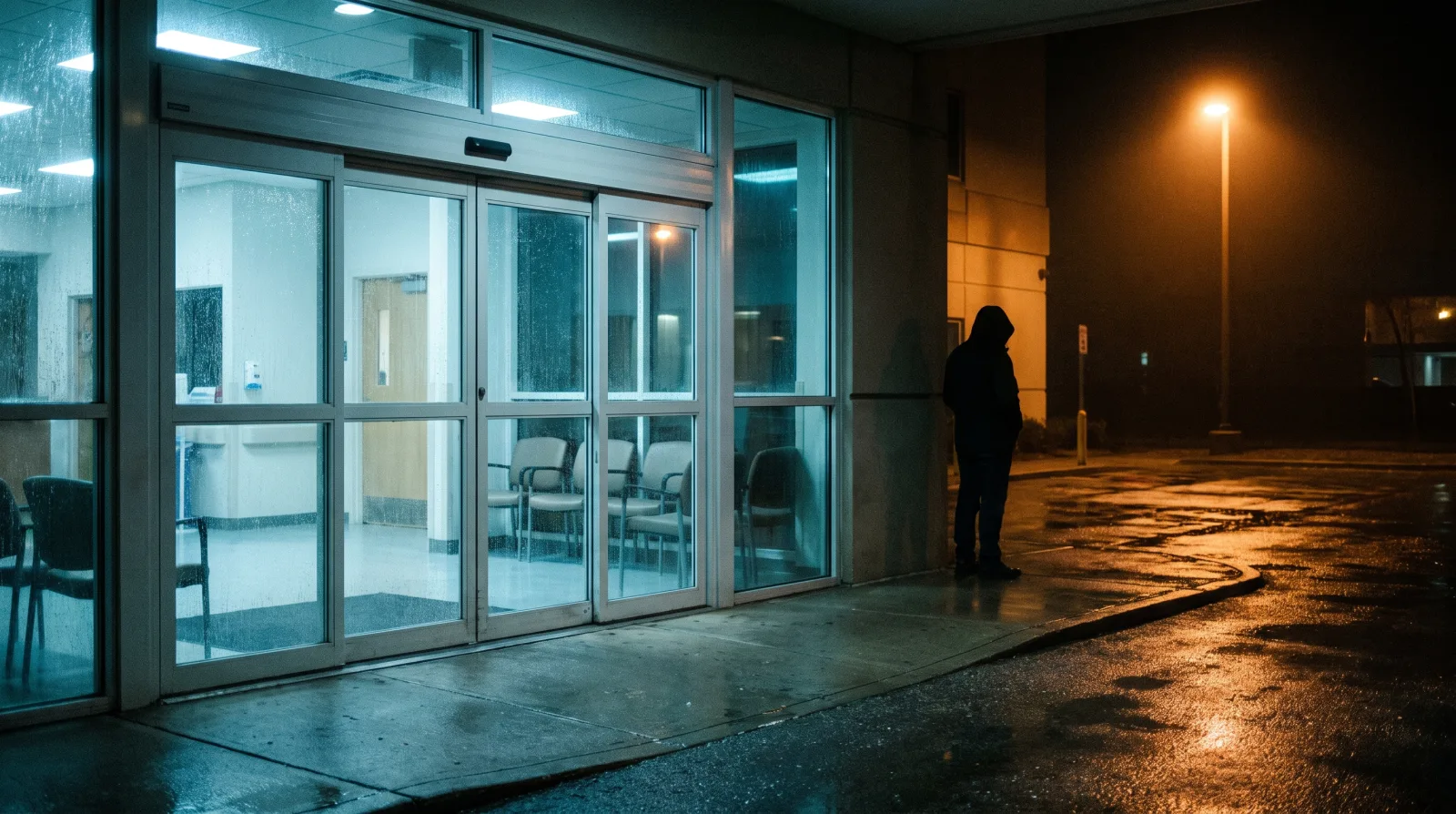
Seven hours for one hour of care
One patient. One value stream.
7:10pm, abdominal pain. From the doors to discharge, everything that happens to her is one connected journey — and most of it isn’t care. It’s waiting between five steps.
She walks in.
Abdominal pain, a long evening ahead. The clock starts now — and it won’t stop for the waiting.
Triage & registration.
Vitals, a wristband, a form. A few minutes of work — then a chair in the waiting room.
Seen by a doctor.
After the longest wait yet, ten minutes of actual examination. Orders get entered.
Orders placed.
Bloods and a scan are ordered. Now she waits for the lab and radiology to come back.
Labs & radiology.
The biggest wait of the night — results sit in a queue long after the sample is taken.
Treated and discharged.
A plan, finally. She leaves after 2am — more than seven hours after she arrived.
You can’t boil the ocean. A team picks one value stream to improve — and there’s a way to choose well.
Emergency department
OR scheduling
Inpatient discharge
Where do you start?
Three journeys are hurting. You can only take on one. Score each against four criteria the book recommends for picking a value stream.
A compelling need.
Does fixing it tie to a real clinical, business, or patient-service need? The discharge flow matters — but the ED’s crowding is the burning platform.
Heavy resource use.
Big quality, cost, or delay problems consuming real resources? All three qualify — the ED most of all.
A mappable scope.
Can you draw it process-by-process with clear boundaries? OR scheduling sprawls across departments; the ED visit has clean doors-to-discharge edges.
The ED wins. Now scope it.
It clears all four. Lock the choice in a one-line value proposition — the problem, the customer, the boundaries, and why now.
No one person can see the whole stream. The real map is built by the people who live each step — and it’s measurable: every step gets three numbers.
D/T 15 min
%C&A —
D/T 60 min
%C&A 60%
D/T 10 min
%C&A 98%
D/T 120 min
%C&A 80%
D/T 90 min
%C&A —
No one sees the whole stream.
A clerk, a nurse, a physician, a lab tech, a discharge nurse — each sees only their step. The true map needs every voice in the room.
“The history waits for the nurse.”
Dana, registration: I capture the chief complaint and insurance — but the full history waits for triage. My handoff is thin.
“My note is right 6 times in 10.”
Marcus, ED physician: I examine, order, and move to the next patient. About 60% of the time my note has everything the next step needs — the rest get chased down.
“Orders run clean.”
Priya, charge nurse: Entering orders is quick and almost always right — 98%. That part isn’t the problem.
“No priority flag.”
Tomás, lab: Samples hit my queue with no urgency flag — urgent and routine look identical, so results sit up to two hours (80% usable).
“Waiting on one signature.”
Mei, discharge: Half my discharges wait on a missing signature or a bed upstairs. Put every voice together and the map is finally true: up to 7.5 hrs, 17% right-first-time.
One clock runs for the patient. One runs for the people caring for her. They share the same hours — and they could not look more different.
Same hours. Two stories.
The top lane is her clock. The bottom lane is the team’s. Watch the evening run forward.
She’s still waiting.
A few minutes of triage, then nothing she can see. Her bar grows; the care lane barely flickers.
Seen — then waiting again.
The exam happened. Now the labs are out. The longest stretch of dead time begins.
Past midnight.
Hours in, and most of the night has been a chair. The two clocks have completely diverged.
About one hour of care.
Across the whole visit, hands-on care totalled around an hour — roughly 15–20% of her night.
Look at that third number — right first time. Each handoff looks fine on its own. Stacked together, they tell a different story.
Pretend every step is perfect.
Right-first-time starts at 100%. Then reality multiplies it down, handoff by handoff.
The exam: 60% right first time.
Four in ten exams carry a gap forward — a missing detail, an unclear note.
Orders: 98%. Nearly perfect.
But it multiplies onto what came before: 60% × 98% ≈ 59%.
Labs: 80%.
Three measured steps stacked: 60% × 98% × 80% ≈ 47%. Already less than half.
Right first time: ~17%.
Carry it across all five steps and the system is right the first time only ~17%. The other 83% is rework — and risk.
The same value stream hides four failures at once. Lean looks for each one on purpose — so the fixes target the system, not the people.
D/T 15 min
%C&A —
D/T 60 min
%C&A 60%
D/T 10 min
%C&A 98%
D/T 120 min
%C&A 80%
D/T 90 min
%C&A —
No value.
Waiting, rework, duplicate tests — time the patient would never choose to pay for.
Broken flow.
Queues, batching, results sitting between steps. The work stops and starts.
Strained work.
Staff hunting for information and inventing workarounds because the standard doesn’t hold.
No feedback loop.
No visible status, no signal when something slips — so the same problems repeat tomorrow.
Flow where you can, build quality in at each step so defects don’t travel, and make status visible. Watch the two numbers that matter actually move.
Today: 7.5 hours, 17%.
Long waits, defects traveling downstream, no one able to see the whole journey. Now apply the book’s four future-state guidelines — one per lens.
Match the work to what the patient needs.
Start with the customer. Cut what doesn’t serve the outcome — duplicate tests, repeated questions, waits that add nothing.
Flow where you can; pull where you can’t.
Create continuous flow between steps, signal the next step to pull work when flow isn’t possible, and level the load. The biggest waits collapse.
Standardize, and build quality in.
Define the best current method at each step and confirm quality as the work happens — so defects are caught at the source instead of traveling. Right-first-time climbs.
Make problems visible. Feed back lessons.
Put measures in place to see and respond to problems quickly, and reflect regularly so the gains hold. Seven hours becomes two — and it stays that way.
Each move is its own craft
The future state is really four disciplines — and we’ve built an interactive guide for each. Start with the one your stream needs most.
Create flow
Stop batching; move one patient at a time so waits and rework collapse.
Batch vs. Flow →Level the load
Smooth the lumps in demand so no step floods and none starves.
Heijunka →Build quality in
Catch defects at the source so they never travel downstream — the path from 17% to 78%.
Defect Classification →Standardize the work
Define the best current method at each step so the gains hold.
Anatomy of a Work Cycle →How to run it with your team
The whole method, in seven moves. The mapping itself is a workshop — half a day to a couple of days; the improvements run over the following weeks. Start small, learn, repeat.
Get the team in the room
Map with the people who live each step, plus four roles: a lean champion (senior sponsor), a value-stream owner, a facilitator, and cross-functional members. Then socialize the draft with everyone the stream touches.
Scope it
Pick one journey against clear criteria and write a one-line value proposition — the problem, the customer, the boundaries, and why now. Bound it to something you can map in a workshop.
Map the current state — together
Walk the journey and draw each step with its three numbers — hands-on time, wait time, and percent right-first-time. (A Time Observation Sheet helps capture the times.) Don’t tidy it; capture the chaos.
Take a waste walk
Look for problems through four lenses: value (waiting, rework), flow (queues, handoff stalls), work (hunting for info, workarounds), and management & learning (no visible status, no feedback loop).
Design the future state
Apply the four guidelines: match output to the customer; create flow where you can and pull where you can’t, leveling the load; standardize and build quality in at each step; and make problems visible so lessons feed back.
Measure & experiment
Set goals against the future state, then run small experiments — plan, do, check, act. Let evidence, not opinion, pick the solution. (An A3 keeps the thinking on one page.)
Manage & sustain
Review progress on a regular cadence, fix what slips, and feed the lessons back into the work — so seven hours becomes two, and stays there. Then pick the next journey.
The wait was never about working harder.
It was about designing the journey around the patient instead of the departments. Map it, see the waiting and the rework, and redesign the flow — and seven hours becomes two.
See how Kaizumi trains care teams →Generic emergency-department journey; one composite patient. The figures — the per-step times, the per-step %C&A (60% / 98% / 80%), and the value-stream summary (process 34–81 min · delay 55–370 min · lead time 89–452 min · 17% complete-and-accurate) — are the illustrative worked example from Perfecting Patient Journeys (Lean Enterprise Institute, 2012), not measured research data. The four waste lenses, the four future-state guidelines, the value-stream selection criteria, the value proposition, and the cross-functional team roles are from the same book. The patient, the staff characters, and the times are illustrative, for teaching.
Frequently asked
- What is value-stream mapping in healthcare?
- Value-stream mapping is a Lean method for drawing every step a patient (or piece of information) passes through, end to end, and measuring each step on three numbers: process time (hands-on care), delay time (waiting), and percent complete-and-accurate (how often the information is right the first time). Seeing the whole journey on one page reveals that most of a visit is waiting and rework, not care — which is where improvement starts.
- Why does a patient spend seven hours in the ED for about one hour of care?
- Because the journey is mostly delay, not work. In the emergency-department example, hands-on care totals 34–81 minutes while waiting totals 55–370 minutes, for a lead time of 89–452 minutes. The patient sits between steps — after triage, before the exam, and especially while labs and radiology sit in a queue. Roughly 80–85% of the visit is waiting.
- What does “percent complete and accurate” (%C&A) mean, and why is it only 17%?
- Percent complete-and-accurate is how often a step passes on information that is right the first time — no missing detail, no rework. Each handoff looks fine alone (e.g., 60%, 98%, 80%), but quality multiplies down the chain: 60% × 98% × 80% is already about 47%, and across all five steps the system is right the first time only ~17% of the time. The other 83% is rework and risk.
- Why map the current state with a cross-functional team?
- Because no one person can see the whole stream. A registration clerk, a triage nurse, a physician, a lab tech, and a discharge nurse each see only their step — and each holds a piece of the real picture (the thin handoff, the unflagged lab queue, the missing signature). The map is only true when every voice builds it together, then it is socialized with everyone the stream touches.
- How do you design the future state?
- Apply four guidelines, one per problem lens: match the output to what the patient needs (value); create continuous flow where you can and pull where you cannot, leveling the load (flow); standardize the work and build quality in at each step so defects do not travel (work); and make problems visible with measures and feedback loops (management and learning). Together these collapse lead time and lift right-first-time.
- How long does a value-stream mapping exercise take?
- The mapping itself is a workshop — typically half a day to a couple of days with the team in a room. The improvements it kicks off run over the following weeks as you scope the work, run small experiments (plan-do-check-act), and sustain the gains. Keep each project bounded to one journey you can map and improve, then pick the next.
Related
Founder of Kaizumi, an AI-powered Lean training platform. More about Matthew →
Updated June 30, 2026 · The current-state map and its figures (process 34–81 min, delay 55–370 min, lead time 89–452 min, 17% complete-and-accurate), the value/flow/work/management-and-learning waste lenses, the four future-state guidelines, the selection criteria, the value proposition, and the cross-functional team roles are drawn from Perfecting Patient Journeys (Lean Enterprise Institute, 2012). The hero photo is AI-generated; the patient, the staff characters, and the times are illustrative, for teaching.