

Anatomy of a work cycle
One operator, one cycle
An operator builds one unit — a bracket and a connector onto a metal housing. Watch the whole cycle first, one move at a time. Don’t name anything yet.

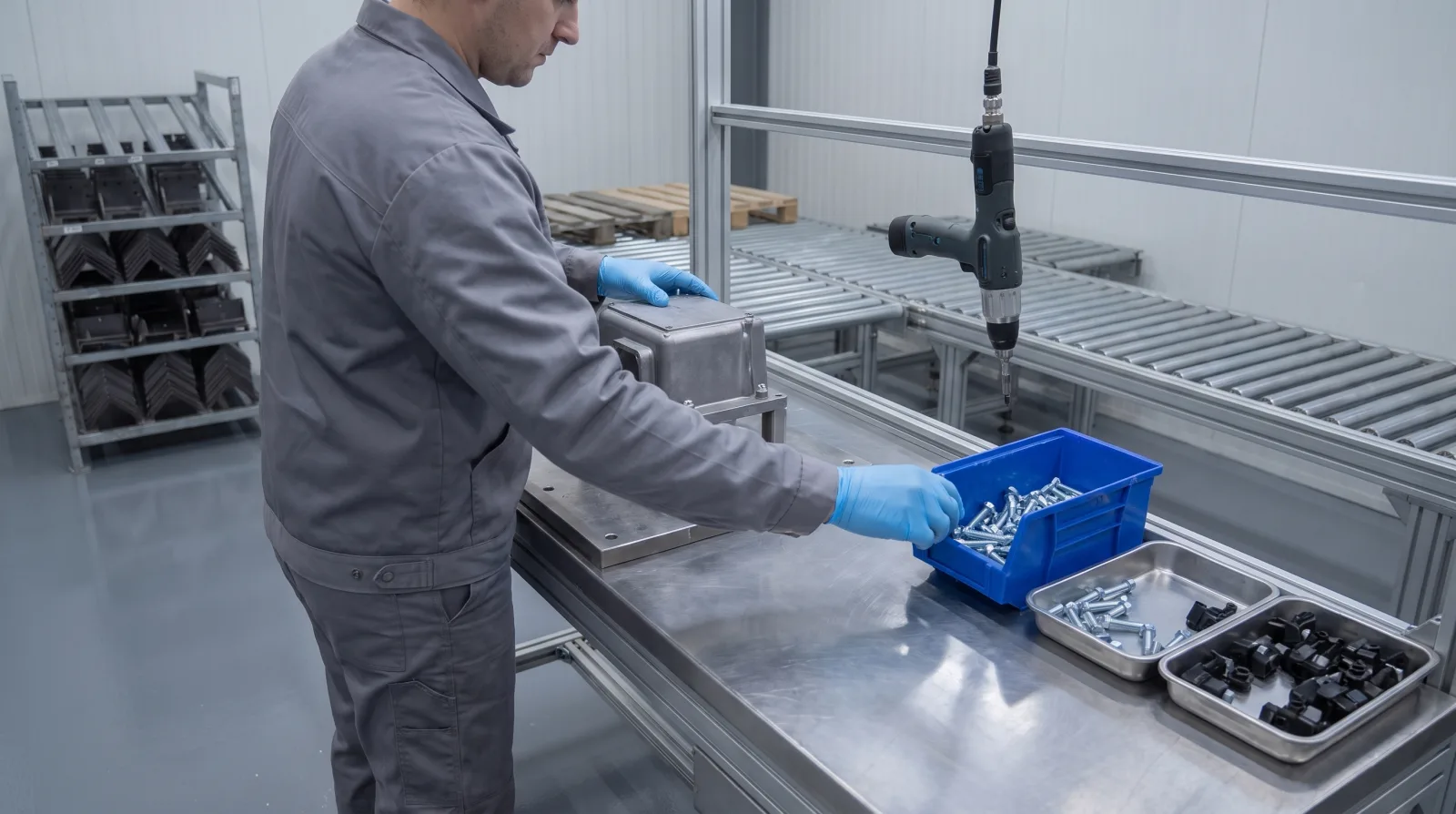
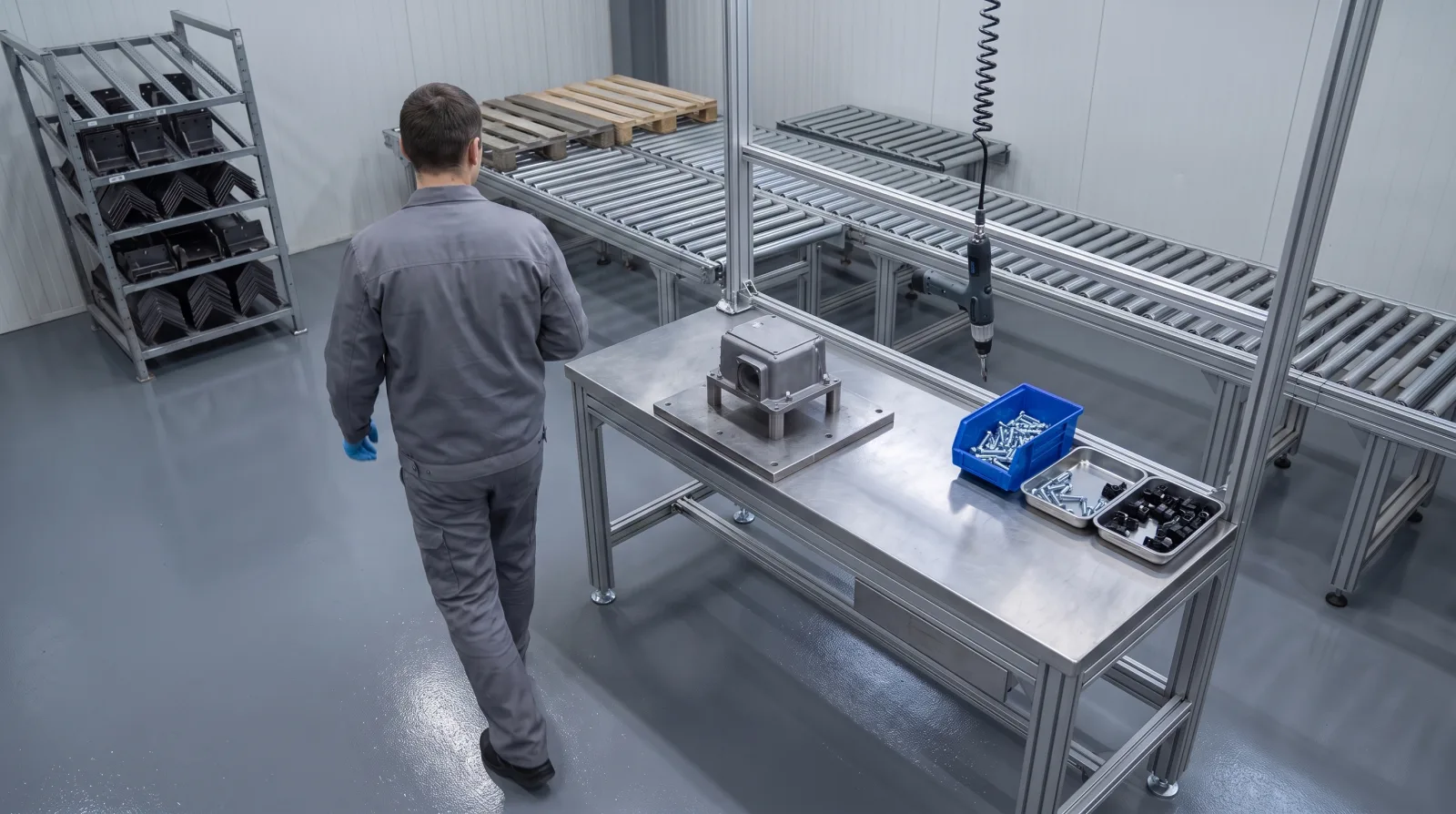
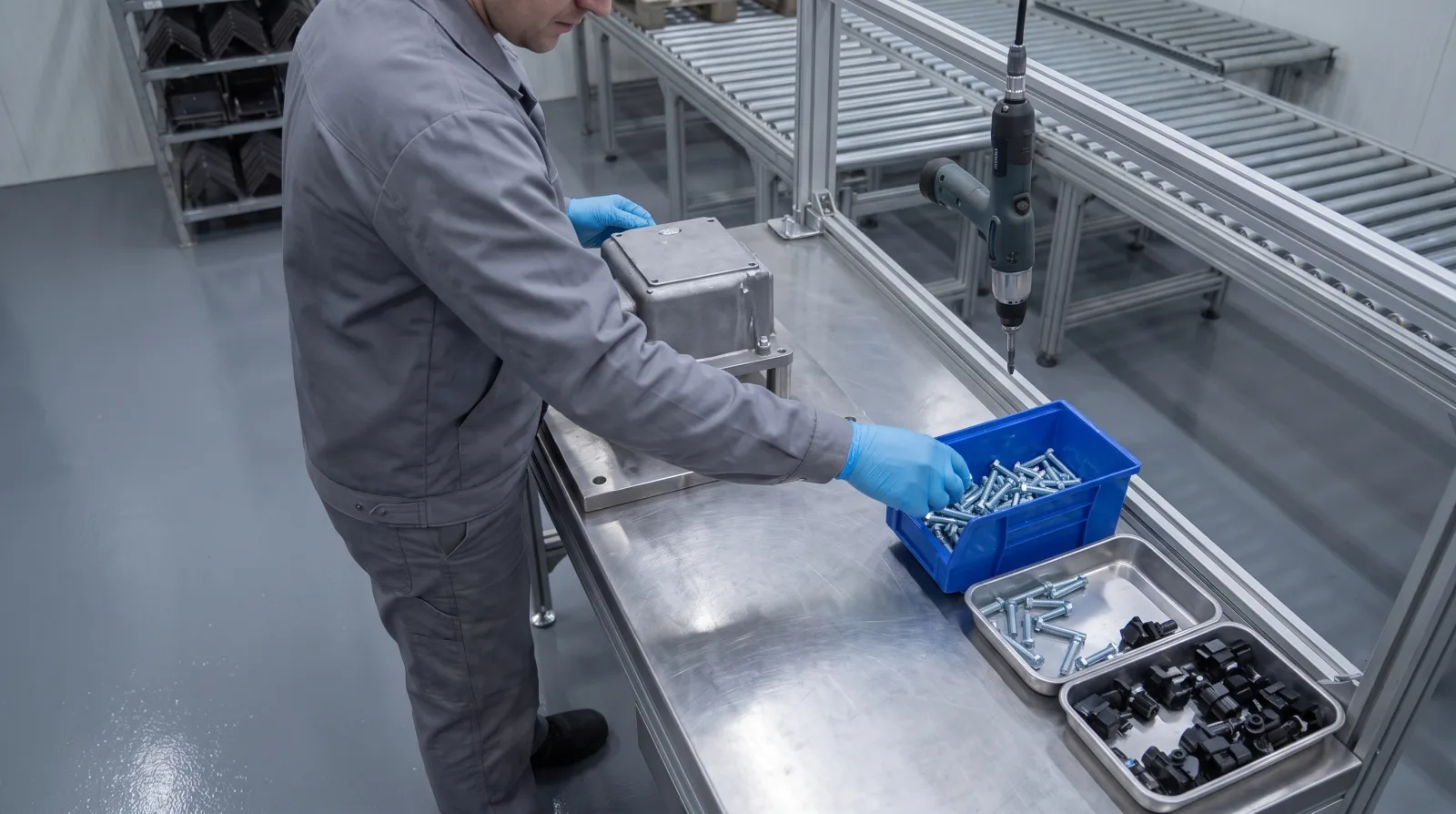
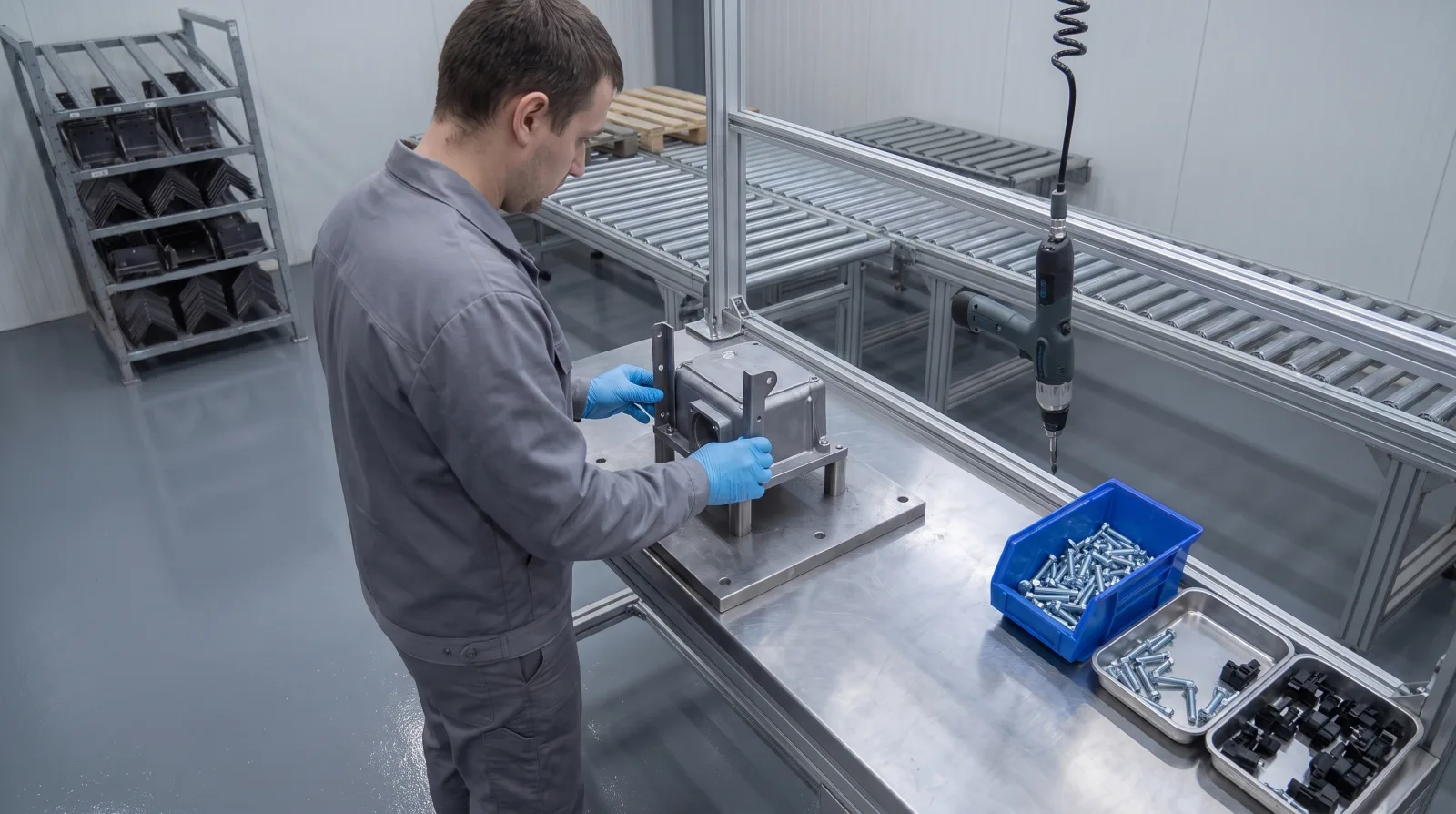


A one-person assembly cell.
A bench, a fixture, parts within reach — and a bracket rack across the floor. Hold that last detail.
Place the housing on the jig.
Set onto the fixture, located against the stops.
Walk to the rack for a bracket.
Across the cell and back. Feels like nothing — it’s in every cycle.
Pick two bolts.
Two, from the bin at his right.
Align the bracket.
Onto the housing, holes lined up.
Torque it down.
Driver pulled down; two bolts to spec.
Seat the connector.
Pressed on until it clicks.
Inspect & set on the conveyor.
A quick look, then it leaves the station.
Before you can improve it you have to break it into pieces. But into what pieces? Not every move is the same kind of thing — and the first cut is the one most people get wrong.
What counts as a work element?
A chunk of work you could hand, whole, to another operator in a rebalance. Run every part of the cycle through that one test.
“Walk to the rack” isn’t one.
You can’t hand someone the walking. It isn’t work you’d ever redistribute — it’s waste the layout created. Out it comes.
“Pick two bolts” isn’t one either.
You can’t pass off picking the bolts on its own — it only exists as part of installing the bracket. It’s a motion inside an element, not an element.
Four real elements.
Position the housing · install the bracket · seat the connector · inspect & release. Each one you could train, time, and hand off whole.
Take the meatiest element — installing the bracket — and look inside it. Even here, most of the seconds aren’t what you’d think.
Install the bracket — 14s.
Three motions, end to end. It looks like solid, productive work. Let’s x-ray it.
NNVA pick the bolts.
You can’t fasten without them — but picking them adds nothing to the product. Necessary non-value-add — NNVA for short.
NNVA align the bracket.
Also required, also no value added. More NNVA. Kaizen can shrink it; design constraints won’t let you delete it.
Value-add torque it down.
This is the only motion that changes the product the customer pays for — the bracket is now fastened. 7 of the 14 seconds.
Half of it isn’t value.
Even a “productive” element is mostly support. That’s normal — and it’s exactly where the next round of Kaizen lives.
Do that for every element and every second falls into one of three buckets — and what you do about each one is what classifying is really for.
40 seconds, every unit.
Ten motions across four elements — plus one walk. Now colour every second by what it really is.
Value-add — 12s.
Torquing the bracket, seating the connector. The only time that changes the product. Barely a third of the cycle.
NNVA — 20s.
Lifting, picking, aligning, checking. Required to do the value-add, but adds nothing itself. Shrink it — you can’t delete it.
Waste — 8s.
The walk. Adds nothing and isn’t needed — the layout put it there. This you eliminate.
Two categories, two verdicts.
Necessary work you improve. Waste you eliminate. That single distinction is what classifying every second buys you.
Necessary work you whittle down with Kaizen — it resists, because design put it there. Waste you remove outright. Start with the red: it’s the fastest, cleanest win on the floor.

8 seconds of pure waste.
Every cycle, the operator crosses the cell to the bracket rack and back. Hundreds of times a shift.
Bring the parts to the work.
Pull the bracket rack right up beside the bench. The walk becomes a reach — same brackets, now at arm’s length.
40s → 32s.
No faster hands, no harder work. Eight seconds gone — the entire waste bar — purely from fixing the layout. A 20% lift, and the value-add never moved.
Next: shrink the 20s of necessary work. Slower and harder — but the same method.Every element, its lowest repeatable time, and its key points — quality, safety, ease — go on one sheet. That sheet is the standard the whole team works to, and the baseline every improvement is measured against.
| # | Work element | Value-add in it | Key point (how & why) | Time |
|---|---|---|---|---|
| 1 | Position the housing on the jig | none · all support | Located hard against the stops — everything downstream depends on it | 5s |
| — | Walk to the bracket rack | Waste · eliminate | Move the rack to arm’s reach — the walk disappears | 8s |
| 2 | Install the bracket | 7s of 14s | Torque to spec, gun clicks off — the bracket is now fastened (the value-add) | 14s |
| 3 | Seat the connector | 5s of 8s | Push to the click — confirms the connection is made (the value-add) | 8s |
| 4 | Inspect & release | none · all support | Catch a defect here, not at the next station | 5s |
| Cycle time after removing the walk | 12s value-add | was 40s | 32s |
Run the study on your job
The same Time Observation Sheet, live below. Add your elements, record ten cycles, and let it find the lowest repeatable time — the basis for a real standard.
See the elements, and the waste has nowhere to hide.
Break a job into work elements — the chunks you could hand off. X-ray each one into value-add, necessary support, and waste. Then protect the value, shrink the support, and delete the waste — and a blur you manage becomes a standard you improve.
See how Kaizumi trains for it →Photos are AI-generated for this guide (generic, unbranded). Element times are illustrative. The work-element / value-add · necessary-non-value-add · waste framing follows standard Toyota-style standardized-work practice (正味 / 付随 / ムダ).
Frequently asked
- What is a work element?
- A work element is the smallest chunk of work you could hand off, whole, to another operator when rebalancing a line. That handoff test is what separates an element from a fragment: you can redistribute "install the bracket," but you cannot redistribute "pick up the bolts" on its own — picking the bolts only exists as a motion inside installing the bracket.
- What is the difference between value-add, necessary non-value-add, and waste?
- Value-add (正味) is work that physically changes the product the customer pays for — torquing a bracket, seating a connector. Necessary non-value-add (付随, NNVA) is work required to enable the value-add but adds nothing to the product — picking parts, aligning, positioning; you reduce it with Kaizen but design constraints stop you eliminating it. Waste (ムダ) adds nothing and is removable — walking to a rack the layout put too far away. The rule: shrink the NNVA, eliminate the waste, protect the value-add.
- Is walking a work element?
- No. Walking is waste, not an element. You can never hand off "the walking" to another operator, and it exists only because of how the cell is laid out — not because the job requires it. Move the parts to the work and the walk disappears entirely. That is the difference between waste (eliminate) and necessary non-value-add (reduce).
- How much of a work cycle is actually value-add?
- Usually far less than people expect. Even inside a "productive" element like installing a bracket, only the fastening is value-add — picking the bolts and aligning the part are necessary support. Across a whole cycle it is common for value-add to be roughly a third of the time, with the rest split between necessary support and outright waste. Seeing that split is the point of classifying every second.
- How do you record work elements and their times?
- With a Time Observation Sheet: list each work element, record about ten observation cycles, and take the lowest repeatable time (not the average) as the standard. Outliers from fumbles or missing parts are flagged but excluded. Those times become the basis for a Standardized Work Combination Table and a Standardized Work Chart.
Related
Founder of Kaizumi, an AI-powered Lean training platform. More about Matthew →
Updated June 29, 2026 · The work-element method and the value-add / necessary-non-value-add / waste (正味 / 付随 / ムダ) split are standard Toyota-style standardized-work practice. The assembly job, element times, and photos are illustrative, generated for teaching.