
The 7 wastes — remembered as TIM WOOD (Transportation, Inventory, Motion, Waiting, Overproduction, Over-processing, Defects) — are the activities that eat time, money, and effort on a project without getting the building any closer to done. In construction they hide in plain sight: steel that arrives two weeks early with nowhere to land, a crew standing idle because a purchase order is stuck in a queue, a wrong-grade rebar order that triggers a return-and-reorder loop. This guide translates all seven for construction procurement and field work, shows you how to run your first waste walk, and points you at the traps that make beginners chase the cheap, visible wastes while the expensive ones run free. The mantra throughout: the system creates waste, not the people.
Why the 7 wastes are different in construction
Most "7 wastes" material is written for a factory line — one station, one repeating cycle, parts that flow past an operator. Construction breaks those assumptions, and that's exactly why copy-pasted factory examples don't land on a jobsite:
- The "product" doesn't move — the work does. A building is fixed in place; people, materials, and information travel to it. So Transportation and Motion show up as trucks rerouted to offsite yards and as a purchase order bouncing through five inboxes, not as a conveyor.
- The "inventory" is heavy, weather-exposed, and project-specific. Excess on a line is a bin of parts. Excess on a site is forty crates of door hardware weathering in a tight staging yard, or a copper bundle corroding under a sagging tarp because it was ordered three months early to lock in pricing.
- Waiting is unusually expensive. When a line stops, you idle a machine. When a project stops, you idle a crew — skilled trades billing real labor rates, standing around because something upstream never got released.
- The wastes are tangled together. One bad decision rarely produces one clean waste. An early delivery creates Transportation, Inventory, and Motion at once. You learn to see them as a connected system, not a checklist.
So the goal isn't a tidy site or a faster typist. Borrowing the Toyota lens: efficiency is the consequence, not the goal. You're after the right material reaching the right place at the right time — and far less chasing, re-entering, and waiting wrapped around it.
The one-line test for any procurement step: is this moving the right material toward the right place at the right time — or is it just moving, sitting, or being redone? If it's the latter, you've found waste.
The 7 wastes, translated for construction
The seven are easiest to remember as TIM WOOD. Here's what each one actually looks like once there's a flatbed truck and a procurement queue involved. (For the underlying concept, see waste, also called muda.)
1Transportation — moving materials or information that adds no value
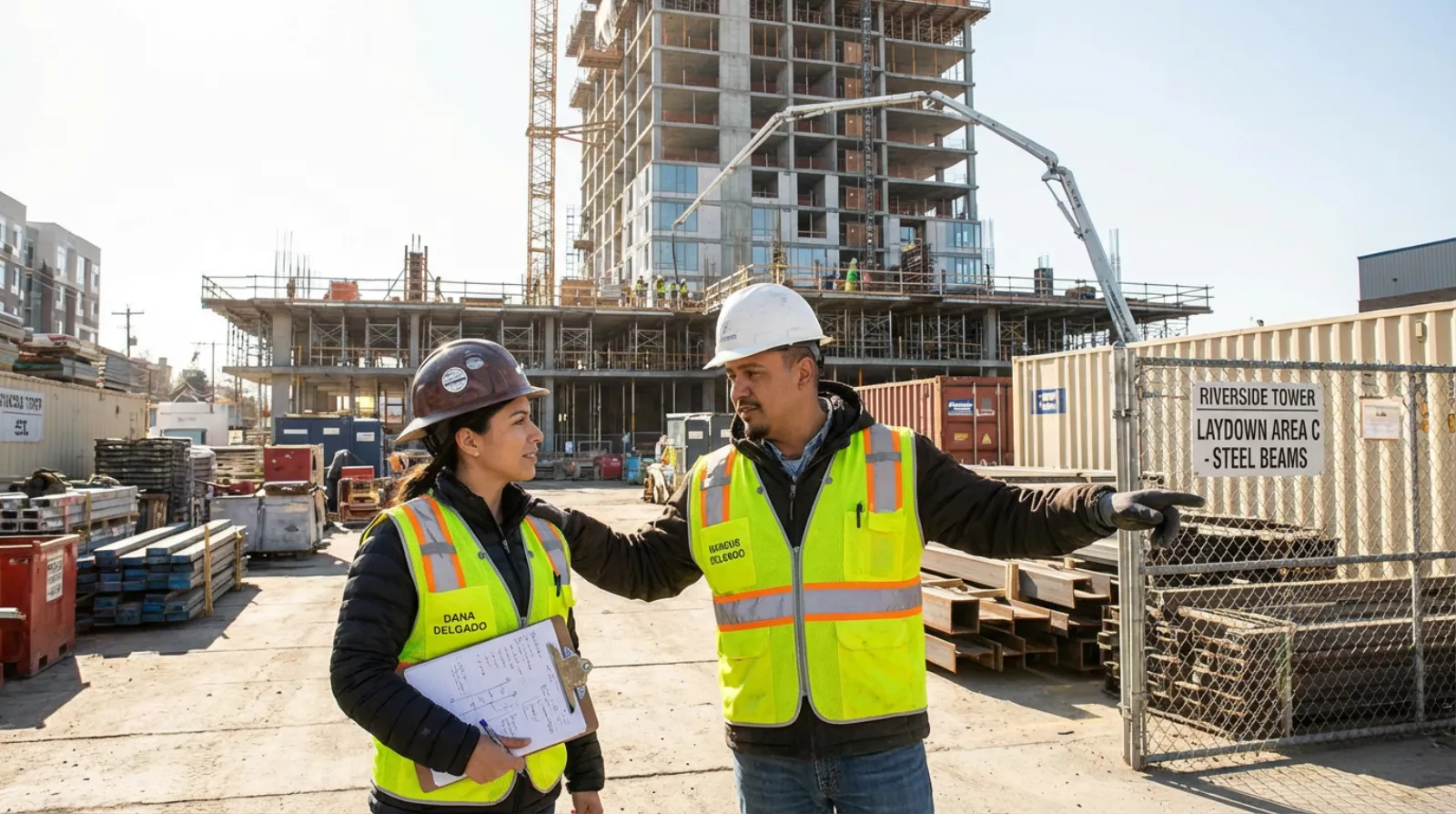
Transportation is any movement of materials or information that doesn't get the work closer to installed. The physical version: steel that arrives early, gets trucked to an offsite yard because the staging yard is full, then trucked back when the site is finally ready — two extra trips, two extra crane picks, and a coordinator spending half a day rearranging schedules. The information version is just as real: a purchase order routed through five inboxes for approval when only two of those people actually review it. The PO travels, accruing time at every stop, and gains nothing.
2Inventory — more on hand than the work needs right now
Inventory waste is material sitting before it's needed. Bulk-ordering door hardware for all fourteen floors to capture a volume discount feels smart — until eleven floors' worth sits crated in the yard for six weeks while only floors one through three are roughed in. The waste isn't only the material; it's the cash tied up, the contested yard space consumed, and the damage that accumulates while it waits.
3Motion — unnecessary movement of people
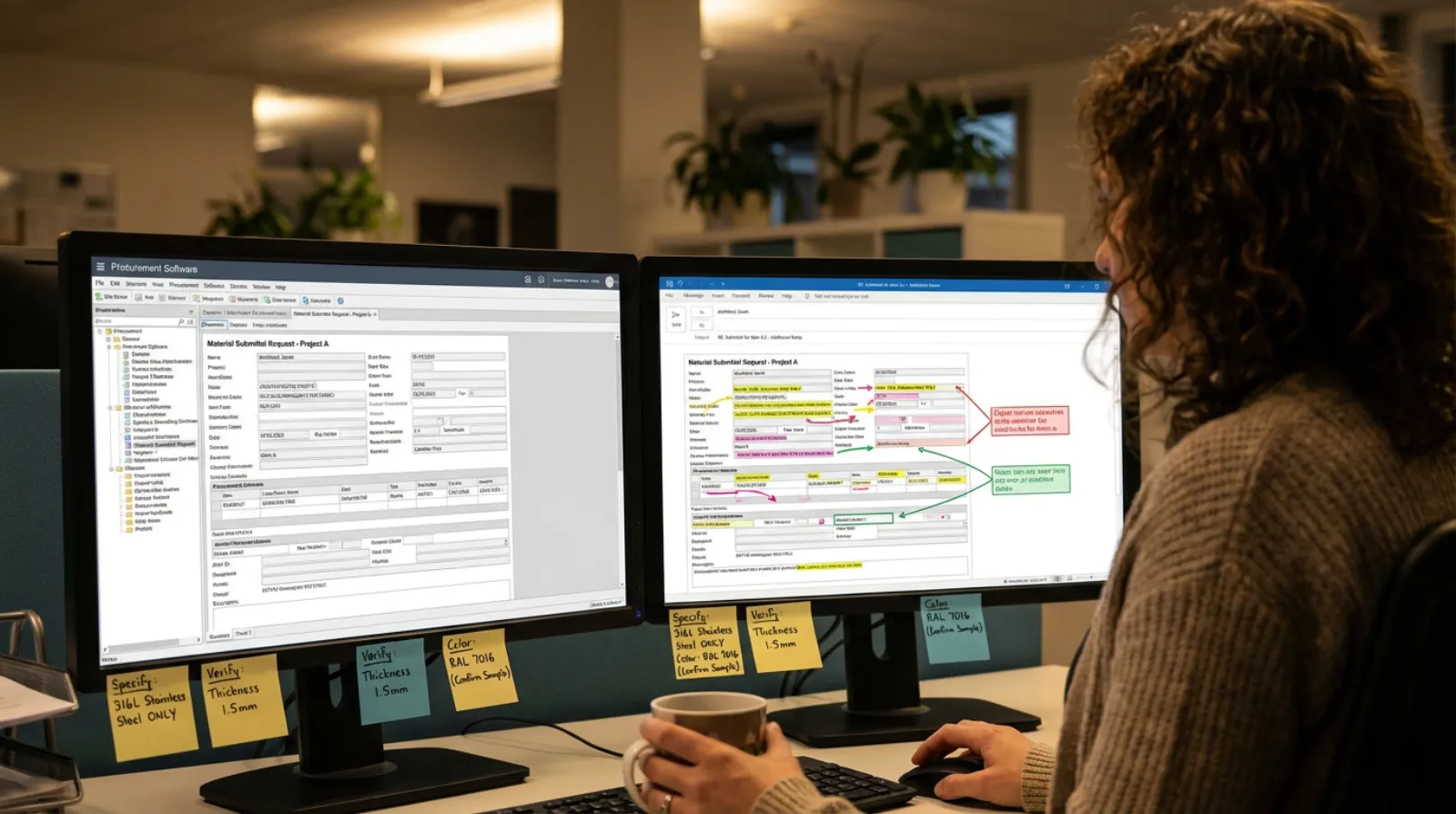
Where Transportation moves things, Motion moves people. A coordinator toggling between six software systems to process a single PO is in Motion — moving, but the PO gains nothing from the switching. So is the walk to a printer down the hall for a paper approval form, then to a manager's office for a signature, then back to scan it. The test: is this movement necessary for the work to gain value, or is the person moving because the system is poorly arranged?
4Waiting — idle time while something upstream catches up
Waiting is work stopped because something hasn't arrived, been approved, or been decided. On site it's the most expensive waste of all: four electricians ready to rough in conduit — tools out, permits pulled — standing idle because the junction boxes are still sitting in a vendor-confirmation queue. In the office it's the RFI parked in an architect's inbox for nine days, or a subcontractor bid stalled on an incomplete scope package. Waiting feels invisible because you're busy with other things while that one item sits — but the schedule doesn't care that you were busy.
5Overproduction — doing, ordering, or processing more than is needed now
Overproduction is ordering 20% extra "just in case," processing POs for materials not needed for three months, or generating reports nobody reads. It feels productive — like staying ahead — which is exactly why it's the most damaging of the seven. It directly triggers the others. Bulk-order just in case → excess Inventory. That inventory must be moved and tracked → Transportation and Motion. It sits long enough to deteriorate or go out of spec → Defects. And while you manage all that surplus, what the project actually needs right now is Waiting. One overproduction decision cascades into five other wastes — which is why Lean thinkers treat it as the root.
6Over-processing — more effort than the job requires
Over-processing is correct work, done to excess. The PO is fine, but it needs three management signatures when one person has full authority. The submittal would have been approved as-is, but someone spent forty-five extra minutes adding annotations the architect never asked for. Re-entering the same vendor data into three systems that don't talk to each other; running a detailed cost comparison on a sole-source item with exactly one qualified supplier — all correct, all more than the outcome requires.
7Defects — work done wrong that has to be redone
A defect is any error that triggers rework: a wrong grade of rebar specified on a PO, the wrong door hardware ordered from an outdated schedule, a submittal bounced back because it was missing a detail sheet. Each defect spins up a loop of calls, emails, reprocessing, return shipments, and reordering. The clean line between the last two: Over-processing is too much correct work; a Defect is work done wrong. Three unnecessary signatures is over-processing. A transposed quantity — 5,100 feet of conduit instead of 1,500 — is a defect.
How to run your first waste walk (step-by-step)
A waste walk is the practical method for finding these in your own work: pick one process, follow it end to end, and observe what actually happens at each step — not what's supposed to happen. The most important rule is the same one that runs through this whole guide: you're studying the system, not the person. When you spot waste, you've found a process problem, not a people problem.
- Pick one process and one unit. A single purchase order from field requisition to delivery acceptance is ideal — concrete, bounded, and full of handoffs.
- Walk it with the people who live it. Don't do this alone. Pair the procurement side with the field side; neither has the full picture. One sees where the PO stalled in approvals; the other knows the material sat on a flatbed four hours because rigging wasn't scheduled.
- Time every step and handoff. Write down each stage, when it started, and when it actually moved. Separate the time someone was working on it from the time it was just sitting.
- Ask the seven questions at each step. Transportation: is this moving, and does the move add value? Inventory: is anything piling up waiting to be worked? Motion: am I switching systems or walking where a better layout would remove the trip? Waiting: is this step idle, and what's it waiting on? Overproduction: is this being done because it's needed now, or just to get ahead? Over-processing: does this step need this much effort? Defects: has anything here had to be redone?
- Sort findings into three buckets, not two. Value-added, necessary non-value-added (code-required inspections, insurance verification — can't be cut, but maybe streamlined), and pure waste. Don't mislabel a safety submittal as waste to eliminate.
- Let the data tell the story. Total the value-added time against the elapsed time. The ratio is usually startling — and it's the start of a prioritized list, not a to-do list of fixes.
A focused single-PO waste walk is a Gemba walk aimed at one value stream — go and see the actual work, ask questions, study the system. It's the unit you repeat.
A worked example: following one purchase order
To make the method concrete, here's how a single waste walk might play out on one PO for mechanical ductwork. The numbers are an illustrative setup — the moves and the ratio are what you'll actually find.
Say a coordinator follows the PO from field requisition to delivery acceptance and times every step. The full journey takes 23 working days. When she totals the time someone was actively creating it, reviewing specs, and confirming with the vendor, it comes to about 1.5 days. The other ~21.5 days, the PO was sitting — in an inbox, awaiting a signature, awaiting a vendor callback, or routed to someone who didn't need to see it. Here's the breakdown:
| Where the 23 days went | Days | Waste type |
|---|---|---|
| Sitting idle, awaiting approvals / vendor callbacks | 11 | Waiting |
| Routed to people who didn't need to review it | 3.5 | Transportation |
| Extra approval steps + duplicate data entry | 3 | Over-processing |
| Switching between systems to process it | 2 | Motion |
| Rework on a spec error | 2 | Defects |
| Actually creating value | 1.5 | Value-added |
Roughly 27% of the elapsed time was value-added — and notice the most expensive lines aren't the annoying ones. The point isn't to shave the 1.5 days of real work; it's to attack the 21.5 days of waiting, routing, and rework around it. No blame — just facts the team can act on.
A simple construction waste audit
You don't need a stopwatch to start seeing waste. Walk one process — a PO, a delivery, a submittal cycle — and score it against these seven prompts. Keep it to one page so it actually gets used:
- Transportation: Is any material or document moving without getting closer to installed? How many approval stops does a typical PO make versus how many actually review it?
- Inventory: What's sitting in the yard or in a queue ahead of when the work needs it? Anything weathering, expiring, or going out of revision?
- Motion: How many systems does one PO touch? How many physical trips (printer, signatures, scanning) does an approval require?
- Waiting: Where does work stop? What's the average RFI turnaround, approval-queue dwell, and vendor-confirmation lag?
- Overproduction: What gets ordered "just in case" or processed months early? What reports are produced that no one reads?
- Over-processing: Where are there more signatures, more annotations, or more data entry than the outcome requires?
- Defects: What share of POs or submittals get bounced back for rework, and what does each loop cost in time and delay?
You can map the bigger picture of where time and material flow — and where they stall — with a value stream map; the waste walk above is the close-up that feeds it.
Common construction mistakes
- Trying to fix everything at once. When you first start seeing waste, it's everywhere, and the urge to change it all is strong. Tackling all seven at once spreads the team thin, finishes nothing, and breeds change fatigue. Pick one or two with the biggest payoff and start there.
- Only seeing the easy wastes. Motion is the most visible waste — you feel every system switch and printer trip — but it's often the cheapest. The expensive wastes (Overproduction and Defects) are embedded in decisions made weeks ago and are far harder to see. Always ask: am I chasing the wastes that annoy me, or the ones that cost the project?
- Confusing necessary work with pure waste. A code-required fire-safety review or a contractually required insurance verification doesn't build the building, but you can't cut it. Those are necessary non-value-added activities — streamline them (submit earlier, send more complete packages), don't target them for elimination.
- Treating overproduction as prudence. "Order extra, get ahead" feels like good risk management. Sometimes a buffer is the right call — but make it a conscious decision with the cascading costs understood, not a reflex.
- Turning a waste walk into a blame walk. The moment "we study the system" becomes "who messed up," people stop showing you the real waste. Frontline crews know where the system breaks; protect that honesty. (See respect for people.)
Templates & tools
- Use the seven-question audit above as your first waste-walk checklist — one page, one PO, walked with both the procurement and field sides.
- For the bigger flow picture, map the value stream with value stream mapping; for the on-the-floor observation discipline, run a Gemba walk.
- See the method as an interactive, multi-lesson module in the featured card above — it walks the steel-delivery scenario, the waste definitions, and a full waste walk with built-in practice.
FAQ
What are the 7 wastes in construction? The seven are Transportation, Inventory, Motion, Waiting, Overproduction, Over-processing, and Defects — remembered as TIM WOOD. In construction they show up as rerouted deliveries, materials sitting in the yard, staff toggling between systems, idle crews, ordering too much too early, excess approvals and annotations, and rework from wrong orders or incomplete submittals.
Which of the 7 wastes is the most damaging? Overproduction — doing, ordering, or processing more than is needed right now. It's the root waste because it directly triggers the others: excess orders create inventory, which creates transportation and motion to manage it, defects as material deteriorates, and waiting as cash and space get tied up. Attack the overproduction and much of the downstream waste resolves itself.
What's the difference between Transportation and Motion? Transportation is unnecessary movement of materials or information (a delivery rerouted to an offsite yard; a PO bouncing through five inboxes). Motion is unnecessary movement of people (walking to a printer; toggling between six software systems). Same instinct, different thing moving.
How do I start finding waste on my project? Run a waste walk. Pick one purchase order or delivery, follow it from requisition to acceptance, time every step and handoff, and ask the seven observation questions at each one. Do it with both the procurement and field sides present. You're not fixing anything yet — you're learning to see.
Is a code-required inspection a waste? No. Inspections, permits, and insurance verifications are necessary non-value-added work — they don't physically build the building, but they can't be eliminated. Don't target them for cutting; look at whether they can be streamlined while respecting their purpose.
Related concepts & guides
- Dictionary: Waste · Muda · Gemba Walk · Value Stream Mapping · Just-in-Time · Respect for People · Continuous Improvement · Kaizen Event
- Guides: How to do a Gemba walk in manufacturing — the observation discipline behind a waste walk, in a different setting.
Sources
- Lean Enterprise Institute, Lean Lexicon: Muda, Mura, Muri
- Ohno, T., Toyota Production System: Beyond Large-Scale Production