
A gemba walk in manufacturing is a leader going to the place where the work happens — the line, the cell, the dock — to see the real condition with their own eyes and understand it by asking the people who do it. It is not an audit, not a tour, and not a checklist hunt for who broke a rule. The point is to observe the actual work against the standard, surface the obstacles operators hit, and turn what you saw into improvement. This guide covers where to walk, what to look at, the questions that open people up instead of shutting them down, how long and how often to go, and — the step most people skip — what to do after you walk so it changes the work instead of just filling a clipboard.
Why a gemba walk is different in manufacturing
Gemba — genba — just means "the actual place." Almost every other improvement habit can be done from a desk: read the report, look at the dashboard, run the numbers. The gemba walk exists precisely because the report is not the work. On a manufacturing floor that gap is wide and physical:
- The numbers reach you hours late and already averaged. A line summary tells you yesterday's output. It cannot tell you that the operator at station three is reaching across her body for every part, that the torque gun cord catches on the fixture, or that parts arrive in a tote that has to be flipped before they can be picked. Those are the things eating your pace, and they only exist in the place.
- Standard work is a document until you watch it run. A laminated sheet says the job takes 48 seconds in nine steps. The floor shows you the operator doing eleven steps because two workarounds got baked in months ago and nobody updated the sheet. The walk is where the standard and reality get reconciled.
- The waste is visible if you slow down enough to see it. Muda — the lean term for any activity that uses resources but adds no value the customer would pay for — is concrete on a floor: a tote of work-in-process (WIP) sitting between stations, an operator walking to a shared tool, a stack of rework waiting for disposition. You don't infer it from a spreadsheet; you stand still and watch it happen.
- The biggest risk is that you walk like an auditor. The moment people read your visit as inspection, they show you the clean version and the problems go underground. A manufacturing floor has a long memory for the manager who walked the line only to find someone to blame. Done that way, the walk doesn't just fail — it actively teaches people to hide.
So the goal isn't to catch problems or to look busy on the floor. Borrowing the Toyota lens: efficiency is the consequence, not the goal. You go to see the work clearly, to remove the obstacles burdening the people doing it, and to build the habit of fixing problems where they live. Better, safer, easier work comes first; the numbers follow.
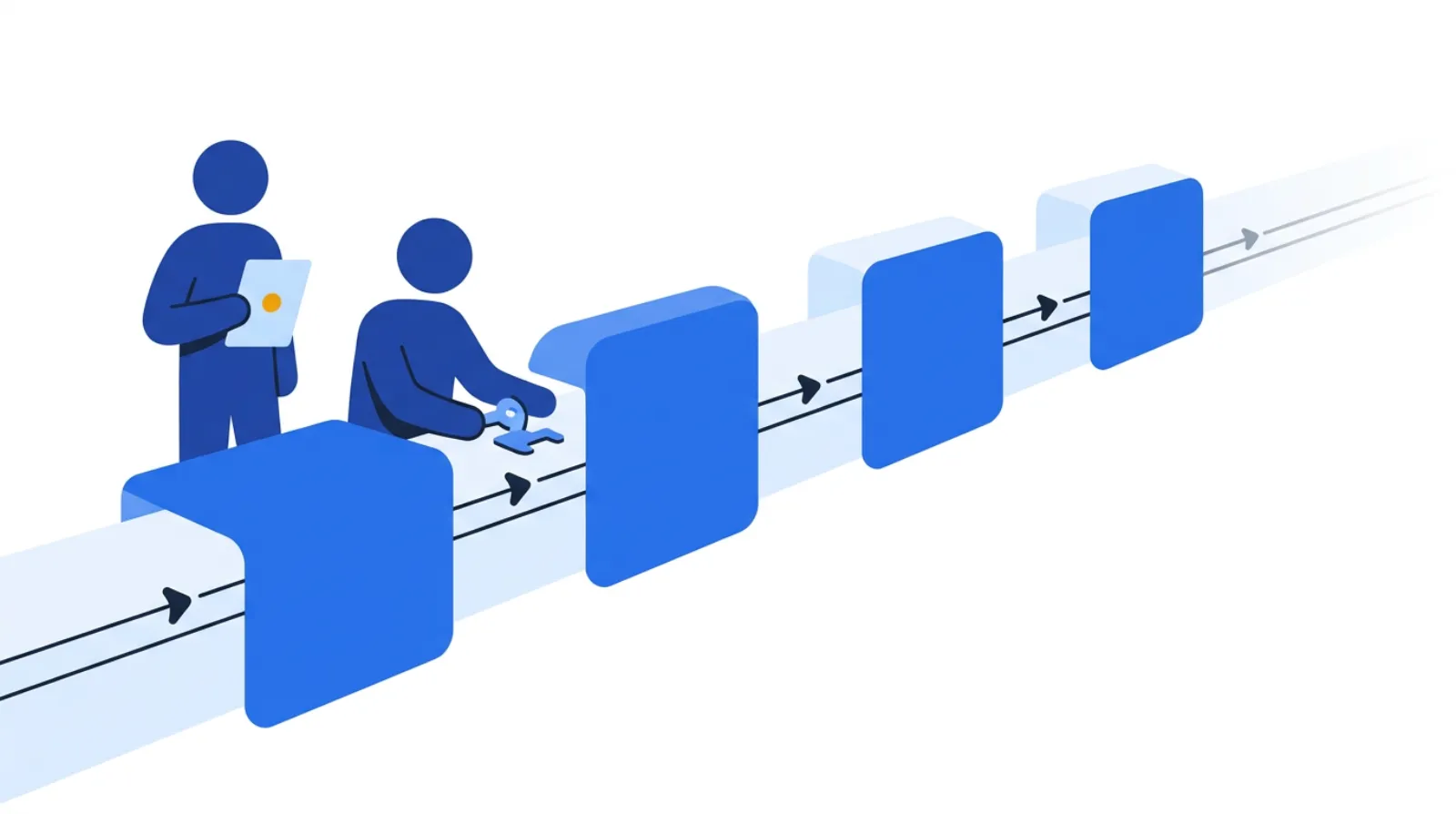 A gemba walk is watching the work with the people who do it — at the place, not from the office.
The one-line test for any gemba walk: did you leave understanding an obstacle the operator faces better than they could explain it from memory — and did they feel helped, not inspected? If yes, you walked the gemba. If you came back with a list of who to write up, you ran an audit.
This is also why a checklist template, on its own, can't do the work for you. A PDF tells you where to look; it can't ask the second question, read a face, or notice the thing that isn't on the list. The checklist is scaffolding. The walk is a leadership behavior — go see, ask why, respect the people.
What a good gemba walk actually looks at
A gemba walk has a focus, not a free-for-all. Pick a theme before you go — safety, quality, flow, or a specific problem — so your eyes have a job. Here's what to observe under each, translated for a manufacturing floor.
1Safety first — the condition that protects people
Start every walk with safety, always, because it signals what you value before you say a word. Look at the real ergonomics of the job: reaches, twists, lifts, repetition. Watch for blocked aisles, missing guards, pinch points, a frayed cord, PPE that's present but not worn because it's uncomfortable. Safety is never a "gotcha" — it's the clearest expression of respect for the people doing the work, and an operator who sees you fix a hazard they raised will tell you everything else.
2The work against standard work — watch the actual sequence
Stand where you can see one operator do the full cycle, and watch several cycles, not one. Compare what you see to the posted standard work: same steps, same sequence, same time? Where they differ, you've found something — either the operator has a better way the standard should capture, or there's an obstacle forcing a workaround. Don't correct on the spot. Note it, ask about it, and treat the gap as information, not a violation.
3Visible flow and waste — what's piling up and waiting
Look at the spaces between the value-adding steps. Is WIP stacking up in front of one station — the bottleneck showing itself? Is an operator waiting on parts, walking to a shared tool, untangling a hose, searching for a fixture? Those are several of the classic wastes made physical — motion, waiting, transport, excess inventory. The floor shows them to you for free if you slow down enough to notice.
4The visual management — can the floor tell you its own state?
A healthy floor talks to you without anyone speaking. Can you tell, in a glance, whether each station is ahead or behind? Is the hour-by-hour board filled in honestly, or backfilled at break? Are abnormal conditions flagged? Good visual management and a working andon — the signal (often a light or a cord) an operator uses to flag a problem the moment it happens — mean problems surface in seconds, not at end-of-shift. If you can't read the floor's state at a glance, that's your finding.
5The people's obstacles — what gets in their way
The richest data on any walk comes from the operators, and it only comes if you ask well. You're after the friction in their day: the thing that breaks, the part that's hard to fit, the information they don't get, the tool they have to share. This is the heart of the walk — surfacing the obstacles so you can remove them — and it's why the questions you ask matter more than anything on your clipboard.
The questions to ask (and the ones to avoid)
The fastest way to wreck a gemba walk is to ask questions that sound like an interrogation. "Why are you behind?" puts an operator on defense and ends the conversation. The questions that work are open, about the work not the person, and genuinely curious. A few that earn real answers on a manufacturing floor:
- "Can you walk me through how you do this?" — Lets them show you the real sequence, workarounds and all.
- "What's the most frustrating part of this job?" — Surfaces the daily friction faster than any metric.
- "What slows you down or makes you wait?" — Targets waste from the person who feels it.
- "How do you know when something's wrong here?" — Tests the visual management and quality signals.
- "If you could change one thing about this station, what would it be?" — Invites the improvement idea they've been sitting on.
- "What did you have to work around to make standard today?" — Names the gap between standard work and reality without blame.
For a safety-focused walk, shift the questions to risk: "What's the riskiest part of this task? Where have you had a near miss? What do you do that doesn't feel safe but feels faster?" The aim is the same — get the truth about the real condition, from the person who lives it.
What to avoid: anything starting with "Why didn't you…", anything that asks them to defend a number, and any question you ask while looking at your phone. And resist the urge to solve it on the spot in front of everyone — that turns their problem into your show. Listen, ask the next question, write it down.
How to run your first gemba walk (step-by-step)
Pick one area — a single line or cell — and one theme. Don't try to walk the whole plant.
- Pick a focus and tell people you're coming. Choose a theme (safety, a quality escape, flow on one line). A surprise walk reads as a raid; a known, regular walk builds trust. The standard is the same either way — see the real condition.
- Go to the actual spot and stand still. Position yourself where you can watch a full work cycle without being in the way. Then watch several cycles before you say anything. Most people talk too soon and see too little.
- Observe against the standard. Compare what you see to the posted standard work and to what the visual controls say. Note gaps as questions, not verdicts.
- Ask the operators — open questions, about the work. Use the questions above. Listen more than you talk. When something surfaces, ask "why" a couple more times to get past the symptom — that's 5 Whys on your feet, not a forensic interview.
- Write down what you saw and heard — on the spot. Specific observations and the obstacles people named. Not "improve flow" but "operator at station 3 walks to shared torque gun ~6×/cycle." Vague notes die; specific ones get fixed.
- Close the loop before you leave the floor. Tell the people what you'll follow up on and by when. Then actually do it and come back to tell them. Nothing builds a walk's credibility like an operator's complaint that visibly got fixed.
A worked example: a morning walk on an assembly line
Here's how a focused 30-minute walk tends to play out. The observations are an honest hypothetical — the shape is what you'll find on a real floor.
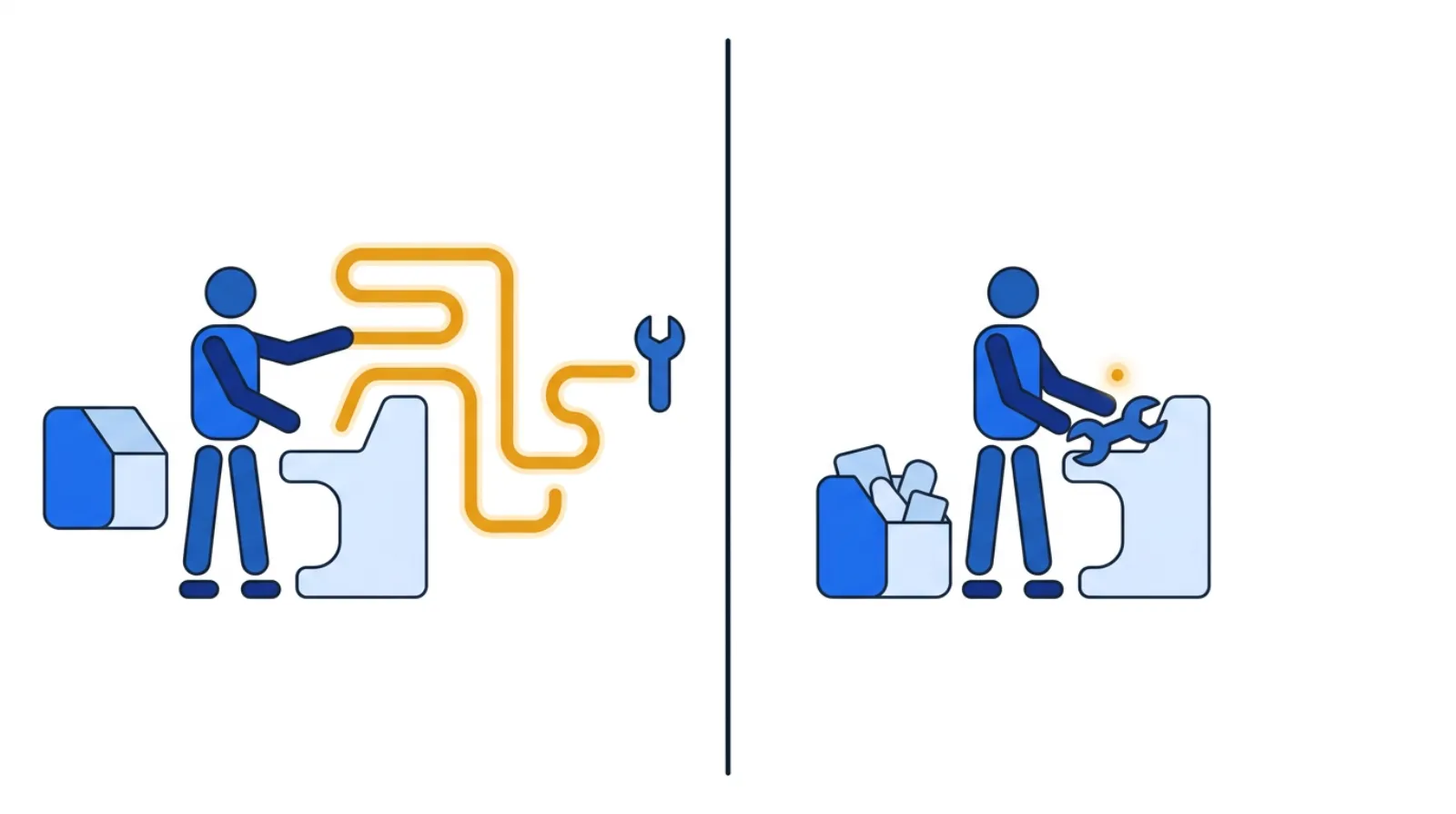
A line lead picks a flow theme and walks one assembly line for half an hour. Standing at each station for a few cycles and asking what gets in the way, here's what the notes look like:
| Station | What you observed | What the operator said | The real obstacle |
|---|---|---|---|
| 1 — Sub-assembly | Reaching across body for every part | "The tote sits on my left, parts face away" | Part presentation — fix, don't blame |
| 2 — Main build | Walks to shared torque gun ~6×/cycle | "We share one gun between two stations" | Motion waste from a tooling shortage |
| 3 — Test | WIP stacking up in front of station | "I'm always waiting on the build" | Imbalance — Station 3 is the bottleneck |
| 4 — Pack-out | Hour-by-hour board blank since break | "I fill it at the end, no time during" | Visual management not real-time |
Read those notes and the moves are obvious — and none of them are "tell the operators to hurry." Station 1's reach is a part-presentation fix (turn the tote, present parts at the point of use) that makes the work easier; remove the awkward reach and the time comes down on its own. The shared torque gun at Station 2 is pure motion waste; a dedicated gun is worth pricing against the time the operator loses walking — let the actual numbers decide, not a guess. Station 3's growing WIP marks the real constraint, the place a follow-up improvement event should aim. And the blank board at Station 4 means the line can't see its own state in real time — fix the visual management so problems can surface during the shift instead of at the end of it.
Notice what the walk did: it converted "the line feels slow" into four specific, ownable obstacles, each tied to a person who confirmed it. That's the output of a gemba walk — not a score, a to-fix list grounded in what you saw — and it's the raw material for your next kaizen.
A simple gemba walk health check
You don't need a 40-line audit form. After a walk, ask yourself five honest questions — if you can't answer yes, you toured, you didn't walk the gemba:
- Did I stand and watch the actual work for several full cycles, not just pass through?
- Did the operators do most of the talking, and did I learn an obstacle I didn't know about?
- Did I observe against a standard — comparing what I saw to standard work and the visual controls?
- Did I capture specific observations, not vague intentions ("station 3 waits ~40s/cycle," not "improve flow")?
- Did I close the loop — commit to a follow-up, do it, and come back to tell the team?
Make the walk a routine, not a mood. Building it into leader standard work — a set day and time, a known route, a simple record — is what turns a good intention into continuous improvement the floor can count on.
Common manufacturing gemba walk mistakes
- Walking like an auditor. Hunting for who broke a rule teaches people to hide problems. Watch the work, not the worker.
- Talking before watching. Narrating, correcting, or fixing on the spot means you see one cycle and miss the pattern. Stand still and watch several first.
- Asking closed, defensive questions. "Why are you behind?" ends the conversation. Open, work-focused questions keep it going.
- Walking only when there's a problem. A walk that appears only after a bad week reads as punishment. Regular, routine walks build the trust that surfaces problems early.
- No follow-up. The fastest way to kill every future walk is to collect obstacles and fix none. If you can't close the loop, don't ask the question yet.
- Skipping the standard. Without standard work and visual management to observe against, you're just sightseeing — there's no baseline to see a gap from.
- Making it a managers-only ritual. The richest walks include the operators and frontline leaders. The point is shared seeing, not a VIP procession.
Templates & tools
- A focus theme + a notebook beats a fancy form. Pick safety, quality, or flow before you go, and write specific observations in the operator's own words.
- Standard work is your baseline — you can't see a gap without the standard to compare against. Make sure it's posted and current before you walk.
- Visual management and a working andon are what let the floor show you its own state; if they're missing, that's your first finding.
- Build the walk into leader standard work — a fixed cadence and route — so it sticks. A kamishibai board (rotating audit cards) is the common way plants make the routine visible.
FAQ
How do you do an effective gemba walk? Go to the actual place where the work happens, pick one focus (safety, quality, or flow), and watch a full work cycle several times before you speak. Then ask the operators open questions about the work — "what slows you down?", "what's the most frustrating part?" — and listen more than you talk. Compare what you see to the standard work. Capture specific observations, and close the loop by following up on the obstacles people raised. Effectiveness comes from seeing the real condition and helping, not from inspecting.
How often should you do a gemba walk? Make it a routine, not a reaction. Frontline leaders and supervisors often walk daily; plant and senior managers commonly walk weekly. The exact cadence matters less than regularity — a predictable, scheduled walk built into leader standard work builds far more trust and surfaces more problems than an occasional surprise visit.
How long should a gemba walk take? Long enough to watch the work, short enough to stay focused — typically 20 to 45 minutes for one area or line. A daily supervisor walk might be 15 minutes on a single cell; a deeper themed walk runs 30 to 60. Resist trying to cover the whole plant in one pass; one area observed well beats five glanced at.
What should you do after a gemba walk? This is the step most people skip. Review your specific observations, prioritize the obstacles operators raised, assign owners and dates for the top one or two, and — critically — go back and tell the team what you're doing about what they told you. An obstacle that visibly gets fixed is what earns you the truth on the next walk. Feed bigger items into a kaizen event or a 5 Whys on root cause.
What's the difference between a gemba walk and an audit? An audit checks compliance against a rule and produces a score, often with someone accountable for a miss. A gemba walk seeks understanding — it watches the work, asks the people who do it about their obstacles, and produces a list of things to fix for them. Same floor, opposite intent. The instant a walk feels like an audit, people show you the clean version and the real problems go underground.
What questions should you ask on a safety gemba walk? Focus on risk from the operator's point of view: "What's the riskiest part of this task?", "Where have you had a near miss?", "What do you do that feels faster but not safe?", and "What would make this job safer?" Then fix something they raise — a visible safety fix is the single best way to prove the walk is about respect for people, not catching them out.
Related concepts & guides
- Dictionary: Gemba Walk · Gemba · Standard Work · Visual Management · Muda · Andon · 5 Whys · Leader Standard Work · Respect for People · Kaizen
- Guides: How to Use Takt Time in Manufacturing for the cycle-time-vs-pace math a flow walk surfaces, and How to Do 5S in a Warehouse for organizing the work a walk exposes.
Sources
- Lean Enterprise Institute, Lean Lexicon: Gemba (Genba)
- Womack, J., Gemba Walks (Lean Enterprise Institute)