Karakuri: automation made of gravity.
Japan’s factories hold a national championship for machines that use no electricity — gravity, string, counterweights and eight simple mechanisms, built by the operators themselves. It descends from Edo tea-serving dolls, it powered Toyota’s founding loom, and it’s back as the "ultimate carbon-neutral device." There’s one inside you can run.
Japan’s factories compete with machines that use no power at all.
Every year, Japan’s biggest manufacturers gather in Nagoya to compete — with machines that use no electricity, no air, no motors. The 2024 grand prize went to a Toyota Auto Body device named 恋のエレベーター — "the Love Elevator." This is karakuri kaizen, and it is deadly serious play. The rules, per Japan’s plant-maintenance institute: solve a real shop-floor problem using only natural energy — gravity, human motion, springs, magnets — through the eight basic mechanisms, cheaply, safely, and — the defining rule — built by the operators themselves.
JIPM exhibition materials; the hero image is an AI illustration of the device genre.The lineage runs from a tea-serving doll to Toyota’s founding machine.
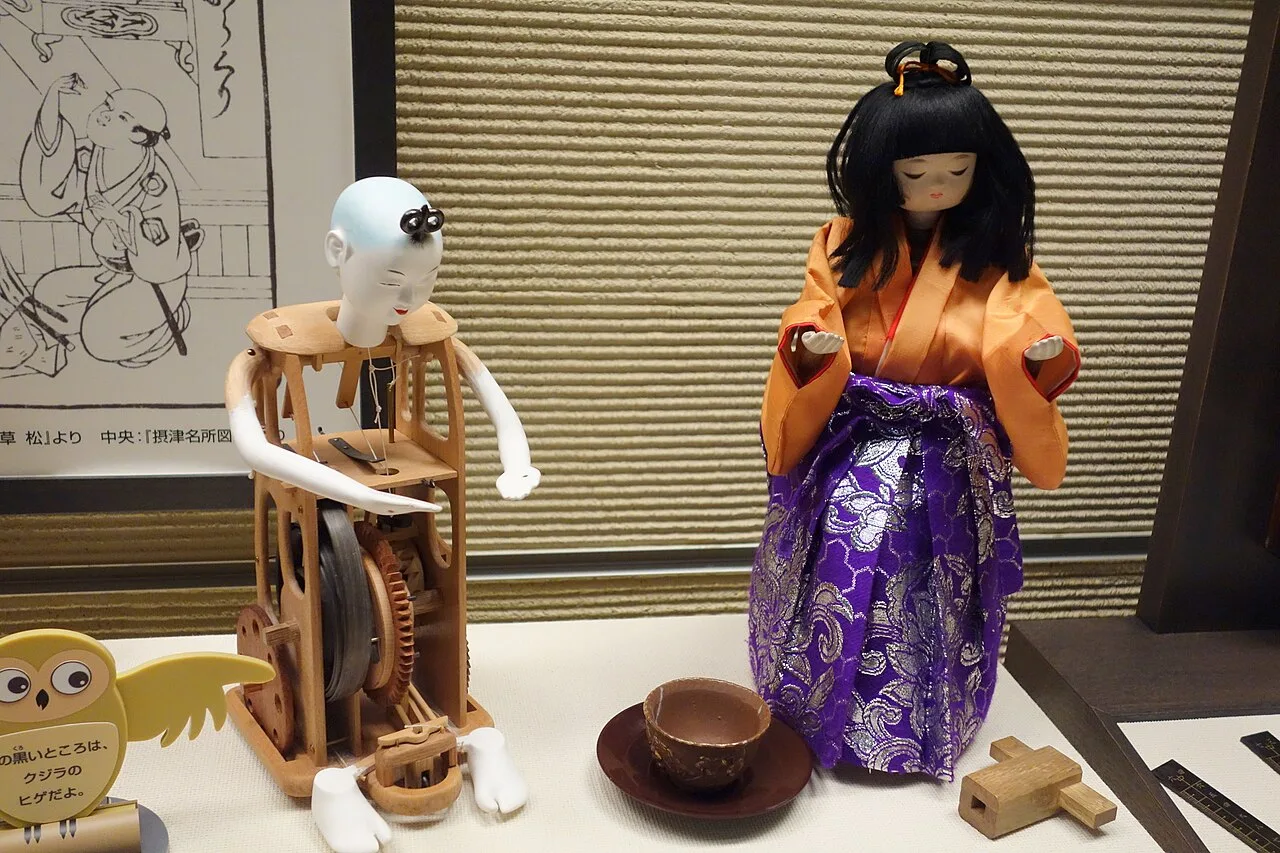
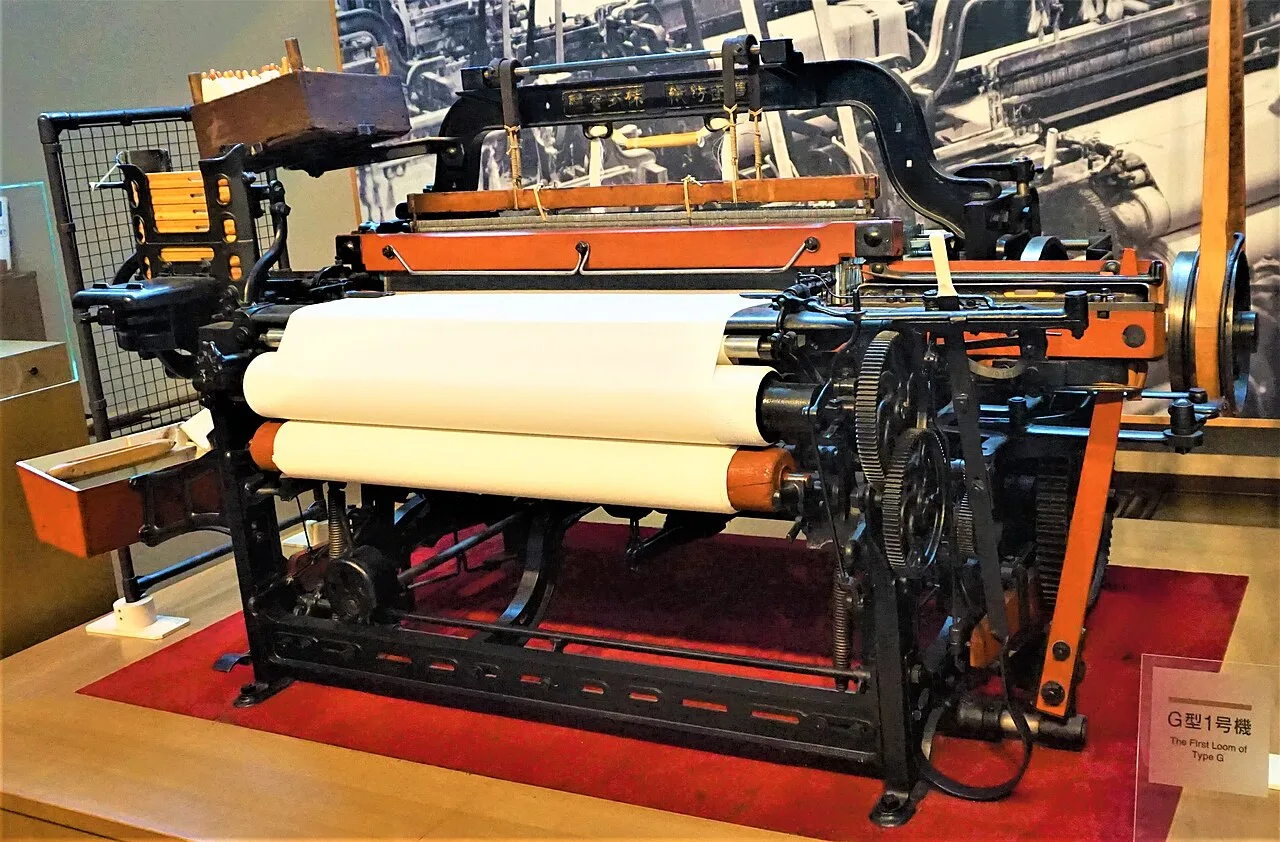
The lineage runs straight through Japanese industrial history: Edo-period 茶運び人形 tea-serving dolls (whalebone spring, wooden cams) → Tanaka Hisashige, "Karakuri Giemon," whose company became Toshiba → Sakichi Toyoda. Sakichi’s 1924 Type G loom is karakuri at industrial scale: ~25 purely mechanical mechanisms, including warp- and weft-break auto-stop — the mechanical root of jidoka — letting one operator tend 24–36 looms. Toyota’s founding machine was a karakuri. When people say jidoka has mechanical roots, this is literally what they mean: Toyota’s founding machine was a karakuri — and the auto-stop that let one weaver mind three dozen looms became the quality philosophy of the world’s most studied production system.
Type G per Toyota Industries and JSME Mechanical Engineering Heritage; doll mechanism per museum records.Here’s one. Press the button.
The machine at right is a simplified 重力返却シューター — a gravity return shooter, modeled on a real award-winner from Toyota’s Motomachi plant: a full parts tray slides down; its weight (via a counterweight on tuna-fishing line) trips a stopper; the empty tray climbs back to the operator on the return rail. Press the button. The real one — the インパネ意匠シューター — replaced an AGV run for parts delivery. Materials: pipe rack, rollers, fishing line, a weight. The company award for eliminating a robot with string and gravity: about ¥20,000. The AGV it retired cost two orders of magnitude more.
Device per Toyota Times’ Imaginative & Creative series; the animation is a schematic, not a blueprint.The whole toolbox is eight simple machines.
The basic 8 mechanisms are the whole toolbox: lever, cam, pulley, linkage, gear, screw, wheel-and-axle, inclined plane. Karakuri training rooms (からくり道場) teach them with hands-on rigs — mechanism literacy as a shop-floor skill. And the craft is in the composition: the 2022 national grand prize, 坂道のぼる君 ("Little Hill-Climber"), harvests the push you were already making — slide one empty box onto the rack and the previous box climbs to hand height. Zero watts, one clever linkage, and a queue that manages itself.
坂道のぼる君 per Toyota Industries’ award release; karakuri dojos per Toyota Times.Five real devices, five mechanisms worth stealing.
The catalog at right is all production-floor reality, not concept art: a screw feeder that counts to two with a magnet and the tool’s own weight; a cart that drives itself home on a counterweight it charged during loading; a pendulum that replaced a ¥1M powered feeder for ¥50k; a lever that cut die-lifting force 75%; a press whose wasted crank motion now manufactures compressed air. Every one is a sensor, motor or robot that never had to be bought.
Devices per Toyota Times, Toyota Boshoku, Toyota Energy case PDF and Roser’s catalog — all in Sources.There’s a national championship for this.
The national stage: JIPM’s からくり改善くふう展, held since 1994. The 2024 edition drew 105 companies, 432 devices and 7,472 visitors to Port Messe Nagoya — an industry competing on ingenuity-per-yen. Toyota Motor Kyushu runs a からくりマン ("Karakuri-man") certification — tied to promotion. Mechanism fluency is a career skill, formally. And the leaderboard tells you who takes it most seriously: Recent grand prizes: 2022 Toyota Industries’ 坂道のぼる君, 2023 Toyota Motor Kyushu, 2024 Toyota Auto Body’s 恋のエレベーター — Toyota-group companies keep winning their own game.
Contest figures per JIPM’s official history list (2024: 105 companies, 432 works).Karakuri’s second act: the carbon-neutral device.
Karakuri’s second act is strategic: Toyota Times calls it "the ultimate carbon-neutral device." Toyota targets zero-CO2 plants by 2035; Tahara reached carbon neutrality in FY2026 — and every powered conveyor replaced by gravity is permanent negawatts. It also compounds with flexible lines: a device with no power feed, no air line and no control cabinet relocates in minutes when the line reconfigures — karakuri is the natural furniture of the "simple & slim" plant.
Toyota Times Newscast; Toyota environmental reports; flexible-line synergy per plant coverage.The economics are almost embarrassing.
The economics are almost embarrassing: 20× cheaper than powered automation is typical, operators maintain what they built, and nothing with zero watts ever throws a fault code at 3 a.m. This is why karakuri devices survive audits that kill automation proposals: no capex committee, no integration project, no maintenance contract — a pipe rack, a weekend, and a team that understands its own work.
The ¥50k-vs-¥1M case per Toyota Boshoku; maintenance model per JIPM rules.Karakuri is the philosophical opposite of the dark factory.
Here is the deeper point, and the reason this guide follows our dark-factory one: karakuri is the philosophical opposite of lights-out automation. In a dark factory, automation is bought, opaque, and de-skills the floor. In karakuri, automation is built by the people who use it — every device is a mechanism lesson, a kaizen rep, and proof that the operator understands the work deeply enough to teach it to physics. If you read our Leaner Than Toyota? guide, this is the positive image of that argument: 自働化 made of wood and string.
“To be the master of the machine, you must be able to teach the machine.”
That’s Kawai Mitsuru — Toyota’s "oyaji" of monozukuri, apprentice to executive — and it is the entire philosophy in one sentence. And nothing about it requires a Toyota badge: a gravity return chute works in a hospital supply room or a warehouse pack station exactly as it works in Motomachi. The toolbox is eight simple machines and the discipline to ask: what is gravity already doing here for free? Go build one.
Kawai per 東洋経済 and Japan Times profiles. Companions: How a Toyota plant works · Parts Per Billion.
AI illustration
AI illustrationThe chain: full tray’s weight → counterweight on fishing line → stopper trips → empty tray released up the return rail. It replaced an AGV; the parts were a pipe rack, rollers, string and a weight. Award for retiring a robot with gravity: ~¥20,000.
The basic 8 mechanisms are the whole toolbox: lever, cam, pulley, linkage, gear, screw, wheel-and-axle, inclined plane. Karakuri training rooms (からくり道場) teach them with hands-on rigs — mechanism literacy as a shop-floor skill.
Recent grand prizes: 2022 Toyota Industries’ 坂道のぼる君, 2023 Toyota Motor Kyushu, 2024 Toyota Auto Body’s 恋のエレベーター — Toyota-group companies keep winning their own game.
Karakuri’s second act is strategic: Toyota Times calls it "the ultimate carbon-neutral device." Toyota targets zero-CO2 plants by 2035; Tahara reached carbon neutrality in FY2026 — and every powered conveyor replaced by gravity is permanent negawatts.
It also compounds with flexible lines: a device with no power feed, no air line and no control cabinet relocates in minutes when the line reconfigures — karakuri is the natural furniture of the "simple & slim" plant.
The economics are almost embarrassing: 20× cheaper than powered automation is typical, operators maintain what they built, and nothing with zero watts ever throws a fault code at 3 a.m.
And nothing about it requires a Toyota badge: a gravity return chute works in a hospital supply room or a warehouse pack station exactly as it works in Motomachi. The toolbox is eight simple machines and the discipline to ask: what is gravity already doing here for free?
"Manual work is the origin of skill." · "To be the master of the machine, you have to have the skills to teach the machine."Kawai Mitsuru (河合満) — Toyota’s "oyaji" of monozukuri, who rose from apprentice to executive
Every karakuri device is a mechanism lesson, a kaizen rep, and proof the operator understands the work deeply enough to teach it to physics. That is what "automation with a human touch" builds — and what a purchased robot cannot.

Ask what gravity is already doing for free.
Karakuri needs no Toyota badge — a gravity chute works in a hospital supply room or a pack station exactly as it works in Motomachi. Eight simple machines, a pipe rack, and a team that understands its own work. Build one this month.
How a Toyota plant works
The system karakuri lives inside — takt, andon, kanban, milk runs.
kaizumi.com/guides/toyota-assemblyLeaner Than Toyota?
The dark-factory question karakuri answers from the opposite direction.
kaizumi.com/guides/leaner-than-toyotaThe Five Whys
The thinking skill behind every good karakuri: understanding the mechanism.
kaizumi.com/guides/five-whys-root-cause-analysisTrain your team
AI-built lean training for your industry, your roles, your reality.
kaizumi.comFrequently asked
- What is karakuri kaizen?
- からくり改善 — solving shop-floor problems with devices that use only natural energy (gravity, human motion, springs, magnets) through simple mechanisms: lever, cam, pulley, linkage, gear, screw, wheel-and-axle and inclined plane. The rules, per Japan’s plant-maintenance institute (JIPM): low cost, no powered energy, safe — and, the defining one, built by the operators themselves. It is closely related to low-cost automation (LCA), with a self-build tradition and a distinctly playful streak.
- Where does karakuri come from?
- From Edo-period automata: tea-serving dolls (茶運び人形) driven by whalebone springs and wooden cams. The lineage runs through Tanaka Hisashige — "Karakuri Giemon," whose company became Toshiba — to Sakichi Toyoda, whose 1924 Type G loom used ~25 purely mechanical mechanisms including thread-break auto-stop: the mechanical root of jidoka, letting one operator tend 24–36 looms. Toyota’s founding machine was, literally, a karakuri.
- Is there really a national karakuri competition?
- Yes — JIPM’s からくり改善くふう展, held since 1994. The 2024 edition drew 105 companies and 432 devices to Port Messe Nagoya, with 7,472 visitors. Recent grand prizes went to Toyota Industries (2022, the "Little Hill-Climber"), Toyota Motor Kyushu (2023) and Toyota Auto Body (2024, the "Love Elevator"). Toyota Motor Kyushu even runs a "Karakuri-man" certification tied to promotion.
- Why is Toyota reviving karakuri now?
- Carbon neutrality made it strategic: Toyota targets zero-CO2 plants by 2035, and karakuri is what Toyota Times calls "the ultimate carbon-neutral device" — every powered conveyor replaced by gravity is permanent energy savings (one press-crank air harvester alone cuts 2.85 tonnes of CO2 a year). Karakuri also compounds with flexible lines: a device with no power feed or control cabinet relocates in minutes when a line reconfigures.
- How much cheaper is karakuri than powered automation?
- Roughly an order of magnitude or more is typical: a documented Toyota Boshoku pendulum feeder cost about ¥50,000 to build versus a ¥1,000,000 powered alternative — 20× cheaper — and the Motomachi gravity shooter that replaced an AGV was built from a pipe rack, rollers, fishing line and a weight. Operators maintain what they built, and a device with zero watts never throws a fault code.
- How is karakuri different from a "dark factory"?
- They are philosophical opposites. In lights-out automation, machinery is purchased, opaque, and de-skills the floor. Karakuri is automation built by the people who use it: every device is a mechanism lesson and a kaizen rep, embodying Toyota’s 自働化 — automation with a human touch. As Toyota’s Kawai Mitsuru puts it: "To be the master of the machine, you have to have the skills to teach the machine."
Founder of Kaizumi, an AI-powered Lean training platform. More about Matthew →
Updated July 12, 2026 · Drafted with AI assistance and reviewed by Matthew Savas for accuracy. Every statistic is dated and sourced (data as of 2026-07-12); device mechanics and contest figures trace to JIPM, Toyota Times and company releases; the in-page machine is a schematic, not a blueprint; and the hero and doll images are AI illustrations, labeled as such.
References
Every statistic in this guide traces to one of the sources below · data as of 2026-07-12. Chinese titles are given as published.
Definition & history
- JIPM — からくり改善くふう展: about the exhibition and the definition
- Toyota — Monozukuri Kids: karakuri, in Toyota’s own words
- Toyota Industries — Sakichi Toyoda and the Type G loom
- JSME Mechanical Engineering Heritage — the Type G automatic loom
- Wikipedia — karakuri puppets (茶運び人形 mechanism)
- Wikipedia — Tanaka Hisashige, "Karakuri Giemon" (Toshiba’s founder)
- AllAboutLean (Roser) — karakuri kaizen introduction
The contest & devices
- JIPM — contest history and results list (since 1994; 2024: 105 companies, 432 works)
- Toyota Times — Imaginative & Creative series: the Motomachi gravity shooter and plant karakuri
- Toyota Times — Imaginative & Creative series: more devices, the karakuri culture
- 豊田自動織機 — 坂道のぼる君 wins the 2022 grand prize (company release)
- Toyota Boshoku — Team Breakthrough: karakuri in manufacturing
- AllAboutLean (Roser) — karakuri examples, with mechanics
- Toyota Energy — karakuri case PDF (device mechanics)
Why now & the philosophy
- Toyota Times Newscast — karakuri as the carbon-neutral device
- Toyota — Environmental Report: plant zero-CO2 challenge
- Japan Times — "Gods edging out robots at Toyota facility": the Kawai hand-skill philosophy
- 東洋経済 — Kawai Mitsuru, from apprentice to executive: 手作業こそ技能の原点
- item — karakuri kaizen: automation with smarts (LCA and karakuri)
- 日経 — karakuri and energy-free plant improvement coverage