
Leadership rounding in healthcare: leader standard work for nurse leaders
A single-page schedule that defines when nurse leaders walk the unit, what to observe, and where findings escalate.
Nurse leaders often intend to round on patients, yet their mornings vanish into inbox triage, staffing calls, and meetings. A safety defect reaches patients because nobody was assigned to verify the workflow. Structured rounding succeeds when grounded in leader standard work: time-blocked rounds with explicit observation targets and defined escalation paths. It applies the reliable structure of clinical protocols directly to unit management.
 Case · 10 lessons · 19 minutesView the specialized training developed for a hospital nursing service
What leadership rounding with standard work means
Leader rounding involves walking the floor to observe daily operations and converse directly with patients alongside staff. Unstructured rounds often become aimless. Leader standard work introduces protected calendar windows, concrete focal points, and clear channels for resolving observations. It standardizes how supervision occurs, leaving clinical bedside judgment intact. David Mann detailed this method in Creating a Lean Culture in 2005, connecting unit huddle boards with daily operational huddles.
How much of your time to standardize
When leaders operate close to direct bedside care, their operational tasks show greater regularity. Four management tiers reach from frontline charge roles up to executive directors, each maintaining a distinct operational tempo. The higher tier evaluates whether lower tier checks function reliably rather than duplicating earlier inspections.
| Tier | Rhythm | Standardized | What they check |
|---|---|---|---|
| Charge nurse | Every shift | 80% | Every shift: review the assignment board, verify fall-risk status, check isolation precautions, track pending discharges, confirm rounding logs, and maintain a walk focus. |
| Nurse manager | Daily | 50% | Daily: protect a dedicated rounding block to confirm charge nurse checks happen and remain effective, a practice called process confirmation. |
| Director of nursing | Weekly | 25% | Weekly: review manager sheets across units to identify patterns, evaluate planned versus actual gaps, and resolve problems repeating on several floors. |
| Chief nursing officer | Monthly | 10% | Monthly: examine safety and quality trends across all inpatient services, removing systemic organizational barriers that lower leadership tiers cannot resolve alone. |
Standardized portions scale down from 80 percent for charge nurses to 10 percent at executive levels. That modest executive commitment remains essential because it maintains operational backing across every frontline level.
The one-page rounding document
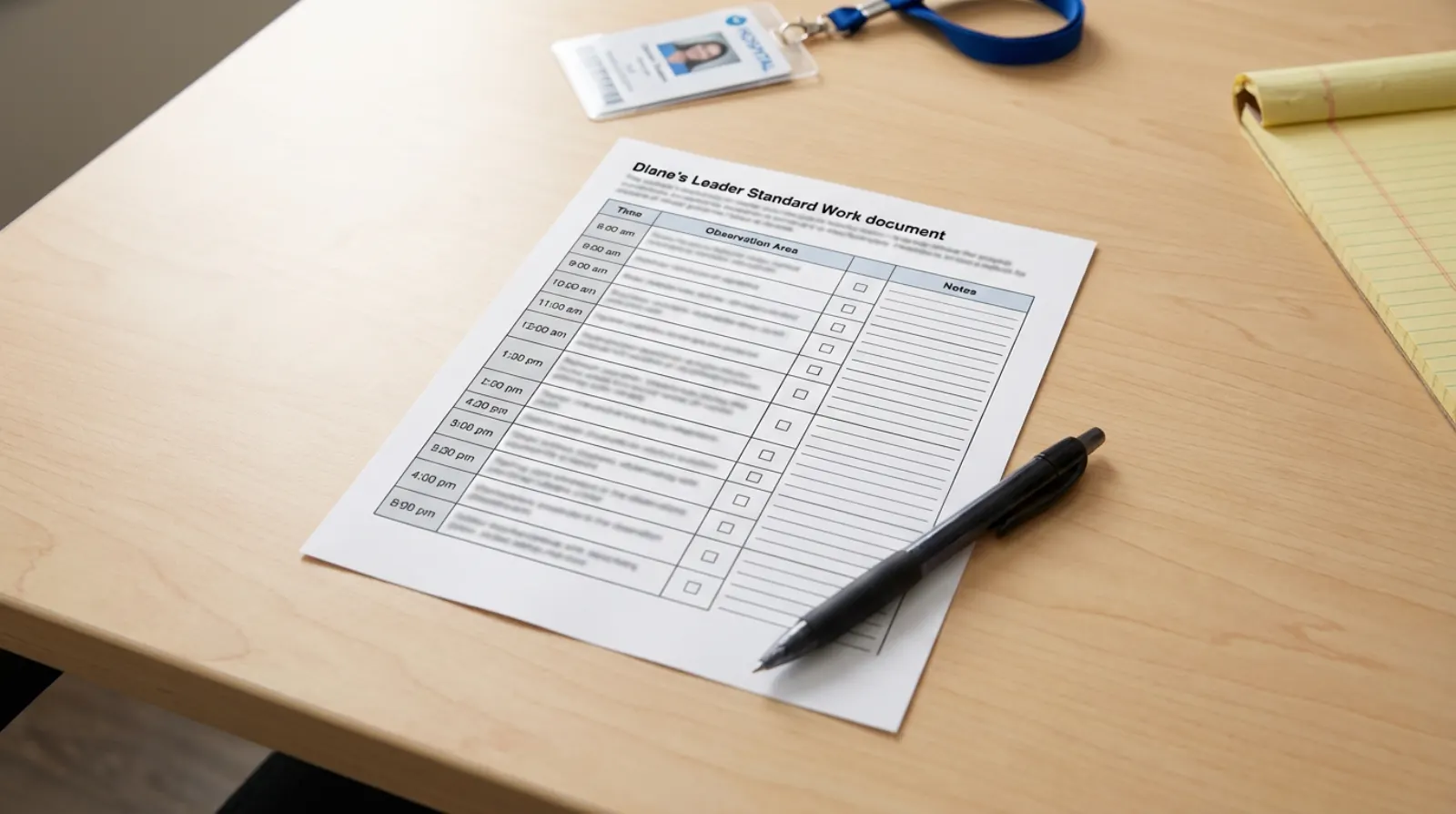
Keep this reference on a single sheet rather than inside a heavy policy binder. Six clear fields guide the routine. The sample below shows how an inpatient med-surg manager uses the tool during a typical day shift to observe care and capture operational facts.
| Time | Observation focus | Plan | Actual | Abnormality found | Countermeasure | Escalation |
|---|---|---|---|---|---|---|
| 06:45 | Attend morning huddle with charge nurse to review staffing ratios, fall risks, and planned discharges | 15 | 15 | None observed | None required | None |
| 08:00 | Inspect patient rooms for updated whiteboards, correct fall precautions, and rapid call light response | 45 | 20 | Room 16 whiteboard had no day shift goals or current pain rating | Charge nurse updated the board and placed fresh dry-erase markers | Added to huddle board quality metric, notify director if unresolved in 3 days |
| 09:00 | Stand in on the mid-morning unit huddle led by the charge nurse | 15 | 15 | No operational barriers identified | None required | None |
| 10:00 | Observe one bedside shift handoff report against the clinical transfer checklist standard | 20 | 20 | Two nurses skipped the environmental safety check during handoff | Provided immediate bedside coaching and watched staff complete the safety sweep | Add report checklist review to the unit huddle agenda tomorrow |
| 13:30 | Compare planned versus actual rounding minutes and choose the core focus for tomorrow | 30 | 30 | Leader completed 20 of 45 planned minutes after an urgent staffing call | Requested central staffing office route non-critical calls after 09:00 | Discuss schedule disruptions during weekly director review |

Planned versus actual
Planned versus actual is the field that makes standard work operate. A nurse leader who schedules 45 minutes on the floor but logs 12 discovers an informative 33-minute gap. This metric never judges individual effort. It exposes where unit time disappears, whether into meetings scheduled inside protected blocks, emergency staffing calls, or delayed bed placement. The director reviews this documented gap to remove administrative friction.
Comparing scheduled 45 minutes with actual 12 on a rounding walk reveals systemic operational friction.
What standard leader rounding is not
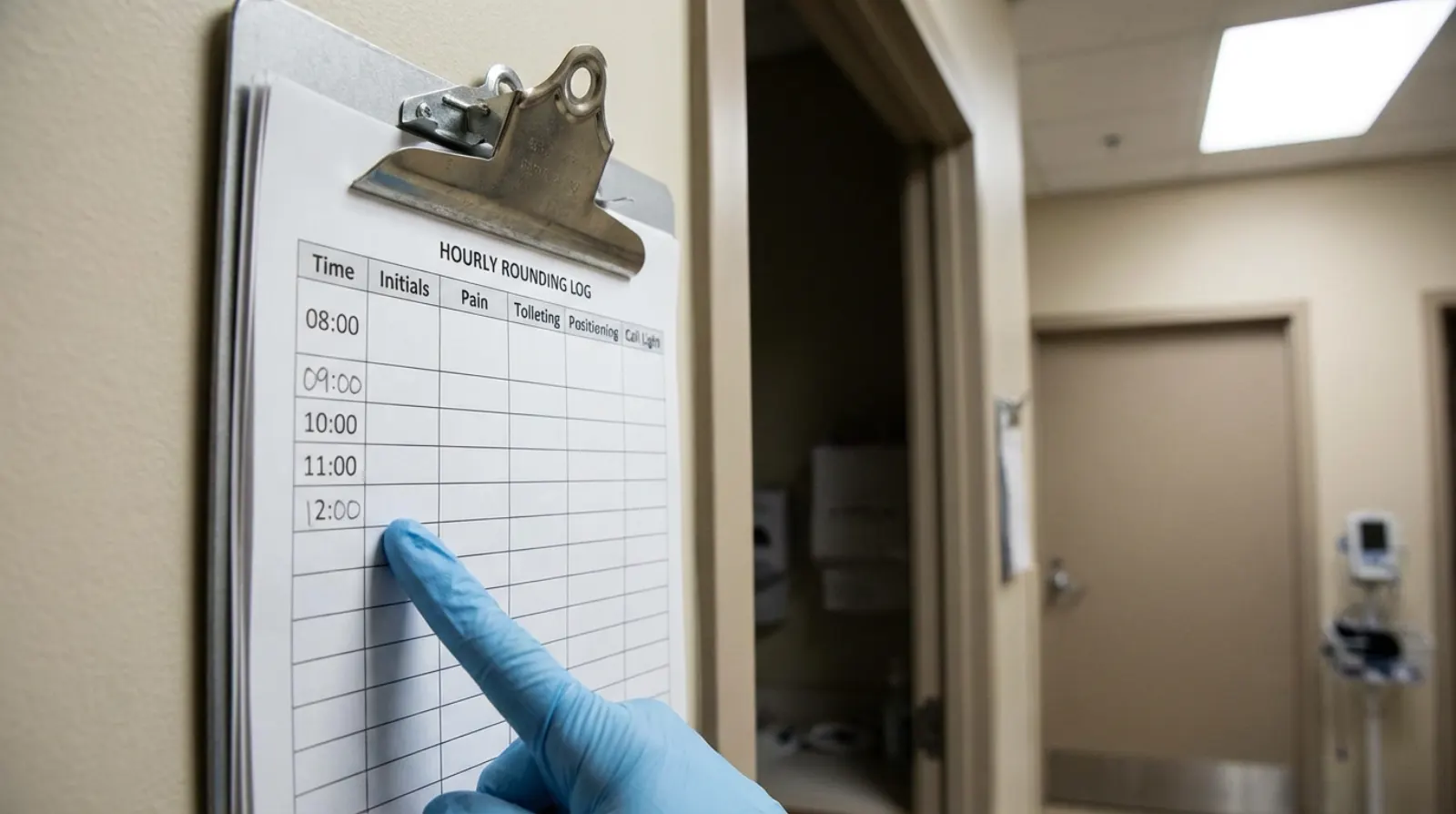
Bedside nurses visiting patients every hour for pain, positioning, and bathroom needs is direct clinical care. Leader standard work confirms those unit workflows occur reliably.
Unscheduled administrative tasks completed at random times lack protected time blocks, defined observation targets, and designated escalation channels for recurring operational defects.
A clinical policy defines how staff perform an intervention. Leader standard work establishes when leaders verify proper execution and what actions follow an observed variance.
Informal visibility maintains presence but lacks clear purpose. Without a specific observation focus, leaders ask casual questions and learn very little about unit reliability.
Missing schedule windows signals an unstructured task list. Guidance showing execution steps without verification intervals represents clinical procedure. Physical presence without defined inspection targets is merely wandering corridors.

Rounding does not work alone
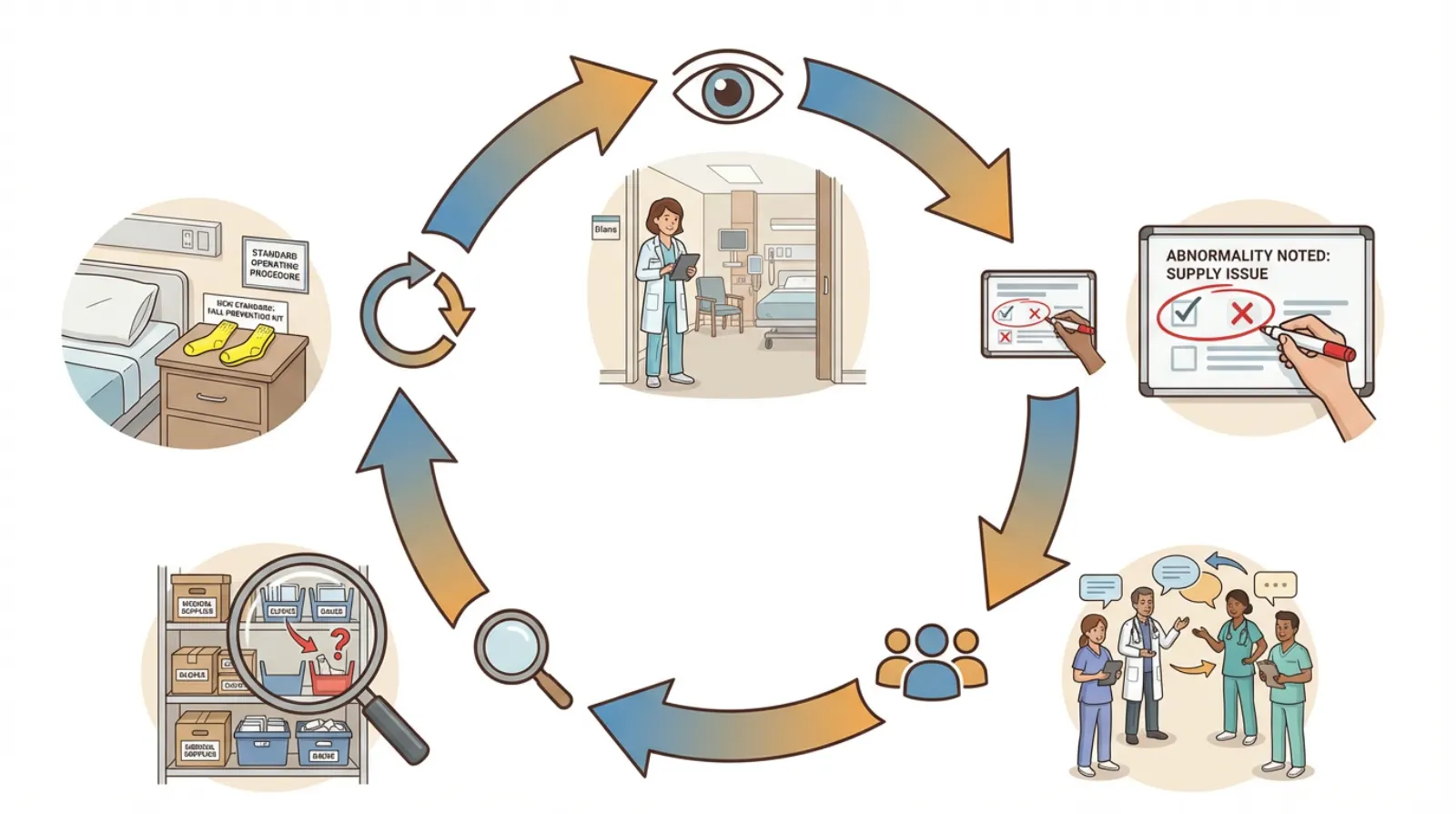
The rounding walk reveals the operational gap. The unit huddle board displays that finding to the entire care team. The daily huddle assumes ownership of the issue. Structured problem solving uncovers the underlying systemic cause. Without this continuous cycle, a manager merely resolves one isolated room issue while underlying conditions across the unit remain unchanged.
- 1ObserveThe leader identifies an operational variance during a protected walk and applies an immediate countermeasure to protect patients.
- 2Make visibleRecord the finding across designated board categories covering patient safety, care quality, throughput, operating cost, or staff engagement.
- 3Find the causeDuring the stand-up huddle, the care team asks why until revealing an underlying condition, such as supply layout or process design.
- 4Test the fixRun a disciplined plan-do-study-act cycle on one nursing station, checking results during the next scheduled rounding block.
Three ways rounding routines fade
Most leadership routines quietly erode within 90 days. Each common breakdown requires an intentional countermeasure established well before challenges begin.
Census surges, hall boarding, and sudden staff call-outs leave the clipboard untouched on a desk. Leader standard work matters most during severe strain because it exposes systemic friction. The designated countermeasure is storm mode.
Leaders turn rounding rounds into an exercise to catch errors. Frontline staff become defensive and stop sharing operational defects. The countermeasure is asking what made the work difficult rather than who failed to follow the rule.
Routines start strong for 2 weeks, slip quietly by week 6, and sit inside an office drawer by week 12. The countermeasure is a weekly director review to identify and eliminate emerging administrative barriers.
Storm mode is a focused 15-minute leadership routine containing three targeted safety checks: fall precautions active, critical medications on schedule, and charge nurse support secured. Teams establish this emergency standard during stable operations rather than improvising amidst a census surge.
Leadership standard work on 32 beds
Here is an operational deployment within an anonymous medical center. Kaizumi designed tailored instruction for their leadership group, evaluating an inpatient floor with 32 beds alongside its charge nurse, unit manager, and a service director supervising four clinical floors.
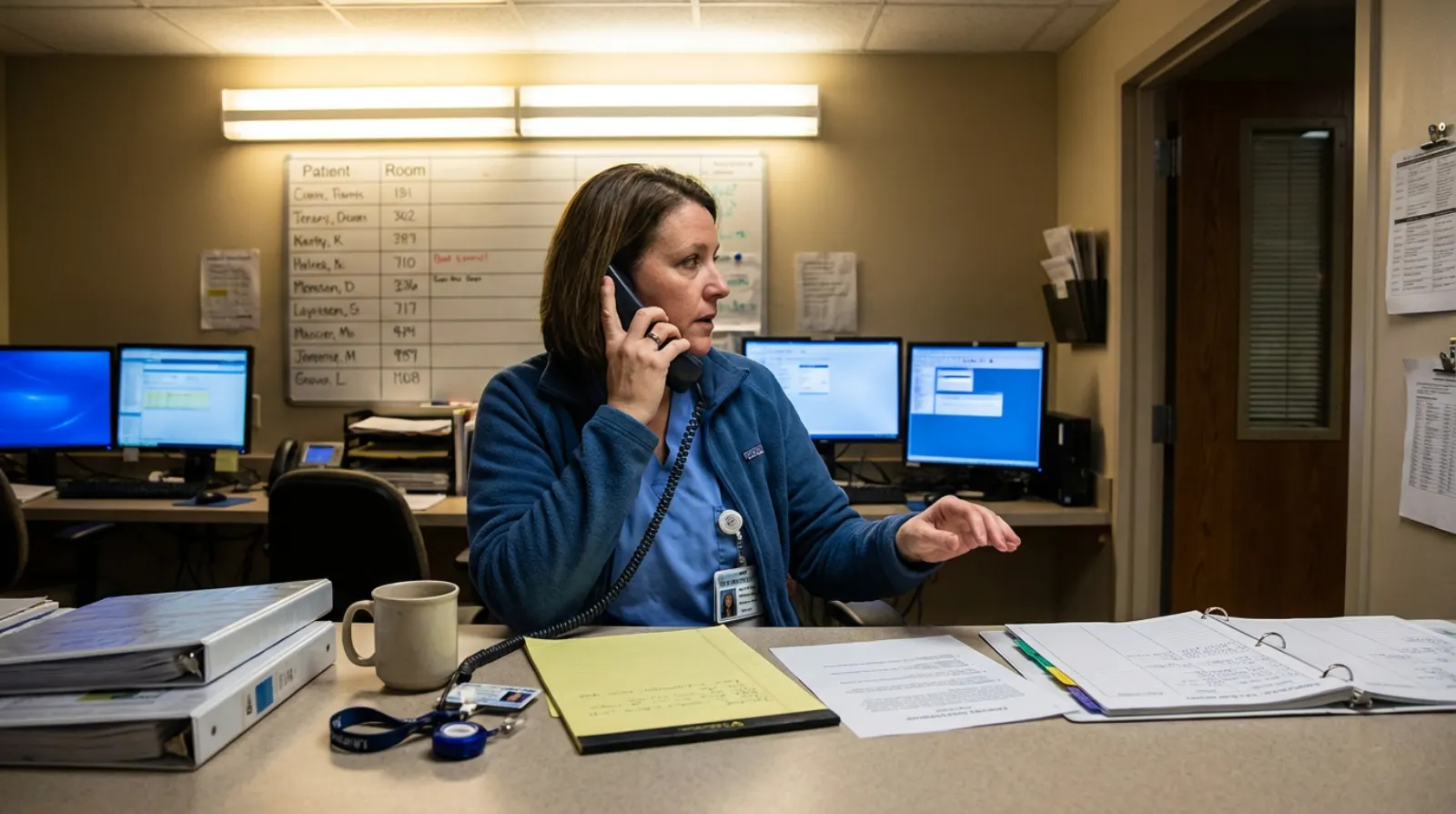
Diane begins her shift at 06:45 carrying focused intentions on a notepad. By 08:30 unread messages numbering 17, an unplanned staffing shortage, and hallway conversations keep her trapped in the office. Overnight, a patient fell in room 11. The hourly check sheet stayed blank for five hours. Staff were not negligent: nobody was tasked with verifying documentation.
Keisha reviews patient assignments alongside floor check sheets when each shift begins. Diane rounds from 08:00 to 08:45 to confirm Keisha checks occur. James reviews sheets from four unit managers every Thursday. Executives evaluate fall patterns each month across services. An incomplete log gets discovered within hours instead of going unnoticed.
During initial audits, Diane planned 45 minutes for daily unit rounds but logged only 12. Two standing administrative committee meetings had been scheduled over her protected floor time. James moved both committee sessions, resolving a schedule barrier Diane lacked the authority to change alone.
During rounds Diane discovered three vulnerable fall candidates lacking slip-resistant footwear and active bed alarms. During the team huddle staff traced the breakdown: central distribution had reorganized stock, sliding footwear to bottom shelving behind laundry bins. Bedside rooms now receive stock during patient intake. The cause was storage layout, not worker noncompliance.
The complete training curriculum follows this exact operational sequence for floor nurses and unit managers. Work through the modules in order or select individual lessons as needed.
Part 1
Part 2
Part 3
Part 4
Developed with Kaizumi for a hospital nursing department. Your organization can adopt an equivalent model.
Request a unit sampleYour first 30 days
- 1Week 1Change nothing in your routine. Shadow your schedule in 30-minute blocks, recording where you spend hours, what causes interruptions, and your ratio of planned work to reactive firefighting.
- 2Week 2Select 3 to 5 critical unit conditions that pose the highest risk of patient harm if neglected. These core clinical vulnerabilities become your primary observation focus during floor walks.
- 3Week 3Construct your one-page sheet containing protected time blocks, your observation focus, fields for specific abnormalities, and clear escalation paths back to the unit huddle board.
- 4Week 4Round using your new sheet while tracking planned versus actual minutes. Use your very first documented time gap as the initial operational problem to address with your director.
Equip your nursing leaders with standard work
This operational training program stems from real unit responsibilities, shift patterns, and recurring clinical roadblocks. Kaizumi constructs matching customized curricula reflecting the specific clinical structure, leadership levels, and distinct language of your healthcare system.
Request a unit sampleFrequently asked questions
- How does leadership rounding function within modern healthcare units?
- Leadership rounding in healthcare is a routine where supervisors visit patient units on a set schedule. Leaders observe direct care, listen to bedside nurses, and speak with patients. When tied to leader standard work, rounding runs on dedicated time blocks. Each visit addresses a clear operational focus and provides a reliable escalation path for problems that bedside teams cannot resolve alone.
- What elements make up successful leadership rounding?
- Successful leadership rounding relies on a protected calendar block and a defined observation focus. You compare planned progress against actual unit conditions and write down every abnormality you find. The visit must produce an immediate countermeasure for the shift. If an issue requires broader support, you route it through the unit huddle to trigger a clear escalation path.
- How does leader rounding differ from purposeful hourly rounding?
- Purposeful hourly rounding is direct patient care that floor nurses complete at the bedside to check comfort, pain, and position. Leader rounding is a management routine. Nurse leaders visit the floor to see whether baseline practices like hourly rounding function as intended. The goal is confirming that clinical systems support the staff rather than repeating bedside assessments.
- What percentage of a nurse leader's shift should follow standard work?
- The proportion of standard work depends on your role in the hospital. Charge nurses spend roughly 80 percent of their shift on structured routines. Nurse managers dedicate about 50 percent of their schedule to set tasks. Directors reserve 25 percent for standard routines, and hospital executives maintain about 10 percent to protect time for strategic work.
- How can hospital teams prevent leadership rounding from fading over time?
- Sustain the practice by switching to storm mode when patient volume surges or staffing drops. This temporary stance protects core checks without abandoning the floor. Replace blame with curious questions so staff talk openly about operational roadblocks. Finally, schedule a weekly review with the nursing director to evaluate logged abnormalities and hold the routine in place.
Related concepts
Related guides
Tools and templates
Sources
- David Mann, Creating a Lean Culture
- Lean Enterprise Institute, Lean Lexicon: leader standard work
Founder of Kaizumi, an AI-powered Lean training platform. More about Matthew →
Updated September 2026 · Case details draw from a real hospital course developed by Kaizumi, with the facility name removed. The sample sheet serves as an illustration. All steps follow standard leader standard work methods.