
Takt time is the pace your line has to hold to meet customer demand — the heartbeat the work is supposed to match. The formula is the easy part (available time ÷ demand). The hard part is using it: setting available time honestly, planning to real demand instead of the busiest day, measuring what each station actually does against that pace, and balancing the work so no one is drowning while the next person waits. This guide walks all of that for a manufacturing line — with a worked example, a quick health check, and the failure modes that quietly break the pace. You'll finish able to set and defend a takt time for one line this week.
Why takt time is different in manufacturing
Takt time gets taught as one tidy division problem, and that's where most lines get it wrong. On the floor, the number isn't the work — deciding what goes into it is. Three things make manufacturing the place where takt either earns its keep or becomes a poster nobody believes:
- "Available time" is a negotiation, not a clock reading. A shift is 8 hours, but the line isn't building for 8 hours. Breaks, startup, planned changeovers, cleaning, and scheduled maintenance all come out first. Use the clock instead of the real running time and your takt is a fantasy the line can never hit.
- Demand swings, and a line can't. Customers order in bursts; a physical line wants a steady beat. If you reset takt every time an order spikes, you whipsaw the line — chasing a pace that changes faster than people and machines can. Manufacturing is where production leveling stops being theory and starts being survival.
- One slow station caps the whole line. Offices route work around a backlog. A serial line can't — the slowest station is the line's pace, full stop. So takt isn't really about the average worker; it's about finding and fixing the one that can't keep up.
- Going faster than takt is also a defect. Beating the pace feels like winning. It isn't — it's overproduction, the waste that builds inventory, hides problems, and burns people out. Takt is a ceiling and a floor.
So the goal isn't a faster line. Borrowing the Toyota lens: efficiency is the consequence, not the goal. You're after work that flows at a steady, humane, repeatable pace — where the right output is the natural result, not something you sprint for at the end of the shift.
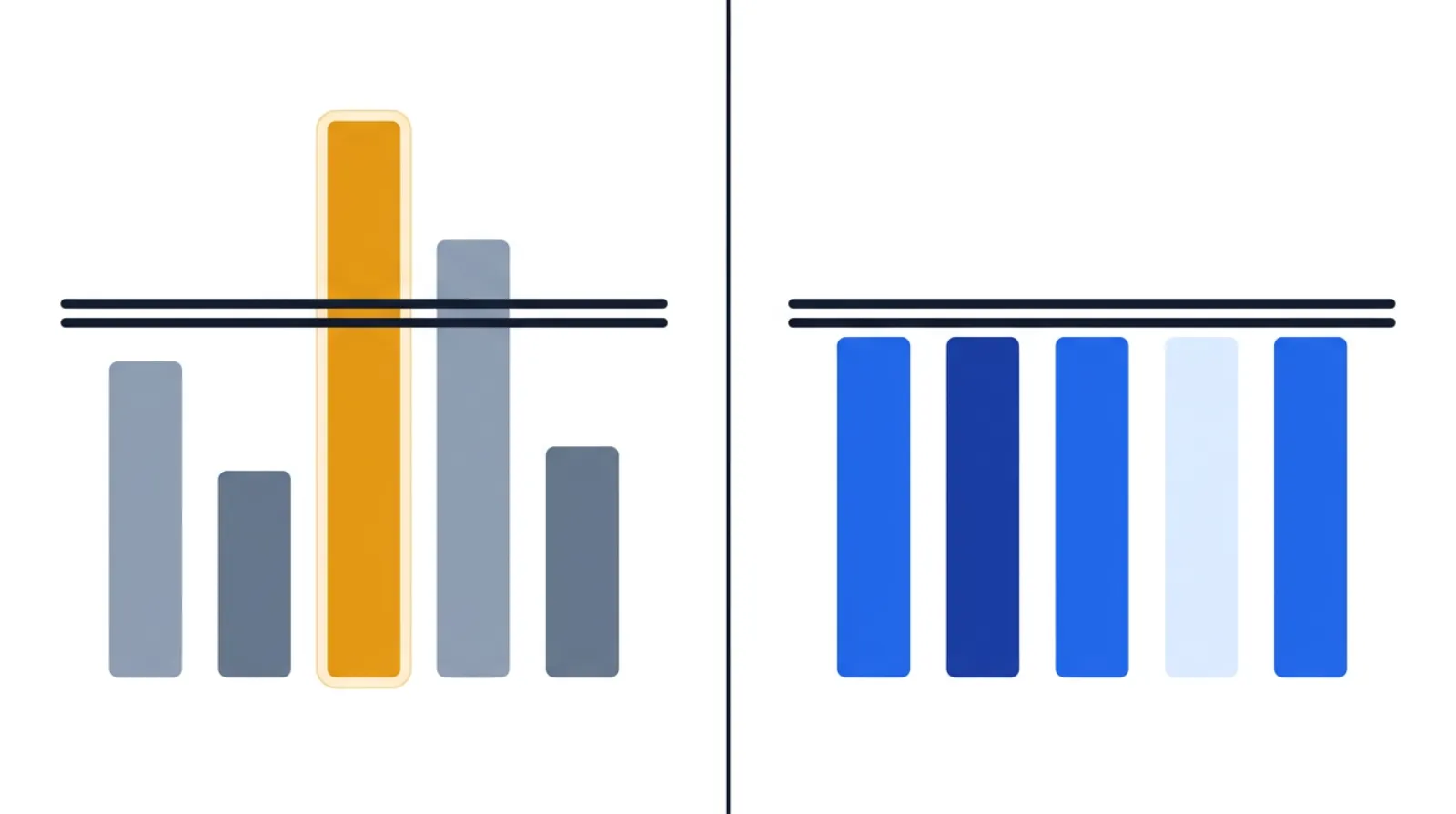
 The line's true speed is set by its slowest station, not its average one.
The one-line test for takt on any line: is your slowest station's cycle time under takt? If yes, the line can meet demand without heroics. If no, no amount of hustle will close the gap — you have a balancing problem, not a motivation problem.
The five moves that put takt time to work
Takt time isn't a five-step method like 5S — it's one number. But using it well is a sequence, and skipping a move is where lines go wrong. Here's the order that holds up on the floor.
1Start from honest available time — strip the clock down to real running time
Available time is your scheduled production time minus everything you already know you'll lose: breaks, shift handover, startup and warm-up, planned changeovers, scheduled cleaning, and planned maintenance. This is the same planned-loss thinking behind OEE — you're not pretending the line runs every second it's powered on.
Be honest here or nowhere. A common trap: a planner uses the full 480-minute shift, gets a takt that demands a unit every few seconds faster than reality allows, and the line "fails" against a number that was never achievable. Strip out the known losses first, then divide. The leftover is the time you're actually asking the line to build in.
2Set takt to real demand, then level it — Heijunka: a steady beat beats a frantic one
Pull your takt from average sellable demand — what the customer actually pulls, not what sales forecast — over a sensible window, not the peak week and not a single big order. A line tuned to its busiest day overproduces every other day; a line tuned to its average, then leveled so the daily mix is smooth, holds a pace people and machines can actually sustain.
If demand genuinely shifts (a new season, a lost or won contract), you re-set takt deliberately — change the available time (add a shift, add overtime) or change the pace — as a planned event, not a daily reaction. The discipline is: takt changes on purpose, never by accident.
3Measure actual cycle time against takt — find the bottleneck
Takt is the pace you need. Cycle time is the pace each station actually delivers. Lay every station's real, observed cycle time next to takt — not the engineered standard but the gemba reality, what actually happens on the floor, watch in hand. Now the picture is obvious: any station whose cycle time is over takt is a bottleneck that caps the line; any station far under takt is either waiting or quietly overproducing.
This single comparison — cycle time vs. takt, station by station — is the most useful chart on the floor, and it's exactly what the free takt time calculator draws for you once you enter the numbers.
4Balance the line to takt — Line balancing: move the work, then lock it down
Once you can see who's over and who's under, you redistribute. Line balancing is the craft of shifting work elements between stations so every station's cycle time lands just under takt — high utilization, but with enough margin to absorb a hiccup. The lever is the work, not the worker: you move elements between stations until the load is even.
Then you make it stick. Capture the balanced sequence as standard work for each station — the agreed best-known way to hit the pace — so the balance survives the next shift, the next new hire, and the manager who isn't watching.
5Protect the pace with stable flow — Jidoka and one-piece flow
A balanced line still drifts the moment quality or flow wobbles. Two habits protect takt:
- Jidoka — stop and fix. Build in the ability to halt when something's wrong, so a defect doesn't ride downstream and quietly eat the pace of three stations. A line that stops to fix root causes holds takt better than one that never stops but reworks constantly.
- One-piece flow, tracked by pitch. Move work one unit at a time where you can. Then track the pace in short intervals called pitch — takt multiplied by a small pack quantity, which on many lines works out to a check every 30 minutes or so. That lets you catch a slip within the hour instead of discovering it at shift's end; falling behind pitch is the early warning that something's off.
How to set your first takt time (step-by-step)
Pick one line or cell — not the whole plant — and work it end to end.
- Define the window and the demand. Choose the period (a shift, a day) and the average sellable demand for it. Resist using a spike.
- Calculate honest available time. Start from scheduled time and subtract planned breaks, startup, changeovers, cleaning, and planned maintenance. Write down what you subtracted — you'll defend it later.
- Compute takt. Available time ÷ demand. Do it in the calculator so you can change inputs and see the effect instantly.
- Observe real cycle times. Walk the line and time each station several cycles (use the median, not the best run). Record them against takt.
- Spot the bottleneck and the slack. Mark every station over takt and every station well under. That's your balancing work-list.
- Rebalance and standardize. Move work elements to even the load under takt, then write the new station standards and post them. Re-measure at the next run.
A focused single-line pass like this is a Kaizen in miniature — and it's the unit you repeat line by line.
Run your numbers now — enter your available time and demand, then add each station's cycle time to see which one breaks takt:
A worked example: one assembly line
To make the moves concrete, here's how they'd play out on a single line. The numbers are an honest hypothetical — the moves are the ones you'd actually make.
Say a line works a shift with 27,000 seconds of available time after you strip out breaks, startup, and a planned changeover, and average demand for that same shift is 450 units. That puts takt at 60 seconds per unit — the line needs to finish one unit a minute to keep pace.
Now you observe the four stations and lay their real cycle times next to takt:
| Station | Observed cycle time | vs. takt (60s) | Move |
|---|---|---|---|
| 1 — Sub-assembly | 48s | Under — has slack | Take on work from Station 3 |
| 2 — Main build | 57s | Under, but tight | Leave; little margin |
| 3 — Test & adjust | 71s | Over — caps the line | Kaizen the step; else shed work to Station 1 |
| 4 — Pack-out | 39s | Far under — waiting | Absorb a downstream element |
Station 3 is the whole story: at 71 seconds it can only feed the line every 71 seconds, so the line's real pace is 71 — not the 60 you need — no matter how fast everyone else moves. The fix isn't to tell Station 3 to hurry. Start by handing the team the bottleneck as a kaizen target: can they make the adjustment step itself lighter — a better fixture, a shorter reach, a jidoka stop that halts on a bad unit instead of slowing down to catch one? Improving the work is the first move, because it removes time instead of shoving it elsewhere. Only if kaizen can't get the step under takt do you move a work element off Station 3 onto Station 1, which has 12 seconds of slack. Either way, every station lands under 60 with a little margin and the line holds takt without anyone sprinting — the gain comes from lighter, better work, not added effort.
Use takt to drive kaizen — not layoffs
Balancing is only half of what that cycle-time-versus-takt chart is for — it's also the sharpest kaizen-targeting tool you have. The station sitting over the takt line is, by definition, your highest-value improvement target, because fixing it lifts the whole line's pace. That's why the worked example reached for kaizen before redistribution: improving the slow step removes time, while moving a work element only relocates it.
Takt hands you a second, bigger challenge. Add up every station's cycle time — the sum of cycle times, ΣCT — and divide by takt:
Theoretical operators = ΣCT ÷ takt — always round up, because there's no such thing as a fractional person.
On the line above, the stations sum to 215 seconds against a 60-second takt: 215 ÷ 60 = 3.6, rounded up to 4 — exactly what the balanced line runs. But walk a typical floor and the gap is wide: a line whose work sums to 420 seconds at a 60-second takt needs 7 operators in theory, yet often runs ten or eleven. The extra people are absorbing imbalance, waiting, walking, and rework — and that gap is a standing kaizen challenge: how close can we get to the theoretical number? The cycle-time-versus-takt chart shows you exactly where the time is hiding.
One rule makes or breaks this. You never turn that number into a layoff list. The moment takt-driven kaizen costs people their jobs, improvement stops dead — no one will surface the waste that eliminates their own role. When you free up operators, you repurpose them: onto improvement work, a new line, cross-training, or the next bottleneck. Respect for people isn't a courtesy bolted onto Lean — it's the precondition that keeps anyone willing to improve.
A simple takt-vs-cycle health check
You don't re-run a full study every week. Walk the line and answer five questions — keep it to one page so it actually gets used:
- Available time: Is the takt built on real running time, with planned losses subtracted — and would the planner defend the subtractions?
- Demand basis: Is takt set to average sellable demand and leveled, not chasing the last spike?
- Bottleneck: Is every station's observed cycle time under takt? Which one is closest to (or over) it?
- Balance: Is the work reasonably even across stations, or is someone drowning while another waits?
- Drift: Are stations following the posted standard work, and is the line tracking to pitch through the shift?
Run the takt and cycle-time comparison interactively — and see the bottleneck chart instantly — with the free takt time calculator, no spreadsheet wrangling.
Common manufacturing takt time mistakes
- Using the clock as available time. Building takt on the full shift instead of real running time creates a pace the line can never hit, then blames the team for "missing it."
- Chasing every demand spike. Re-setting takt to the busiest order whipsaws the line. Set it to average, level the mix, and change it only on purpose.
- Confusing takt with cycle time. Takt is the pace you need; cycle time is what a station does. They're different numbers, and the gap between them is the whole point.
- Treating "faster than takt" as a win. Beating the pace builds overproduction — inventory, hidden defects, burnout. Takt is a ceiling too.
- Balancing on paper, not at the gemba. Engineered standard times miss the real slow step. Time the line with a watch, use the median, and balance to what actually happens.
- No standard work to hold the balance. A line you balanced once drifts back within weeks unless the new station sequences are written down and followed.
Templates & tools
- Free takt time calculator — enter available time and demand, then compare station cycle times against takt on a bar chart to spot the bottleneck. No login required.
- Standardized Work Combination Table — balance work elements against the takt you calculated and lock in the sequence.
- Time Observation Sheet — capture real cycle times at the gemba to compare against takt.
- Value Stream Map — see where takt sits as the customer demand rate across the whole flow.
FAQ
What is takt time in manufacturing? Takt time is the pace a production line must hold to meet customer demand — the available production time divided by the units the customer needs in that time. If a line has 27,000 seconds of real running time and demand is 450 units, takt is 60 seconds: the line should finish one unit a minute. It's the rhythm the work is supposed to match, not how fast any single operation runs.
What's the difference between takt time and cycle time? Takt time is how long a unit should take to keep pace with the customer; cycle time is how long an operation actually takes. When a station's cycle time is over takt, it's a bottleneck that caps the line. When it's far under, the station is waiting or overproducing. Balancing the line means getting every station's cycle time just under takt.
How do I calculate available production time for takt? Start from scheduled production time and subtract the losses you already plan for: breaks, shift handover, startup, planned changeovers, cleaning, and scheduled maintenance. What's left is available time. Using the full shift instead is the most common reason a takt comes out impossibly fast.
Can takt time change? Yes — but on purpose, not daily. When demand shifts for real (a season, a new or lost contract) you re-set takt deliberately by changing available time (adding a shift or overtime) or the planned pace. Resetting it to chase every order spike just whipsaws the line; level the demand instead.
What happens if a station runs faster than takt? It overproduces. Running faster than the customer needs builds inventory, hides quality problems, and burns people out — it's waste, not a win. The aim is a steady, even pace across every station, not a fast one.
How many operators does takt time say a line needs? Add up every station's cycle time and divide by takt — that's the theoretical minimum number of operators, always rounded up (there's no fractional person). A line whose work sums to 420 seconds at a 60-second takt needs seven in theory. Real floors usually run well above that, and the gap is a kaizen target — not a layoff list. As you close it, you repurpose the freed-up people onto improvement work or the next line rather than cutting them.
Related concepts & guides
- Dictionary: Takt Time · Cycle Time · Line Balancing · Heijunka · Standard Work · OEE · Bottleneck Analysis
- Guides: How to Do 5S in a Warehouse · Line balancing in manufacturing (coming next) · How a Toyota Assembly Plant Works (interactive)
Sources
- Lean Enterprise Institute, Lean Lexicon: Takt Time
- Rother, M. & Harris, R., Creating Continuous Flow (Lean Enterprise Institute)