
5S in healthcare isn't about a tidy supply room — it's about making the next patient-care task faster, safer, and harder to get wrong when seconds and sterility matter. This guide walks the five steps (Sort, Set in Order, Shine, Standardize, Sustain) as they actually play out in clean supply rooms, med rooms, par carts, and on the crash cart — with a sample audit, a worked example on a unit supply room, and the failure modes that quietly kill most programs. You'll finish able to run your first 5S on one room this week.
Why 5S is different in healthcare
Most 5S material is written for a factory workbench — one operator, one station, a fixed set of tools (if you want that version, our 5S visual guide walks all five steps on exactly such a bench). A care unit breaks those assumptions, and that's why copy-pasted factory 5S so often stalls here:
- The "defect" is a patient harm. A missing item, an expired supply, or a med grabbed from the wrong bin isn't scrap — it's a delayed treatment or a safety event. The stakes change what Sort and Set in Order are for.
- Time saved is time at the bedside. Nurses can lose real minutes per shift hunting for supplies. In healthcare, Set in Order buys back time with patients, not just steps walked.
- "Shine" overlaps with infection control. Cleaning isn't housekeeping here; a cracked bin or a grimy IV-pole wheel is a contamination and reliability risk.
- People float. Travelers, float-pool nurses, and cross-covering staff work rooms they didn't set up. If every room is different, Standardize is the difference between safe and lost.
- Regulators are watching. Expired stock, unsecured meds, and blocked egress are survey findings, not just clutter.
So the goal isn't a photogenic shelf. Borrowing the Toyota lens: efficiency is the consequence, not the goal. You're after better, safer, easier care — the right supply found in seconds, no expired item in reach, no nurse improvising during a code.
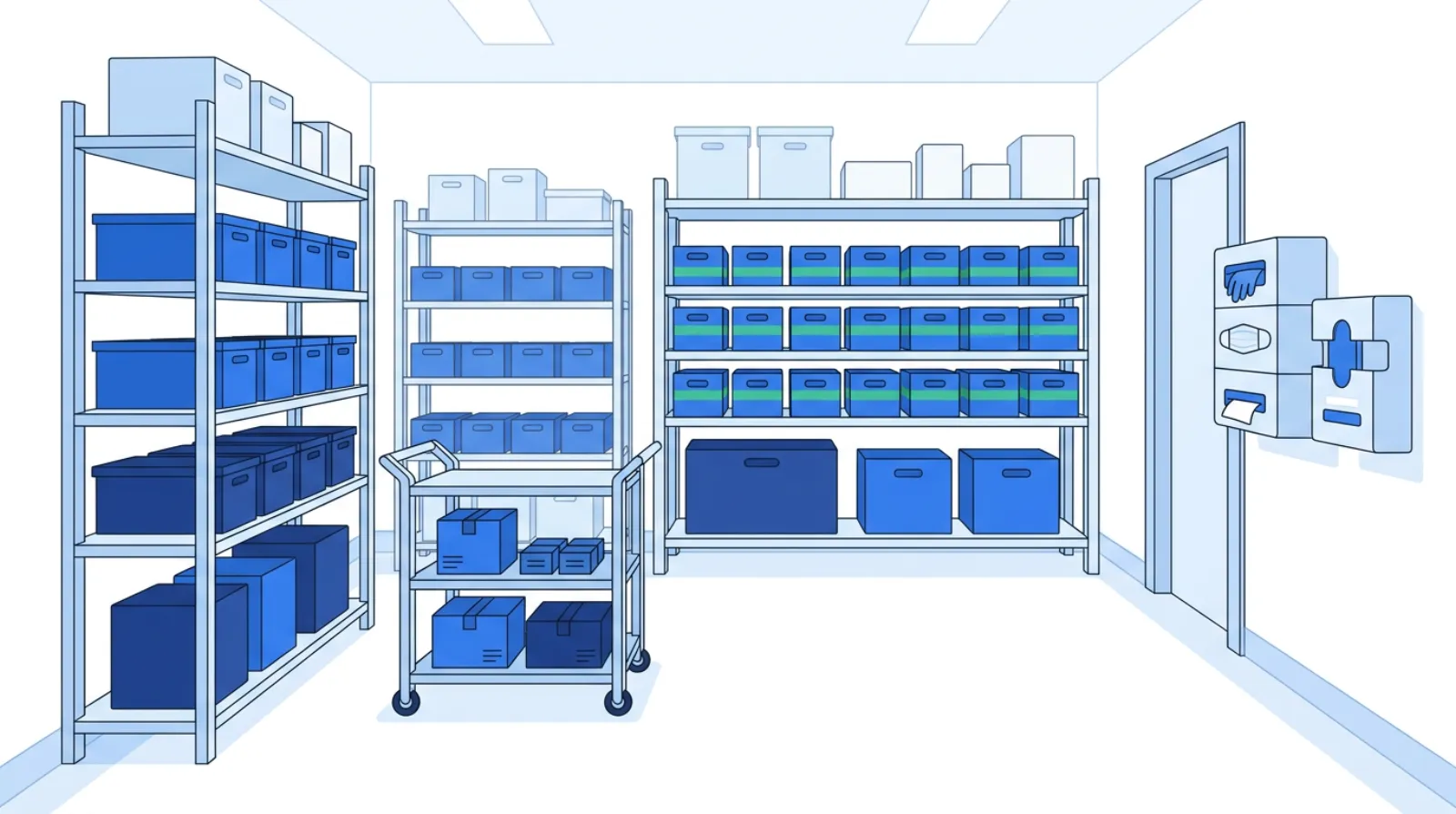 A calm, findable room is a side effect of those wins.
The one-line test for every 5S change in healthcare: does it make the next patient-care task faster to do right than to do wrong? If not, you've cleaned, not improved.
The five S's, translated for the care unit
5S comes from the Japanese Seiri, Seiton, Seiso, Seiketsu, and Shitsuke. Here's what each actually means once there's a patient involved.
1Sort — Seiri: keep only what earns its place — and is in date
Walk one room and separate what's needed here, now from what isn't. On a unit that means:
- Expired supplies and meds. The single highest-value Sort in healthcare — anything past date comes out, every time. This is patient safety and survey readiness, not tidiness.
- Obsolete or duplicate equipment crowding the clean utility room (the two broken IV pumps "waiting on biomed," the three half-working glucometers in a drawer).
- Overstock that hides shortages and ties up cash — six boxes of one catheter size, none of the size you actually use.
Use red-tagging: tag anything questionable, stage it in a marked area, and set a decision date. Healthcare-specific win: pulling expired and excess stock out of reach removes a real harm pathway — it's Muda (waste) disguised as "being well-stocked."
2Set in Order — Seiton: a place for everything, arranged by how care actually happens
This is where units win or lose. Set in Order here means point-of-care access and findability, not labels for their own sake:
- Arrange by frequency. The supplies used every shift sit at eye-to-waist height, nearest the door; rarely used items go high or in the back.
- Put emergency items where a panicked hand expects them. The single most safety-critical placement on the unit — the item you reach for in a crisis should be in the same, obvious spot every time.
- Par levels you can see. Two-bin or kanban min/max lines so a glance tells anyone when to reorder — no stockouts, no hoarding.
- Point-of-use everything. Gloves and PPE at the room entrance; sharps containers where the procedure happens; the dressing-change supplies together, not scattered across three shelves.
- Visual management. Bin labels a float nurse can read at a glance, shadow-boards for shared equipment, labels that match what staff actually call the item.
One honest constraint: medication storage, controlled substances, and crash-cart contents are governed by pharmacy and regulatory standards (automated cabinets, locked rooms, sealed carts, code-committee-approved layouts). Staff optimize within those rules, not around them — 5S makes the compliant way the easy way, it doesn't override the rule.
The measure of good Set in Order isn't neatness — it's seconds to find the right item and minutes of hunting given back to patients.
3Shine — Seiso: cleaning as inspection
In a care setting, Shine is about equipment reliability and point-of-use ownership, layered on top of clinical cleaning — not a replacement for it. Any disinfection step must use your infection-prevention–approved products and respect the EVS responsibility matrix; 5S adds the daily inspection habit, it doesn't reassign terminal cleaning:
- Daily wipe-downs of high-touch equipment (IV poles, pumps, vitals machines) that double as a check: the cracked housing, the wheel that won't lock, the frayed cord get caught early.
- Bins and shelves kept clean and intact so they don't harbor contamination.
- Shared devices returned, charged, and cleaned — not left dead in a corner when the next nurse needs them.
The principle from TPS: cleaning is inspection. When a team wipes down a pump daily, they catch the fault before it fails mid-infusion.
4Standardize — Seiketsu: make every room the same, so the right way is the obvious way
Turn the first three S's into the default — and make identical rooms truly identical:
- One layout, everywhere. Every med-surg supply room on the floor stocked and arranged the same, so a nurse pulled to cover another unit is instantly safe and productive.
- The crash cart is the canonical case. A standardized crash cart means every cart in the building has the same drawer in the same place — the defibrillator pads, the airway kit, the code meds. In a code, no one reads a label; they reach. Standardize is what makes that reach correct under stress.
- Photo standards taped inside cabinet doors showing the "to-be" state; min/max conventions documented so every room reads the same.
Standardize is what stops room 2 from drifting while room 1 shines — and it's where 5S quietly becomes a safety control.
5Sustain — Shitsuke: the only S that actually fails
Sorting a room is easy. Sustaining is where ~every program dies — usually because leaders treated 5S as a one-time clean-out instead of a habit. Sustain is built from:
- Leader gemba walks on a set cadence, using the audit, asking questions rather than issuing citations.
- Visible scorekeeping tied to the unit's daily huddle, so 5S lives where the team already meets.
- Fast follow-up on what the audit surfaces (a broken label maker, a missing PPE holder) so the team trusts the system.
- Respect for people: 5S done to a unit decays; 5S done with it sticks. Let the nurses and techs who work the room design its layout — they know exactly where the hunting happens.
Try it: stock a supply room yourself
Put Set in Order into practice. Place supplies across the room by how often and how urgently they're used, set the par levels, then run a shift and watch how your layout drives nurse hunt-time — and whether an expired item ends up within reach.
How to run your first healthcare 5S (step-by-step)
Don't boil the ocean. Pick one room — a single clean supply room, one med room, or one procedure cart — and run a focused event with the people who use it.
- Pick the room and baseline it. Photograph the current state from fixed points and capture 2–3 things you can re-measure later. For example: time two or three nurses finding an 18-gauge IV catheter, count the expired items on two shelves, and note last month's stockout count from the par sheet.
- Sort (red-tag). Walk the room with the team. Pull every expired item; red-tag anything that doesn't earn its place; stage it; set the decision date.
- Set in Order. Arrange by frequency and urgency, set visible par levels, label bins in staff language, and stage point-of-use supplies. Have the people who work the room place things — then walk a few real tasks to test it.
- Shine + make safe. Clean and inspect equipment, fix what you just exposed (a wobbly cart, a blocked panel), and confirm nothing blocks egress or access.
- Standardize. Photograph the new "to-be" state, tape the one-page standard inside the cabinet, and make the other identical rooms match it.
- Sustain. Before you leave the room, put two dates on the calendar — your week-2 and week-4 re-measures — and name who runs the first leader walk. Set the recurring audit cadence now, not "later."
A focused single-room event like this is a Kaizen event in miniature — and it's the unit you repeat room by room.
A worked example: one unit supply room
To make the five steps concrete, here's how they'd play out in a single clean supply room. The starting point is a hypothetical — the moves are the ones you'll actually make.
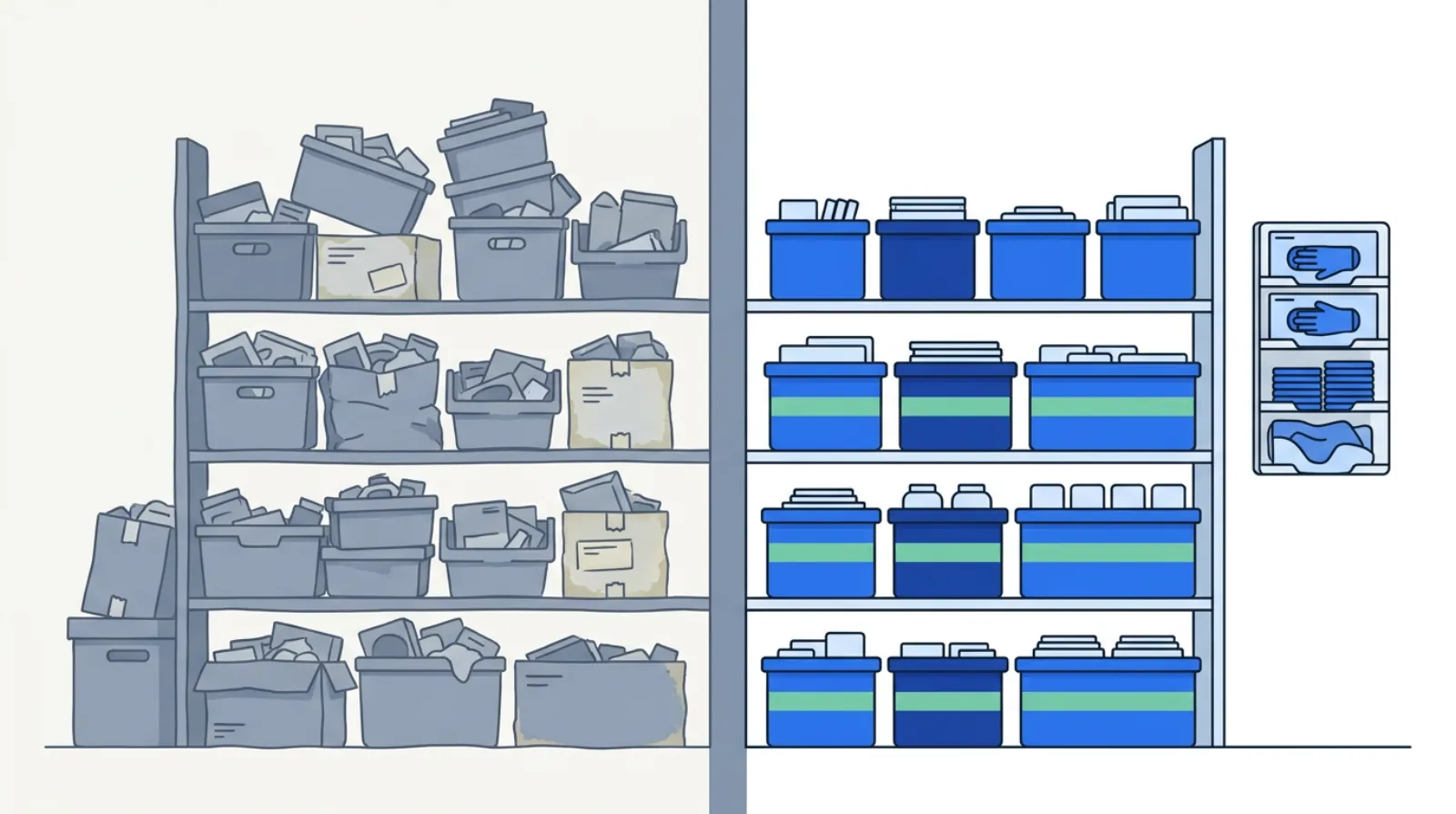
Say a 32-bed med-surg unit's clean supply room takes a nurse about 90 seconds to find three common items on a bad day, has 11 expired items sitting on the shelves at the baseline walk, and is one of three supply rooms on the floor, no two arranged the same way. The walk turns up three problems 5S addresses directly: expired and current stock mixed together, no visible par levels (so the unit both stocks out and overstocks), and high-use items buried behind rarely used ones. (Those baseline numbers are illustrative — yours come from step 1.) Here's how each step responds:
| Step | Change | Effect |
|---|---|---|
| Sort | Pull all expired items; red-tag obsolete equipment | Removes a harm pathway, frees shelf space |
| Set in Order | Move high-use supplies to eye level by the door; add two-bin par lines | Cuts time hunting, prevents stockouts |
| Shine | Clean and inspect bins and shared equipment | Catches contamination and faults early |
| Standardize | Photo standard inside the door; make all three rooms match | A float nurse is safe in any room |
| Sustain | Weekly audit + leader walk on the calendar before you leave | Keeps the gains from eroding back |
The gain doesn't come from working harder — it comes from removing the hunting and ambiguity that pulled nurses away from patients. Standardizing the layout across all three rooms usually takes the biggest bite, because a nurse who covers another room no longer has to relearn it. Get the right supply to also be the fastest supply to find, and both time-at-bedside and safety follow.
A simple healthcare 5S audit
Score each room 0–5 on five questions, walked weekly. Keep it to one page so it actually gets used:
- Sort: Is everything in the room needed and in date? Any expired stock or red-tag items past their decision date?
- Set in Order: Does every item have a labeled home? Are high-use and emergency items easy to reach? Are par levels visible?
- Shine: Are equipment and bins clean, intact, and functioning? Daily checks done?
- Standardize: Is the one-page visual standard posted — and do the other identical rooms match it?
- Sustain: Are scores posted, leader walks happening, and surfaced issues closed out?
You can run this scorecard interactively (and save your scores) with the free 5S audit tool — no spreadsheet wrangling.
Common healthcare 5S mistakes
- Cleaning instead of improving. A spotless room with high-use items still buried in back missed the point. Always return to the test: faster to do right than wrong?
- Labels as theater. Labeling bins but not arranging by frequency or setting par levels = effort with no time-at-bedside or safety payoff.
- Standardizing one room, not the set. The safety win is identical rooms. Fixing one and leaving its twins different leaves the float nurse just as lost.
- Doing 5S to the unit. Layouts imposed from an office drift back within weeks. The nurses and techs know where the hunting happens — let them design the room.
- No sustain plan before you start. If the audit cadence and leader walks aren't scheduled before the event ends, the room regresses. Sustain is the program.
- Boiling the ocean. Rolling 5S across the whole hospital at once guarantees shallow, short-lived results. One room, done well, repeated, wins.
Templates & tools
- Free interactive 5S audit tool — score rooms, track them over time, no login required.
- The 5S numbers game — the timed exercise to run before a rollout. Three rounds on the same sheet, and the only variable is how the numbers are organized. Play it in the browser or print the facilitator card.
- Play the 5S arcade game — a fast visual-management challenge: keep the line running as the system speeds up.
- Related: Visual management and Kaizen events for the improvements 5S surfaces.
FAQ
What does 5S mean in healthcare? The five steps — Sort, Set in Order, Shine, Standardize, Sustain — applied to care environments: removing expired and unneeded stock, arranging supplies by how care actually happens, keeping equipment clean and reliable, making every identical room the same, and sustaining it through audits and leader walks.
How do I start 5S on a unit? Pick one room (a clean supply room, med room, or procedure cart), baseline a few numbers and photos, then run Sort → Set in Order → Shine → Standardize → Sustain on just that room before expanding to its twins.
Why does 5S matter for patient safety? Because the "defects" it removes are harm pathways — expired supplies in reach, a med grabbed from the wrong bin, a crash cart laid out differently than the one a nurse trained on. Standardized, in-date, findable rooms make the safe action the easy action.
Is 5S just housekeeping? No. A clean shelf is a side effect. The goal is faster, safer, easier care — seconds to the right supply, no expired item in reach, no improvising during a code. If a change doesn't make the next task better, it's cleaning, not 5S.
Related concepts & guides
- Dictionary: 5S · Red-Tagging · Visual Management · Gemba Walk · Muda
- Field guide: How to Do 5S in a Warehouse — the same five steps in a very different setting.
Sources
- Lean Enterprise Institute, Lean Lexicon: 5S
- Agency for Healthcare Research and Quality (AHRQ), Patient Safety Network glossary